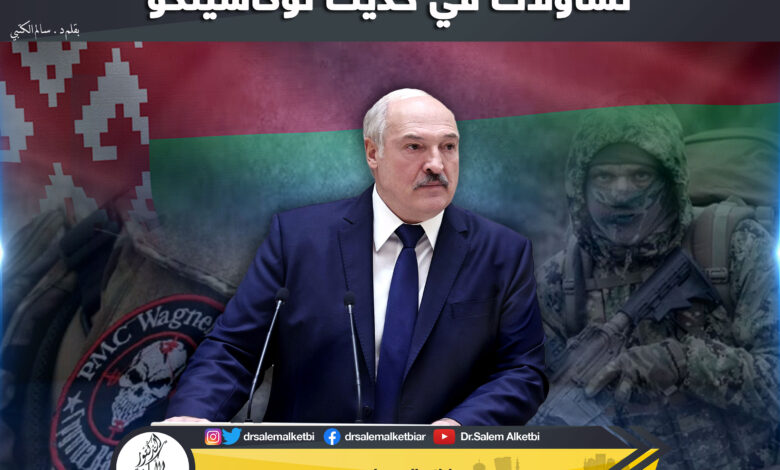
In a recent address at the Independence Palace in Minsk, Alexander Lukashenko, the President of Belarus, invited a select group of journalists for a “conversation.” Lukashenko’s speech and his responses to the journalists’ inquiries have sparked intrigue and raised numerous inquiries, leading to diverse interpretations.
One noteworthy aspect of Lukashenko’s speech that captured my attention is the Belarusian government’s proactive step in inviting a limited number of journalists to engage with the President directly. This move warrants further scrutiny and investigation, particularly when considering Lukashenko’s own statements, which suggest meticulous planning in terms of the objectives intended to be achieved and the specific messages intended to be conveyed to concerned parties, particularly in Western capitals.
President Lukashenko raised a pivotal issue in his address, debunking the rumors that Yevgeny Prigozhin, the head of the Wagner private military company, had relocated to Belarus following the conclusion of the mutiny. Lukashenko clarified that, instead, Belarus facilitated a mediated relocation of Prigozhin and some of his fighters through negotiations with the Kremlin in order to quell the uprising.
Lukashenko explicitly stated that the Wagner fighters remain stationed in the camps they retreated to after departing from Bakhmut. He asserted that their leader is either in Saint Petersburg or potentially in another undisclosed location, but certainly not in Belarus. Furthermore, he underscored that the Belarusian agreement and mediation efforts are ongoing and have not ceased. These revelations open up a range of possible scenarios, suggesting that the entire play is still unfolding, with the final scenes yet to transpire.
To avoid further mystification surrounding the Wagner incident, let’s say that the speech delivered by the President of Belarus matters both in its timing and the underlying messages it conveys. Alexander Lukashenko’s deliberate act of introducing ambiguity regarding the whereabouts of the Wagner leader is not a mere coincidence but rather a calculated move executed as part of a premeditated scenario. Lukashenko is well cognizant of his role as a key player within the entire process.
In addition, Lukashenko made a noteworthy statement when he expressed his belief that no one emerged as a hero from the uprising. This remark was in response to the assertion made by the official Russian channel regarding President Vladimir Putin having emerged victorious in the recent events. While this statement may appear as a facade at first glance, it is my firm conviction that it is intentionally crafted and potentially forms an integral part of the planned outcome, particularly aimed at confounding Western powers and inciting disruption.
Lukashenko, being a close ally of Putin, whom he referred to as “my brother President Putin” during the same meeting, would not risk jeopardizing his relationship with Putin or casting doubt on Putin’s political standing. Hence, it is more plausible to consider that Lukashenko’s statements align with his assumed role in shaping the outcome of the mutiny.
Furthermore, Lukashenko explicitly stated, “Not Prigozhin, not Putin, not Lukashenko. There were no heroes.” This declaration emphasizes his perspective that no individual, including himself and his allies, emerged as heroic figures in the events under scrutiny.
Additionally, Lukashenko highlighted a key lesson to be learned from the situation: “If we create armed groups like this, we need to keep an eye on them and pay serious attention to them.” By positioning himself at the core of the event as a key figure responsible for managing the repercussions of the rebellion, Lukashenko effectively demonstrates respect for his ally without undermining Putin. He skillfully navigates to achieve the desired strategic objectives of the conversation while preserving President Putin’s authority and image in front of a broader audience.
Lukashenko’s speech presents a challenging task of definitive interpretation, leaving us with more questions than answers. Thus, it is evident that the concluding chapter of the Wagner uprising narrative has yet to be written. However, it becomes apparent that Yevgeny Prigozhin, the leader of the group, may not be the sole casualty of the uprising. Lukashenko’s allusions to governmental control over armed groups suggest the potential involvement of other actors within the Russian system, with the exception, of course, of President Putin.
In most scenarios, Yevgeny Prigozhin will bear the consequences of the uprising, whether it was orchestrated with the Kremlin’s consent or an authentic rebellion. Nonetheless, the Wagner group will remain intact and unscathed. Russian President Vladimir Putin will exploit the events to tighten his grip on power, eliminate his critics, and purge individuals who are deemed disloyal or incapable of advancing his objectives, including securing a decisive victory in the Ukraine conflict.
It is crucial to acknowledge the close friendship and mutual trust between Putin and Prigozhin. Despite the uprising, the Wagner chief explicitly stated that his intention was not to target President Putin as he advanced towards Moscow. Instead, he claimed his objective was to hold accountable those officials who had made grave unprofessional errors in the Ukraine conflict. Given Wagner’s notable victories in Bakhmut and other Ukrainian cities, despite their limited weaponry, Prigozhin’s skepticism regarding the competence of senior Russian leaders may resonate within the Russian leadership’s considerations.
It is highly likely that the Wagner saga is far from over, and the fate of its leader, Yevgeny Prigozhin, remains concealed within the intricacies of the uprising operation.
The covert happenings that unfolded during the 24-hour period of the rebellion have become highly classified secrets within the Russian state, making them immensely challenging to unearth both presently and in the future. However, when viewed comprehensively, these events do not align with the narrative that has been interpreted by some in both Eastern and Western circles, suggesting that a rebellious military force of approximately 25,000 individuals was on the brink of launching an assault on the Kremlin.