On September 17, 2001, a few days after the September 11 attacks, then President George W. Bush received a message from late Sheikh Zayed Bin Sultan Al Nahyan expressing the official stance of the UAE on terrorism. “Terrorism is execrated in Islam and other Abrahamic religions,” it says. The UAE has a firm stance on this criminal phenomenon and has been actively engaged in a series of international counter-terror campaigns since 2001. “Our position on terrorism is steadfast and our involvement in the war against it continues, because we believe that this is a serious global problem that’s brought about by obscurantist ideology, and that causes unjust damage” said Sheikh Khalifa bin Zayed Al Nahyan, President of the UAE, “in this context, we call for removing the roots of this evil, namely international tensions, poverty and hunger. Such frustration can be exploited by extremists and terrorists. And while security enforcement by many States is important, it must go hand in hand with a political approach aimed at preventing terrorists from exploiting regional conflicts and international instability to justify their actions.”
The UAE has had a comprehensive strategy for the terrorist threat since 2001 and even before. The strategy views terrorism as a global phenomenon that’s not specific to one religion, nationality or State. Although the inherently moderate religion of Islam condemns this criminal practice, terrorist organizations appeal to faith to justify such acts. The UAE has repeatedly called for the de-Islamifying terrorism and for counter-terror collaboration to controvert the civilization clash narrative promoted by radicals, be they Muslims or Westerners. The UAE’s strategy also considers terror a global threat that compromises security and stability as well as the coexistence on which many countries are established. It also strives to tear apart the social fabric of nations and societies by spreading poisonous ideas among members of different religious groups. The war against terrorism is a global war that transcends the security and military measures to include intellectual, cultural, educational, media and economic components. Any plan to eradicate terror will not achieve its objectives unless the State-sponsorship of terrorism, from financing to hosting violent radicals, is effectively addressed.
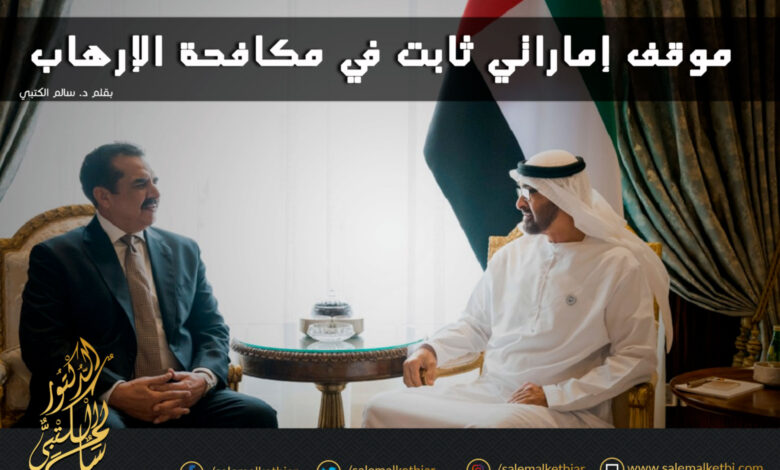
Upon His Highness’ recentl meeting with General Rahil Sharif, the military commander of the Islamic Military Counter Terrorism Coalition, Sheikh Mohammed bin Zayed Al Nahyan, Crown Prince of Abu Dhabi and Deputy Supreme Commander of the UAE Armed Forces, reaffirmed the UAE’s stance on terrorism. “The UAE continues to work with regional and international partners to address terrorist groups and all extremist ideologies that spread chaos and unrest all over the world.”
Seventeen years after the September 11 attacks and global war on terror, the country’s contribution can still be seen. It did not change, nor did the Emirates use terrorism to achieve any interests as do some of the countries sponsoring terrorism and pushing regional political agenda against the interests of several other countries in the Middle East.
The UAE, represented by its wise leadership, never compromises shared principles and values and has doubled down participation in the war against Daesh, the Houthis and Al Qaeda in Yemen, while continuing to back sister Arab countries to address local terrorism.