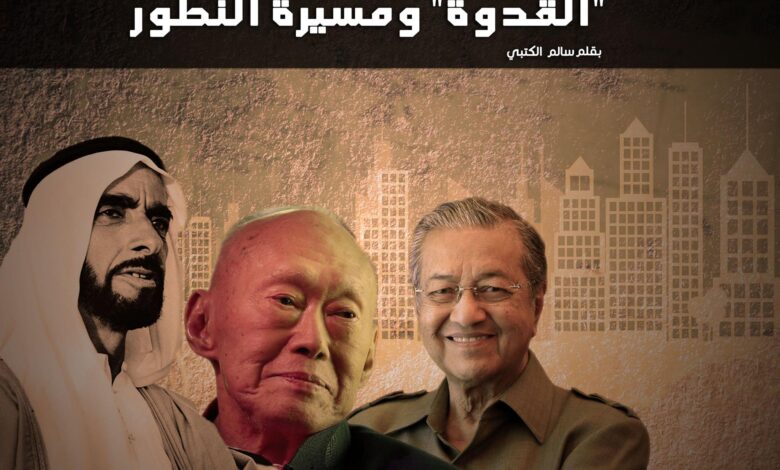
Various countries had experiences of development that were led and designed by pioneer thinkers with great determination and unshakable faith in in the popular potential to challenge hardships and achieve their dreams and ambitions.
Malaysia, Singapore and the UAE, are inspirational examples in this field. Their leaderships played critical roles in certain historical phases, and taken their country from one stage to another completely different. They did not contribute to the mere qualitative development, but rather succeeded in driving a substantial shift from the stage of hard time to the stage of model making.
Mahathir Mohamad, the historical leader and commander of the modern renaissance experience of Malaysia, is considered by some to be the founder of modern Malaysia. He led the country since 1981 until 2003. For 22 years, Malaysia experienced one of the top economic growth rates in Asia, becoming one of Asian Tigers. Lee Kuan Yew, the first Prime Minister and spiritual father of Singapore by virtue of his historic role in transforming the small island of about 700sqkm into a financial and commercial center indispensable for the global economy, and one of the richest countries in the world .
Led by the late His Highness Sheikh Zayed bin Sultan Al Nahyan, the pioneer of progress in the modern era, the UAE experienced an exceptional process of development. He made a barren desert area into a federal state with a unique and sophisticated development experience.
The experience of development in the UAE is exceptional as role models continue. Also, the cultural, humanitarian and development approach is sustainable. our wise leadership, led by His Highness Sheikh Khalifa bin Zayed Al Nahyan, President of the UAE and His Highness Sheikh Mohammed bin Rashid Al Maktoum, Vice President, Prime Minister and Ruler of Dubai and His Highness Sheikh Mohammed bin Zayed Al Nahyan, Crown Prince of Abu Dhabi and Deputy Supreme commander of the armed forces, continues to move along the path of development and modernity with innovative plans and ideas, giving an immense momentum to the development experience in the UAE. We have as well as the historical role models in the field of women’s work, family and social affairs represented by HH Sheikha Fatima bint Mubarak, Chairperson of the General Women’s Union, Supreme Chairperson of the Family Development Foundation and Chairperson of the Supreme Council for Motherhood and Childhood Umm Al-Imarat.
The notion of examples and role models is well-established in modern experiences of development in different countries. Peoples are in need of inspirational leadership with a high level of self-confidence. Self-assurance cannot come from propaganda or flimsy slogans. It is the product of years of hard work for the benefit of everyone. Trust results from achievements and the ability to act and to translate ambitions to deliberate operational plans in line with the human and material resources available.
A few days ago, we celebrated the UAE Women’s Day. A lot of the statements were made on this occasion. They all agree that HH Sheikha Fatima bint Mubarak is ‘inspiring model’ in the rise of the UAE. Not to exaggerate, it is a reality confirmed by both Emiratis and visitors.
There is a real ‘renaissance’ for Emirati women, the fruit of decades of planning and work. Emirati women succeed in making the exception while preserving social, cultural and civilizational values. They have also reached high levels in education and human development, high-powered political and administrative positions, and active roles in various sectors of production and labor.
The role of women in the UAE is not just an additional manifestation of overall development, it is a central part indispensable to governance. They work in the police, security and the government. We cannot imagine all these sectors without active women management on a daily basis.
Role models made it possible to achieve all the said results. Women leaders have provided support for Emirati women through formal and informal institutional channels, and have countless efforts to bring about substantial socio-cultural transformations. Their efforts succeeded as their plans were true to the culture, values and ethics of the society. There lies one of the secrets and peculiarities of the developing Emirates.
Planning for tomorrow, but faithful to yesterday, the country is quite eager to give progress a peculiar touch of local ethics and values. Our nation transformed while preserving idiosyncratic values. Unlike other countries in the region and the world the Emirati character remained unaffected by progress.
Leading by example and being a role model crucially contributed in the transformation. The impact that our historical figures made to progress should be methodically studied. The stories of those to whom we owe a lot need to be addressed at universities and academies to learn from them and keep them in our collective memory. Scholarly documentation is better than certificates and testimonials, and our country encourages academic work, so it is important make specialized and comprehensive studies about our inspirational progress makers.