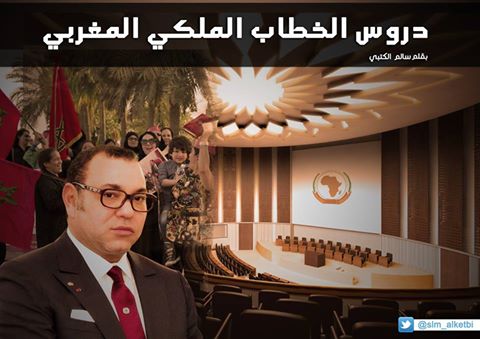
The speech of His Majesty King Mohammed VI of the brotherly Kingdom of Morocco – May God grants him victory – to his people recently, for the 63rd anniversary of the Revolution of the King and the people, contained many vital points, and is worth a lot of pauses to draw lessons from it.
At the forefront of these lessons is the link between the past and the present. Great leaders do not overlook this link for many reasons and considerations, the most important of which is continuity of historical and identity flow in the arteries of the collective memory of nations and peoples, and the emphasis on assimilating the past vocabulary and truths in dealing with reality and building future strategies, as well as evoking the moral values and principles “that inspired previous generations,” as stated in the speech. Therefore, His Majesty has used a smart historical gateway to talk about the deep fraternal ties between the Moroccan and Algerian peoples, stressing that history involves meanings and facts that confirm the link between Morocco and its Maghrebi and African surroundings.
This talk was in turn an entrance needed to call for a revival of the spirit of solidarity among the Arab peoples, including of course the people of the Maghreb region, in order to meet the developmental and security challenges alike.
There is no doubt that the link between what is Arabic and what is African, and the search for commonalities between these two areas, reflects the depth of the spirit of cooperation and communication among our brothers in the Kingdom of Morocco, which is so precise and accurate a strategic vision because the magnitude of the challenges faced by countries in the current era is no longer smooth or clear in a way which facilitates dealing with it and addressing it, but it has become so complex that it dictates the need for cooperation and collaboration in order to eradicate the sources of danger, to meet the challenges and to address the causes and their tributaries at all levels.
His Majesty King Mohammed VI spelled out many critical issues in his speech, as he summed up the developmental problems experienced by the African people, such as underdevelopment, poverty, resorting to illegal migration, wars and conflicts, and diving in the arms of extremist and terrorist groups, as these issues are all related one to another and need to be addressed in an integrated and holistic way to achieve security and stability in the African continent.
There is no doubt that the keenness of the Moroccan monarch to intensify Morocco’s attention to the suffering of the African people, underlines the earnestness of Morocco in the performance of its vital desired role as an influential and active member of the African Union. And the recent return of Morocco to the Union after a long absence means that the will to compensate for the past and to actively contribute to the advancement of African peoples, and the sharing by the African milieu of Moroccan Kingdom’s concerns and difficulties and its looking for serious solutions to them, honestly translates King Mohammed VI message to the twenty-seventh summit of the African Union held in the Rwandan capital, Kigali, as he said in that message that “Morocco is heading today, with determination and clarity, towards returning back to its institutional family, and continuing to assume its responsibilities with greater enthusiasm and with full conviction.” This matter was also confirmed by the King in his recent speech to the Moroccan people when he said, “And our decision about the return of Morocco to its natural place, within its institutional continental family, is the embodiment of this commitment to continue to work on the support of its peoples’ issues.” And he added in very significant and important phrases “Africa for Morocco, is more than just a geographical affiliation and a historic bonding. It is honest feelings of love and appreciation, deep and spiritual humane links, fruitful cooperation relations, and concrete solidarity. It is the natural extension and the strategic depth of Morocco, and this multi-dimensional link puts Morocco in the heart of Africa, and puts Africa in the hearts of Moroccans. It is what made us put it at the heart of the foreign policy of our country.” “We believe that the interests of Morocco stem from the interests of Africa, and its fate cannot be separated from it, and progress and stability, in our view, have either to be mutual or not to be at all”
This African speech par excellence represents a milestone in the history of relations between Morocco and its strategic African depth, as it reaffirmed the constants, and ended a lot of controversy raised by some researchers about the prevailing perception of the African dimension in the Moroccan foreign policy.
The royal speech therefore came to open a new page and establish a mature stage in Morocco’s relations with its African continent, on the basis of common interests and commitment to issues and concerns of Africans, and striving to find solutions to them. His Majesty has reduced any extensive discussions about the limits of interests and commonalities between Morocco and Africa when he said: “For us, Africa is not a goal but rather a commitment.”
There is a very important lesson in the speech of His Majesty, which is his addressing Moroccans living abroad in order to cling to the values of their religion and honored traditions in the face of extremism and terrorism, and His Majesty also invited them “to be always at the forefront of the defenders of peace and harmony and co-existence in their countries of residence.”
This wise political effort to communicate with the Moroccan people living abroad reflects the understanding of the Moroccan leadership, its political awareness and smart sense, which is reflected in the understanding of the need to deal with this issue with the necessary clarity, due to the awareness of His Majesty of his obligations towards his people everywhere, on the one hand, and because he is convinced of the unity of human destiny and his faith in the importance of participating in the promotion of tolerance and moderation, and not hesitating to lend a helping hand to communities experiencing the phenomenon of extremism and terrorism.
His Majesty King Mohammed VI expression of his “understanding” of the difficult situation experienced by some of the Moroccan people abroad, and their suffering from the distortion of the image of Islam and terrorist attacks that took the lives of many of them, was a very intelligent and important point in the speech, and even a fundamental guarantee for the effectiveness of the message and its acceptance by those it targets. The words are reflective of a real understanding of the situation, and a conscious realization of what is happening on the ground, and these are important aspects in winning the sympathy of the peoples and their responsiveness to the leaders and politicians.
The speech of the Moroccan monarch did not throw arbitrary accusations on his own people abroad as some do sometimes, and did not repeat words and statements recurrent in the media or officially in the countries where they live, instead it was keen to dissect the social situation in those countries, to discharge Islam from the charge of terrorism, and to highlight the suffering of Moroccans in the diaspora caused by irresponsible acts of revenge or hatred and anti-terrorism practices, in a way that naming things unambiguously was a reflection of a leadership that is able to understand the complexities of the circumstances, and to carry the historic responsibility for its national, regional and international role.
The condemnation of terrorism in the speech of His Majesty the King of Morocco was also powerful and not like all other condemnations, and it involved a deepening and upholding of the human dimension, which Islam was keen on instilling in the nation of Muhammad (Peace be upon him), as His Majesty said, “We of course strongly condemn the killing of innocent people. We believe that the killing of a monk is religiously forbidden, and killing him inside the church is an unforgivable folly, because he was a human being, and he was a man of religion, although not a Muslim.”
His Majesty’s words were also strong and resonant in discharging Islam and ridding it from the charge of terrorism when he said, “Terrorists in the name of Islam are not Muslims, and what links them to Islam is only the motives they use to justify their crimes and stupidity. Those people have gone astray, and their fate is hell, to dwell therein forever.” He wondered with rare courage “They think, out of ignorance, that what they are doing is Jihad. When was killing innocent people Jihad?” This serious confrontation of the terrorist ideology is what our countries and peoples need in the current stage as danger has exacerbated so much so that half-solutions are no longer acceptable, and there is no more room for waiting any longer.
The lessons of this historic speech are really inspiring for specialists and for those interested in extremism and international cooperation issues, and we have to assimilate them and to work in order to pursue the same approach, with the same stability, openness and clarity.