The British newspaper The Guardian has recently published an article by writer and strategic known expert Ruchir Sharma, author of the book The Rise and Fall of Nations, in which he said that the world must prepare for the post-globalization, saying that open market economy is on the decline, and that its bases are getting gradually eroded.
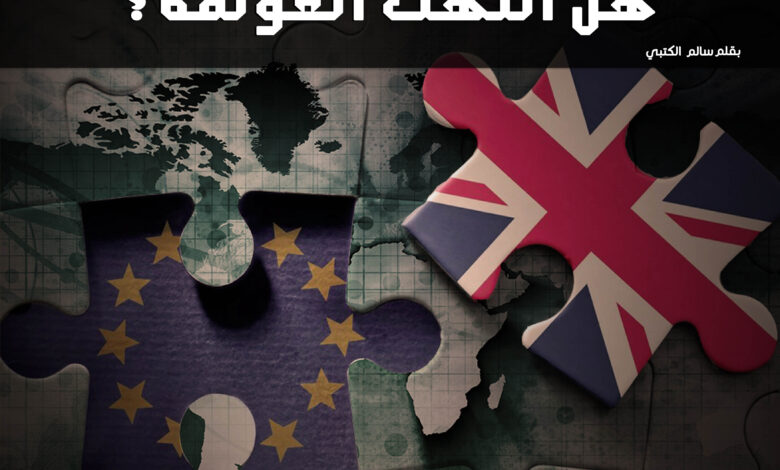
This interesting article was published against the backdrop of the exit of Britain from the European Union, and the waves of panic and strategic conclusions and analysis caused by this historic event which revolved mostly around the idea of the end of the era of blocs.
Clearly, these perceptions had been launched primarily from the effect of the domino theory effect, as everyone is betting that the withdrawal from blocs infection will move to other parts of the world, and will not stop at the borders of the European continent, which is possible, and more importantly, the “aftershocks” of Britain earthquake were so powerful and violent that they led many to believe that this event marks the end of many of the ideas and paths of the after World war II, including of course what is known as the European system, which was born after the war.
Linking between the withdrawal of Britain from the European Union and the end of the era of globalization probably involves a lot of rush and exaggeration in building accurate strategic perceptions on the implications of the event. It is true that the European Union after Britain’s referendum is no longer as it used to be before, but the matter may not live up to the end of the open-borders era for several reasons and considerations. Indeed, we should realize that the idea of mergers and economic blocs only thrived under the ICT revolution, which really removed traditional geographic boundaries, and limited them in a narrow range. Moreover, the ICT revolution and its applications in the field of social media and commercial and economic exchanges and other areas have pushed experts and specialists to deconstruct concepts that had remained quite stable for centuries and decades, such as the concept of “national sovereignty”, which is no longer the same as it was in the past after talking about absolute national sovereignty on a certain geographical area has become difficult to achieve and to implement except in certain conditions of communication, commercial and economic isolation.
Ruchir Sharma believes that one of the reasons for the shift in global public opinion about globalization lies in immigration, and its massive flows that caused the narrowing of employment opportunities in many developed countries, which had not known these high rates of unemployment, and this may be true, of course, but it represents only one side of the scene of globalization, as we are considering a phenomenon whose effects cannot be limited to one side, it is even difficult to study its overall impact at the present time because of the depth of these effects and their continuity and its accelerated pace, which makes it a difficult subject to measure and study until it becomes stable or approaches stability.
One of the problems of globalization is that it has produced politicians hostile to it in many countries, and this is self-evident and natural, but the emergence of strategic threats such as terrorism and migration and the interconnection between these threats to an unexpected degree has started to nourish the idea of fear of open policies, and the positions of large segments of the peoples in Europe specifically, turned to support nationalists and supporters of the far-right, who are anti-immigration and so on.
In the Arab region, these debates on globalization and open borders and so on seem like a kind of political and cultural luxury. Many Arab countries suffer problems of an extraordinary kind, borders are already open in many cases, but not because of globalization but rather because of the collapse of the idea of the national state and its failure to install its roots as well as the escalation of the threat of terrorism and its infinite organizations, which caused an unprecedented situation of regional chaos.
Debates seem far from our region as well because most of the Arab states did not engage in the global economy as it is supposed, but live a kind of imposed exile due to poor growth rates and the immersion in the search for solutions and alternatives to structural and developmental dilemmas dating back to the beginnings of the second half of the twentieth century, in other words, dating to the post-colonial era.
Long ago, we read about the danger of staying in the reception circle of the global interactions in the areas of communications and information revolution and not interacting with them in a way that limits their impact and preserves the cultural and national identities of Arab countries and Islamic peoples, which means that there is a proactive perception of the risk and its vast negative effects, but what happened is that the warnings remained confined to books and classrooms, and many settled for the role of watching and observing without real interaction with the accelerated changes going on around them, and the result was the turmoil and chaos our region is witnessing in many of its parts since 2011!
Talking then about the end of globalization or its continuity may not benefit us greatly in the Arab world, because the majority of our countries remained far from fruitful interaction with the waves of globalization, harvesting only its negative effects, but that does not mean that the idea of globalization itself suffered some kind of damage, it only means that the interaction with it was not up to the challenge.
It is likely that globalization will continue and expand as it is no longer an idea to discuss, which one nation can stop or control its expansion. Globalization has become a symbol of a huge and complex network of strategic interests of countries and giant transnational and multinational companies that compete with the great powers in terms of their influence and resources and strength sources.
Opposing globalization or supporting it is no longer an option, in my opinion, we are facing a phenomenon that self-expands, moreover, avoiding its impacts and delaying positive engagement with it foreshadows very negative effects at all levels.