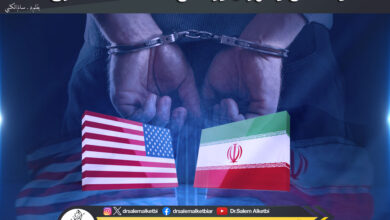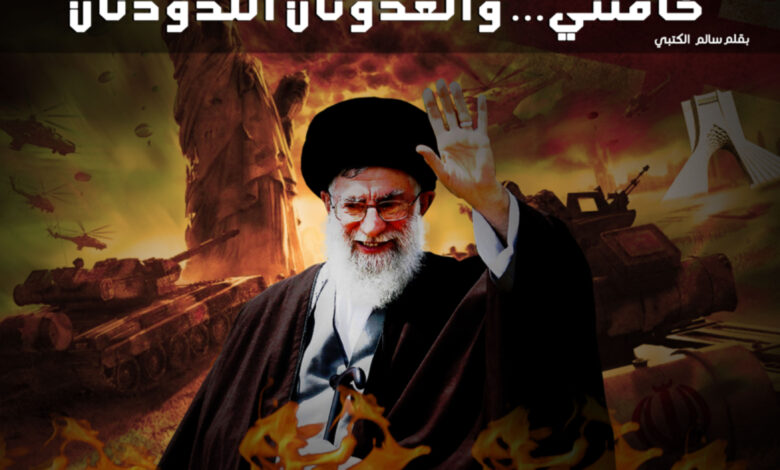
Iran’s mullahs insist on exporting illusions to their followers and supporters inside and outside the country, assuming everyone to be naive and lacking political awareness. The occasion of this speech is that Iran’s Supreme Leader Ali Khamenei, recently spoke at the ceremony to revive the anniversary of the death of Khomeini, to announce his country’s refusal to cooperate with the United States and Britain in regional issues. Khamenei returned to describe the United States as the “Great Satan”, while he described Britain as the malignant state, and described the two as the “archenemies” of Iran.
Khamenei pointed out that “America continues its hostility to Iran since the Islamic revolution in 1979, so the fact that Iran trusts those two countries would be a serious mistake,” and he added “we will not cooperate with America in the regional crisis. Its goals in the region are 180 degrees far away from Iran’s objectives.”
Some may be surprised at my description of Iranian Supreme Leader’s current talk as illusions, but what removes the surprise is that this talk has been released after a few days of the disclosure of some US documents, which Washington revealed, and which are documents about the former leader, the inspiring figure to the mullahs of Iran and the leader of their revolution, revealing that Khomeini whose motto was “death to America” and “the Great Satan”, was closely associated with the US government since the sixties of the last century until few days before his arrival in Tehran from Paris and the declaration of the 1979 Iranian revolution.
The documents published by the CIA point out that Khomeini expressed his desire to communicate with the American president, then there was an exchange of letters with the former President John F. Kennedy, and Khomeini explained in those letters that his verbal attacks against the United States should not be interpreted in the wrong way because it is a way of protecting American interests in Iran.
These important documents were revealed on the eve of the anniversary of Khomeini’s death, to indicate what was going on in the backstage of the Iranian policy, and to expose the falsity of allegations of hostility to America. Khomeini himself explained in a letter that he was not opposed to US interests in Iran, and stressed that “the presence of The United States is important beside the Soviet Union (former)”. The documents confirmed that Khomeini was communicating with Washington and sending it promises at the highpoint of the revolutionary mobilization period that witnessed an escalation of verbal attacks against the United States.
These documents indicate that Khomeini negotiated with former US President Jimmy Carter administration before the Iranian revolution, and gave it many promises, asking it to influence the Iranian army’s position toward him, and made promises not to cut off Iranian oil from the West, and that he would hold a friendly relationship with the United States, and would not export his revolution to the Arabian Gulf region.
These documents reveal a crucial issue, which is that the mullahs of Iran have two faces, a face they show to their followers and disciples, and another face that is shown to the West and the United States specifically. If not, what does it mean for Ali Khamenei to claim continued hostility to the United States while he was the one sending it delegations of senior Iranian officials to negotiate about Iran’s nuclear program over the past few years, until the negotiations ended with the signing by the “5 +1” group of the final agreement last year? And how today is much like yesterday, as what Khamenei is doing today is nothing but a replica of the behavior of his predecessor, the former leader.
Analytically, Khamenei is maneuvering with several cards in the face of the United States’ tough stance towards Iran’s missile program, and trying to show militancy and a return to raising hostile slogans is one of the most prominent of these cards. Tehran believed that signing the nuclear deal would put the current US administration in an awkward position, and would push it to keep silent about Iran’s breaches of international norms in the area of missile and nuclear arms, but its estimates have been unsuccessful, and the US response, particularly by the US Congress and political circles, was disappointing to Tehran, which is now considering with frustration the fate of the nuclear deal after the end of the term of President Barack Obama.
There is another interpretation based on the fact that the nuclear agreement served as another “poison cup” taken by Iran’s mullahs for fear of a pre-emptive American military strike that would destroy Iran’s nuclear facilities, and that could undermine the whole system, therefore, complying with the principle of negotiations on its nuclear program came as a tactic that does not reflect a shift in the strategic approach of the Iranian regime.
Between these two interpretations, I, personally, do not have any problem with political maneuvering. What appears on the surface in the relations between countries represents only the tip of an iceberg that melts over the years, but I feel disgusted from deceiving the peoples, wearing false masks, such as what is happening with Iran’s claims of hostility to the West and its raising of revolutionary slogans against it, while there are dozens of evidence on secret close ties between Tehran and Washington and even Israel, which the mullahs do not stop from verbally attacking, threatening and describing with the ugliest descriptions.