In politics and international relations, you rarely find a virtuous leader. Morality in leadership has been a point of scholar debate since Machiavelli and his views on politics.
In the UAE, one historical leader upheld virtuous principles both in relation to the people and in the foreign policy of the State since its establishment. He established a system of solid moral values that underlie the relationship between the leadership and the people.
On a strong moral and human basis, the UAE was established on December 2, 1971. Our historical founding leaders pioneered in charity and humanitarian work in hot conflicts zones and through cold wars. Before many intellectual and political currents did it, the Emirates called for the humanization of politics, namely, the advancement of humanitarianism in international relations, from tackling issues of poverty, disease and hunger to the provision of humanitarian and relief assistance. The UAE remains a global leader in this field that became, in recent years, the world’s humanitarianism capital.
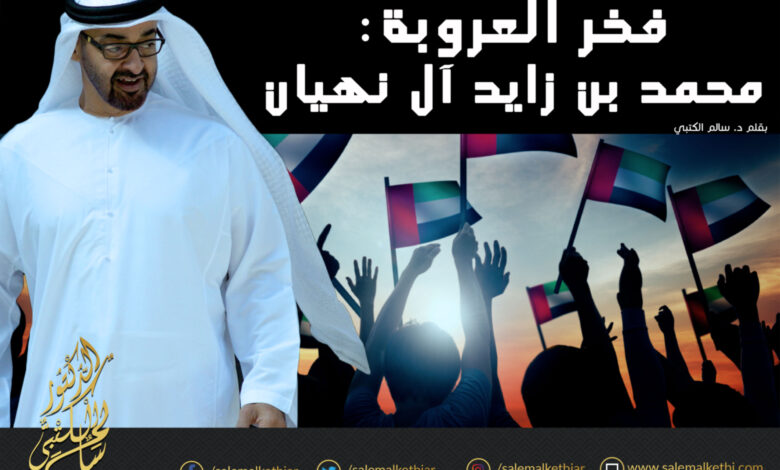
When I started writing my book “The pride of Arabism: His Highness Sheikh Mohammed bin Zayed Al Nahyan, The leader and the human”, I wanted to link the political and humanistic personality traits of His Highness. I found through my review of hundreds of positions and documents that it is difficult for the researcher to separate political and moral dimensions of his leadership style. He is a moral person and his morality is always present in his political work. His values come from a moral legacy he acquired since his early childhood under Sheikh Zayed bin Sultan Al Nahyan, who inspired a whole school of values and care.
For a long time, exploiters of religion exploited the moral aspect to cover their ambitions and conspiratorial projects against the Arab and Islamic nation. Many of them forgot that the moral dimension in politics is not just a slogan but a practice. It was mastered by Mohammed bin Zayed Al Nahyan through his positions. During the days of Eid al-Adha, social networking sites shared a video of His Highness accompanying a leader of a tribe to his car. By abandoning the official protocol, he expressed in a spontaneous gesture a pure message of good governance as we know it in the UAE.
He has frequently expressed the unique relationship between the ruler and the people through his political career. His Highness let go of the protocol in favor of humility and compassion. He considers the people the “bone of the neck” of the country. The fact that his sons took part in the forces defending the national values in battlefields of honor is yet another aspect of the unique national bond.
His Highness Sheikh Mohammed bin Zayed Al Nahyan opened his eyes to the teacher and the founding leader who said:” if it were not for the forefathers, who confronted harsh living conditions, we would not be here in this good land.” The son of Zayed is today carrying this message to future generations.
When leaders moralize their policies, a new kind of good governance takes place. This is clearly reflected in the personality of His Highness Sheikh Mohammed bin Zayed Al Nahyan, Crown Prince of Abu Dhabi and Deputy Supreme Commander of the UAE Armed Forces.
Referring to the charismatic and humble leader whose nickname is Abou Khaled, HH Sheikh Mohammed bin Rashid Al Maktoum, Vice President and Prime Minister of the UAE and Ruler of Dubai, said in his famous poem Sheikh al-Rijal (the head man) “Your humility is an excellent quality”.
“Viva Abou Khaled, his days of glory may we see” the poem reads.