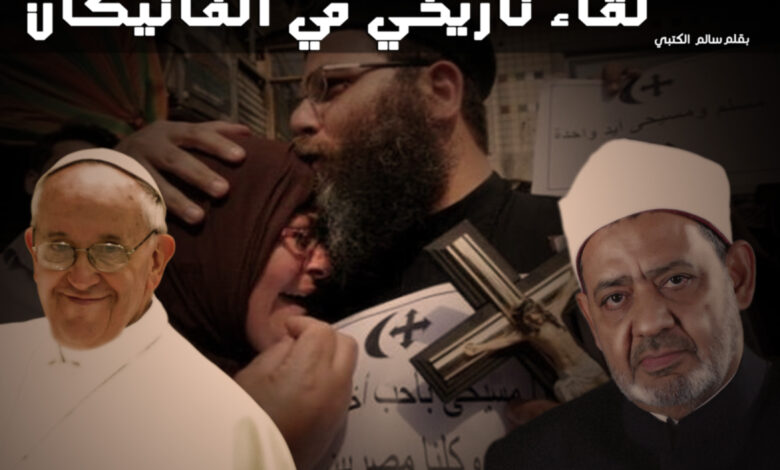
In the middle of the acceleration of events and the aggravation of regional and international crises, recently a meeting I consider very important took place between the Grand Imam of Al-Azhar, Dr. Ahmed Al-Tayeb, and Pope Francis, in a meeting and dialogue that has a great quality value under the threat of sedition and religious conflicts which loop in several places globally.
There is no doubt that the establishment of the rules of the relationship between civilizations is a very important issue, and needs mature and adult minds. Since the last decade of the twentieth century, the world has been living in a noisy debate about the so-called clash of civilizations, a famous thesis launched by Samuel Huntington, who warned in his article published in 1993 in the magazine Foreign Affairs, in an unprecedented way, against the outbreak of conflict between civilizations, and warned exaggeratedly against what he described as the danger of Islamic rise, saying that the coming conflicts would not be economic or ideological but cultural conflicts, so that future limits of tension and fights and conflicts lines will be the geographical limits separating these civilizations, which are the Islamic, the Chinese and the Western civilizations, a theory with a political dimension par excellence, because it stems from politics and aims to it, and it did not have a close link with scientific research because it enslaved all the existing human civilizations and focused on civilizations from a purely political angle, so its warning of the Islamic and Chinese civilizations was closer to a political analysis than to a convincing scientific study, as well as the fact that Huntington did not use religion as a criterion for classification of civilization except for the Islamic case, while he relied on identity related standards in this categorization!
What interests me is that the Islamic-Christian dialogue that was embodied in a meeting of the Sheikh of Al-Azhar with the Pope is a vital step needed to contain the effects of such theses, which have contributed, even with a slight portion, in raising the escalating tensions and hostility that current terrorist groups make up between Islam and the West. The importance of this meeting stems from the fact that it comes after long years of stagnation in these globally influential religious institutions, and particularly since the controversial remarks made by the previous Pope Benedict XVI in a speech in Germany in 2006. This meeting has profound dimensions that may not be perceived by many. It is in the interests of millions of Muslims in the West, defends their interests, speaks on their behalf and tells the truth to defend their stereotypical image that has been distorted due to the follies and crimes of terrorism and terrorists, and at the same time, it sets an example and role model, and elevates the human and civilized values called for by the Islamic religion. It is not reasonable that we remain talking about tolerance and moderation in light of what looks like a staleness of relationships and poor communication between the biggest religious symbols of Islam and Christianity. I liked the comments of Undersecretary of Al-Azhar Al-Sharif, Sheikh Abbas Schuman, in which he said that the Sheikh of Al-Azhar will prompt Western nations to “not to deal with Muslim citizens (in these countries) as if they were groups representing a danger, but as an integral part of their communities.” At the same time he will “exhort Muslims to integrate into their Western communities,” stressing that “the speech (will be directed) to both parties.” This is the message of Al-Azhar that we have been waiting for, that Al-Azhar have an active role and employ its phenomenal religious weight in addressing the extreme and radical ideology and that he be the voice of real moderation of Islam and Muslims in the various regions of the world. The truth is that this meeting is an expression of the thought of two men at the top of religious responsibility, in Islam and Christianity. The Sheikh of Al-Azhar, Dr. Ahmed Al-Tayeb, is an important religious scientist and a cultured man, open and able to recognize the challenges surrounding the Muslim world and what the great Islamic religion endured as a result of mistaken understanding of concepts, distortion and abuse at the hands of extremists and terrorists. And Pope Francis, in turn, is a proponent of dialogue, not conflict, between religions and civilizations, and he has remarkable statements and positions at this level, which confirms the value of this meeting and underlines its importance. This visit, which comes after years of “suspension of dialogue” between Al-Azhar and the Vatican, did not come all of a sudden- there is a communication and dialogues that have been underway between Al-Azhar and the Vatican since the Pope Francis’ presidency of the Catholic Church. So this meeting will dot the i’s and cross the t’s in many issues, especially that the two religious leaderships, Sheikh of Al-Azhar and Pope are known for their wide perspective, openness and moderation, as I said, as the Pope had previously called in his commentary on sectarian terrorism in different countries of the Arab and Muslim world to “avoid generalizations because the real Islam is incompatible with any form of violence,” while Al-Azhar stands firmly against violence and terrorism, and adopts positions that carry neither hesitation nor doubt, as Al-Azhar has previously “firmly” condemned the severe malevolent terrorist acts in different European capitals stressing the absence of any relationship between these crimes and the teachings of the Islamic religion.
This historic meeting will contribute to reinforcing the principle of co-existence in a time when all of us, especially in the Middle East, need this principle as a lifeline and an indispensable alternative to end the conflicts and bloodshed in many countries of the region. Surely, the Sheikh of Al-Azhar, this reverent man, Dr. Ahmed Al-Tayeb, is one of the Islamic scholars that have much faith and conviction in the principle of coexistence between religions and civilizations, and on the other side, the Pope has expressed, on his part, his belief in this principle, it has been addressed in the statements he made recently on the subject, saying “in essence, the coexistence between Christians and Muslims is possible. I hail from a country where they coexist well”. He shows a good understanding of historical events and does not read history with a fanatic or extremist eye. He also advocates dialogue, even among Orthodox and Catholic communities, as Pope Francis met in February, Patriarch Kirill, Patriarch of Moscow and All Russia Orthodox after more than a thousand years of estrangement between Christians of the East and West. And he has already visited mosques and Jewish synagogues, and maintains good relations with many of the leaders of the Islamic countries, and has proven non-discriminatory attitudes between Christians and Muslims, and these are profound considerations and indicators of tolerance in the interest of Muslim-Christian dialogue. Traditionally, the visit of Dr. Ahmed Al-Tayeb, Sheikh of Al-Azhar to the Vatican and his meeting with the Catholic Pope is a historic visit by all standards, but the timing gives it greater significance and historic depth. It comes in very sensitive conditions, and reflects a tremendous awareness by the Al-Azhar institution, with all its heritage and its scientific and religious historical huge role and impact, about the consecration of the principles of religious tolerance and human co-existence between different faiths, and the emphasis of the need for dialogue as an indispensable alternative for security and stability, and the rejection of extremism and terrorism in religion. The meeting of the most important religious leaderships in the Muslim and the Christian world, represents a serious blow to terrorism and extremism, and confirms the values of tolerance, coexistence and moderation, values which are adopted by the UAE, which is always working on their consecration in contemporary reality.