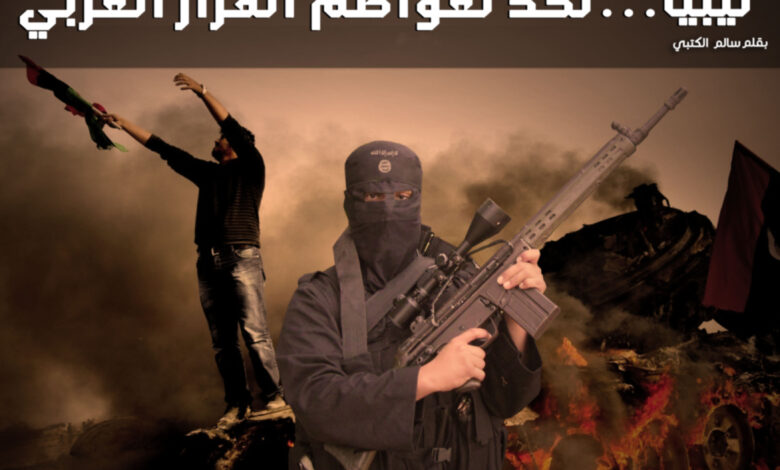
I said some time ago that “Daash” has become a reality in Syria not because of the unusual force of the organization that defies the mightiest armies of the great powers, but because there is an implicit international will to keep the status quo and its administration in a way very similar to what is stated in the book “Management of Savagery”, which represents a political reference for terrorist organizations in recent years! So it looks as though the major powers consented to manage this “savagery” until the right moment comes to exit with the strategic gains that they desire and expect at the centenary of the Sykes-Picot agreement.
Russia, filled the world with banging on the military intervention in Syria to counter the risk of “Daash”. But what actually happened is that majority of the Russian troops got out as a result of a sudden decision and “Daash” remained! As for US President Barack Obama, he is content with crisis management in the Middle East to prevent damage to US strategic interests, waiting for the next US president to decide on the fate of these crises! This area of uncertainty and ambiguity is not limited to Syria, but preceded by Iraq, which seems that it has become a chronic crises area that has hardly any exit out of these crises.
What makes me skeptical of the whole thing is that what is happening in our region is more like tilling the land and preparing it for planting. There is a similar geopolitical preparation occurring, but for re-partition and federalization and new genetic engineering, according to calculations of interests and balance of power. After the preparation of Iraq and Syria to this stage, it seems that it is the turn of Libya, since the focus of international attention suddenly and without warning shifted there, and turned Libya into a center for the attention of politicians, the media and the capitals of Western decision making, and meetings were recently held one after another to discuss the developments of the Libyan crisis, and affirmations were scattered on the fact that the numbers of members of “Daash” in Libya now outnumber their numbers in Syria and Iraq!
What is striking in the issue is that what is happening in Libya is proof of the absence of a strategic vision compass specifically among European countries. Libya is not Yemen for Europe. It is a critical riparian state for reasons related to illegal immigration and the threat of the presence of the “Daash” terrorist organization on the other coast of the European continent, as well as Libya’s oil wealth and what it represents for the European economies. And then it was strange from the beginning that the strategic management of the Libyan crisis was absent on the part of European capitals, particularly Italy, which plunged into a crisis with Egypt, at a time where it seems it was in need for coordination with Cairo more than ever!
Now the great powers remembered Libya, and remembered that there is a growing density of “Daash” on its soil… This is a late awakening but it is better that it comes late than not coming at all. But what one should pay attention to is that turning Libya into a duplicate of Syria represents a real dilemma for the Arab national security. Neither sisterly neighboring Egypt could bear the flows of Libyans and foreign refugees residing in Libya to it under the military conflicts pressures, and Algeria and Tunisia will not allow these flows to enter their borders, and then, everyone may be put in the face of an ethical dilemma beyond the tragedy of the Syrian refugees.
Here, it may be easier for the major powers to agree to supply Libya with weapons and to lift the ban on the internationally recognized Libyan government and even support it with an air cover to counter the risk of “Daash”, but what one should pay attention to it in parallel with all this is to find effective and adequate mechanisms to deal with a new crisis for Libyan refugees.
The Libyan state and people are in a real existential danger, a fact that is not new but well-known long months ago. Reality even says that the area that is the most ripe for the existence of the “Daash” organization is the Libyan territory for considerations relating to the wealth and freedom of movement, chaos, conflict, the absence of the central state, the disintegration of the Libyan army and its division, and tribal and political conflicts, not to mention the unlimited ability of the parties to the conflict for political differences and debate that ignore the crisis environment and the interests of the Libyan people.
It may seem to some that the major powers focus on Libya at the moment will push to end the crisis and to reach a settlement to it, but reality says that the goal is to look for the interests and manage the crisis not to solve it. The speaker on behalf of the US Department of Defense Peter Cook recently said that US special forces deployed in Libya only carry out intelligence work, and that the “small teams” of US special forces deployed in Libya are there “to learn about the existing powers” and “attempt to accurately identify the intentions,” adding that these teams do not have a “permanent” presence in Libya as it enters the country and exits from it. While EU countries are looking for the expansion of the mission of its naval force off Libya to include respect for the arms embargo on the country, which is an important step to prevent the flow of weapons to the “Daash” organization. But the truth is that this organization exists in Libya for nearly two years, which was sufficient for “Daash” to accumulate all the weapons and ammunition it needs, as well as what it got from inside Libya from what it stole from the Gaddafi Libyan army, and the more dangerous land border outlets of smuggling!!.