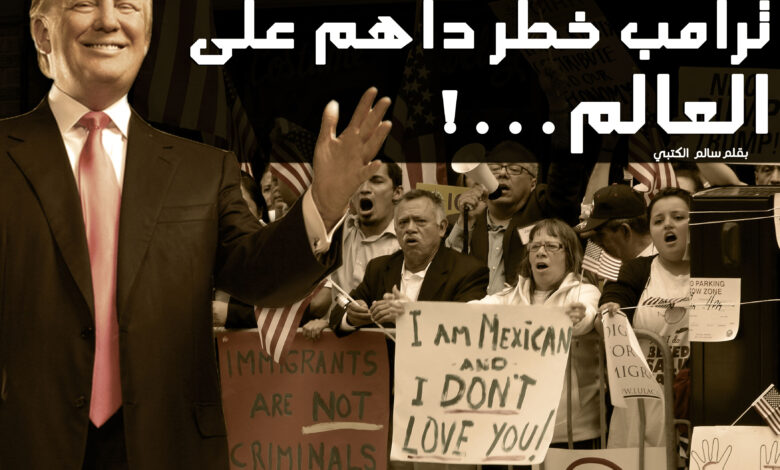
Yesterday the Economist Intelligence Unit, a renowned British think tank came up with a strategic assessment stating that the election of the Republican Donald Trump as president of the United States of America is considered one of the top 10 threats to the world during the coming period! What I’m interested in in this topic is not Trump victory or defeat but the strategic appreciation of the Economist Intelligence Unit, which occupies a prominent global position in its field, so it is necessary to seriously deal with this matter.
From the research side, at least, with its own discretion that Donald Trump’s access to the presidency of the United States will be a global threat at the same level of the danger posed by terrorism, which undermines the global economy. Trump’s remarks against Muslims were not the only nor the most important catalyst to his being classified as an imminent global danger of this size, but his other views, especially in the economic field, which is mainly the concern of the “Economist”, which views with concern his remarks against China, referring to the risk of a potential trade war because of the apparent hostility to Mexico and China, it said: “Trump is exceptionally hostile about free trade, including NAFTA (North American Free Trade Agreement), and repeatedly accused China of being a currency manipulator.” Controversy over Republican US presidential candidate Donald Trump did not stop on the unity of “The Economist” of course, , but I noticed a warning to a professor at the University of Havard, Daniel Alan, in an article in the newspaper “The Washington Post” from the rise of Trump, regarding it more like the rise of the Nazi leader Adolf Hitler, which reflects true fears of a large elite of Americans first and foremost, and then the whole world, east and west, over the policies of the Republican candidate, whose nomination in the beginning was only a light material to the authors of the American “talk show” programs. Policy experts and strategy researchers do not get tired of saying that the US is a superpower run by institutions, and its foreign policy is not made by the president only and is not run through the corridors of the White House alone, and there is countless literature that discusses this issue and addresses it exhaustively, but what surprises me is that all these data are falling one after the other in the face of an important political test, such as the rise of Republican presidential candidate Donald Trump and his growing chance of winning the Republican nomination in the upcoming US presidential election. These fears and warnings also come despite predictions about the difficulty of Trump’s victory in the face of the potential candidate of the Democratic Party, Hillary Clinton, who is expected by many to be the first American woman to sit on the throne of the presidency, and a broad segment of the American elites are clearly enthusiastic about her. Also, these concerns are not limited by the presence of “restrictions” on major decision making in US foreign policy, including the Congress, which could limit the power of the president, whether Republican or a Democrat, if Representatives sensed the gravity of his decisions and policies on the national security of American strategic interests. There is no doubt that Donald Trump’s appearance on the American political scene seems obvious in light of the circumstances experienced by the US policy in the years that followed the attacks of September 11th 2001. Fears have increased, either due to terrorism or to the financial crisis, which the US economy is still suffering its effects since it erupted in the end of 2007, so the emergence of a populist political leader hostile to the other and pro-isolationist, is understandable, especially since the American advocates of isolationism are not limited to Trump, but represent a broad trend in American politics. Advocates of isolationism have a permanent place on the American political scene since the inception of the country. The debate is permanent and heated between isolationism and new imperialism and advocates of imperial thought. Isolationist thought is rooted in American history since the famous Monroe Doctrine about isolation from old Europe, a principle which launched the isolationist trend in American politics throughout its history. Some say that the arrival of Trump to the White House is not unlikely, and that is true, and in the end, it is subject to complex calculations, some of which are related to the institutional positions, and others regard the electoral game and the associated powerful propaganda machine able to guide American public opinion and to shape trends and change its convictions. But attention must be given to the facts that the views of Trump that started to fascinate a slice of Americans now are the same that can be used in the coming months to raise voters’ concerns, especially the positions of the Republican candidate about free trade agreements, and his support for isolationism and rejection of the North American Free Trade Agreement and his call to cancel the partnership agreement through the Pacific concluded with a number of Asian countries. Such a refusal may be a rope that wraps around his chances of success in the upcoming presidential elections due to the opposition of these views with the most important and dangerous pillar of American power in the Twenty First century, the idea of globalization, which is basically a US current, targeting the “modeling” and “Americanization” of the world according to American values and traditions, which represent a hugely influential soft power, on which the United States invested the bulk of their efforts over the recent past decades, and there may be no opportunities to back down from the gains that were achieved at this level, otherwise, the cultural and economic areas of influence and control left by the United will go directly to the ascending Chinese dragon!! I believe that the “nightmare” as described by some authors and experts is hard to turn into reality as long as the economy is at the center of the electoral game. The American voter has barely got out of the consequences of the financial crisis, and more likely the story of the rise of Trump politically will remain an important lesson for researchers in public opinion and in the arts of propaganda. The man cleverly took advantage of the policies of former US presidents and current President Barack Obama, who is accused of withdrawal, weakness, hesitation, and of allowing international events to spiral out of control, but Trump ideas that advocate building walls with others, may by contrast, make of Obama a legendary hero in American history.