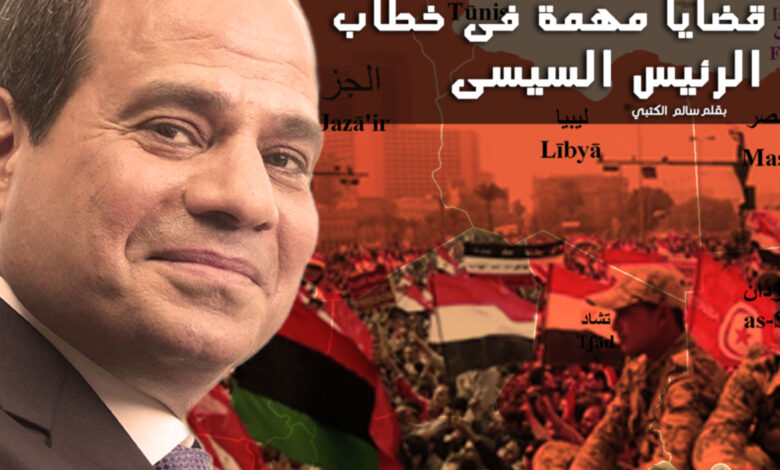
In his recent speech on the occasion of Prophet Mohammad’s birth, Egyptian President Abdel Fattah Sisi addressed many issues beyond the Egyptian local scope, including Arab and Islamic matters. What caught my attention were three issues or fundamental ideas that can be considered substantial entries to address developments in many Arab and Islamic social crises, not only those related to the Egyptian society.
At the forefront of these issues is the idea of responsible freedom in Islam, which is entirely absent from the agenda of discussions on satellite channels, the media and channels that raise issues of awareness and social upbringing in many Arab and Muslim countries, especially since some individual behaviors have violated the responsible freedom in the last few years, and verbal and behavioral violations caught the attentions of a large segment of the public, who exchanges abuses through the means of communication on a daily basis.
There are no longer traditional rules to the media in many Arab countries, as social media has become an arena of creative chaos, and a symbol of the moral, intellectual and cultural deterioration which a lot of young Arabs slipped into. The idea of ’responsible freedom’ needs to be actualized through legal and legislative instruments that define the margins of individual liberties. The instruments must then be applied strictly to punish transgressors severely, so that everyone gets used not to exceed the fine lines of freedom and in order to adjust the rhythm of public and private behaviors within communities.
The second issue that caught my attention in the speech of the Egyptian president is the idea of ’peaceful coexistence’ between religions and peoples essential to address the volatile situation in many Arab and Islamic countries. It is inevitable for the people of the region to coexist according to the rule of accepting difference in opinion, religion, ethnicity, gender. Without this, it would be useless to make efforts to search for exit strategies and solutions to the crises in the region, no matter how great and serious are efforts and the parties involved.
The speech also addressed the issue of ‘efficiency’, considering it the main gate for the Islamic nation to take its proper place among nations. Indeed, efficiency and dedication are fundamental values in the true religion of Islam, but they are unfortunately—sometimes deliberately—absent in many Arab and Muslim societies. Work and making effort is no longer subject to social competitiveness. it was replaced with unfair shortcuts, corruption, nepotism, as these ‘new doors’ helped spreading frustration and despair among young people, dropping the value of hard work and fair competition in order to achieve such and such goals and ambitions.
These religious and societal values that the Egyptian President proclaimed are truly key for curing a lot of diseases Arab and Islamic societies suffer from. They are essential tools other societies adopted to reach progress, development and growth over the recent decades. In advanced societies, diversity, coexistence and respect for the value of the work were pillars for security, stability and progress.
Some may consider that the call for these principles and ideals cannot be implemented given the socio-economic and developmental challenges in some Arab societies. Still, I think such a way of thinking can only beget further pessimism, escapism and irresponsibility among intellectuals and politicians, only fueling further chicken-or-egg debates It is absolutely imperative to inculcate positive values in the Arab and Muslim communities in order to escape from this unfortunate societal reality witnessed on the social media and the streets of Arab cities. Immorality reached high levels, making it almost impossible for positive results to be achieved, both in terms of individual and collective liberties, in light of the absence of regulatory limits for these freedoms, and extremism, incitement and waves of exclusion and marginalization. In his speech, Egyptian President tackled values necessary for the development of human societies. Socialization institutions are supposed to receive the message and actuate well-studied programs and operational plans in order to achieve the set objectives. There is, nonetheless, a deep problematic in the analysis of the content of political speeches of leaders and presidents. One of the reasons for this problem is the perceived master-servant rule and the relationship between the traditional media and the new media (specifically social media).
In many Arab and Islamic countries, the traditional media follow trends in the social media, turning into a servant and a messenger of social networks. Instead pf fulfilling its main function in communities, it ignores that connectivity in many Arab countries is relatively low; when the traditional media follow the trends and biases in the social media, they actually surrender to a bitter reality and disregard the value of hard work and professionalism.
The speech of Egyptian President Abdel Fattah el-Sisi, on the occasion of the Prophet’s birth, dealt with religious and social issues of great importance; however, it is worth pointing out that the topics were not echoed in media debates and political analyzes. Countries aspiring to build a better future must find exit strategies and serious solutions to real issues facing development which were addressed in the President’s speech.