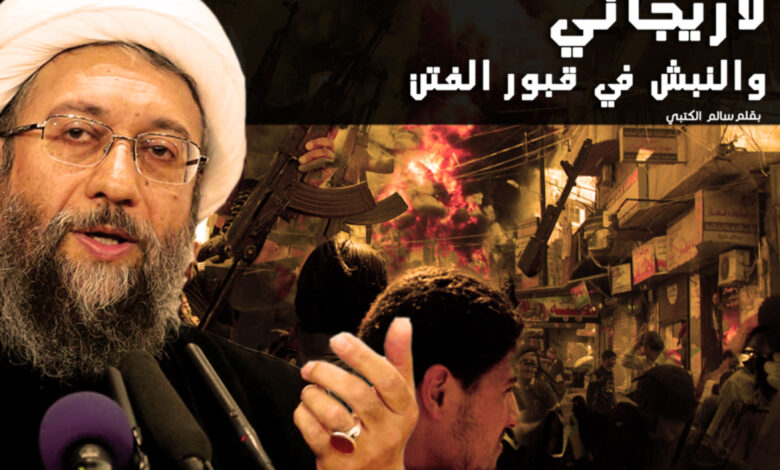
In a long series of insults and abuses that are not worthy of the Parliament officials who claim to defend Islam, not to mention being a cleric, Ali Larijani, head of Iran’s Shura Council, was keen to digging the graves of sectarian strives and religious differences that have caused destruction and division the among Muslims for many decades and centuries.
Fars News Agency reported Larijani saying ‘the Saudi regime is pursuing an unjust Umayyad policy that caused the shedding of the bloods of the Yemeni people, making harsh accusations to the Umayyad dynasty and involving sectarianism in politics.
Larijani never forgot that he was responsible for the formation of the sectarian collective consciousness in Iran. He was in charge of the Iranian ideological media for about seven years until 2007. He has previously served as Minister of Culture and Islamic Guidance in the government of Rafsanjani during the nineties. But he was not famous until his name was linked to negotiations about Iran’s nuclear program, but it looks like he is trying again to achieve a new glory at the level of ideological propaganda and cultural and religious conflicts. Playing with the collective consciousness of the people is Iran’s favorite game. Ali Larijani’s recent comments involved unusual lies as he sought to convince the public with some baseless conjectures.
Larijani is one of Iran’s fanatic mullahs both intellectually and politically, but more importantly he is a central figure in the Iranian regime, whether through his position as one of the ideologues of this theocratic system, or because he belongs to a family that has a long history in the consolidation of this system. His brother Ayatollah Sadeq Larijani is the head of the judiciary, his other brother Mohammad Javad Larijani is the head of the Commission on Human Rights in the judiciary. Ali Larijani is married to a widow of Ayatollah Morteza Motahari, who was close to Khomeini.
Ali Larijani singled out Saudi Arabia for his attack, making the worst accusations. His family actually harbors strong hatred for Saudi Arabia. Dr. Mohammad Javad Larijani, who put forward the so-called ‘Umm al-Qura theory’, has attacked Saudi Arabia about the situation in Yemen and claimed that the Saudi royal family will fall within the next ten years. Larijani the brother has no less hatred than his older brother. He is a conservative extremist and fan of the theory of the export of the Iranian revolution and absolute loyalty to the Supreme Leader. The theory in short is about the notion of sectarian expansion which constitutes Iran’s regional policy at the moment. Ali Larijani is among those who are enthusiastic about invading the Arab world. Larijani the brother believes that Iran should play an expansionist role while avoiding the collision with ambitions of competing regional powers such as Israel. He is the Iranian who made the most statements about reassuring Israel regarding Iran’s nuclear program.
In short, Ali Larijani and his family were supporters and fierce defenders of the idea of expansion at the expense of neighboring Gulf Arab states, who try to promote this sectarian colonial theory that Qom is Umm al-Qura (the metropolis) and not Mecca, crystallize a religious theory of relations between Iran and the Arab and Muslim world from a fanatic Shiite perspective, arguing that Iran is a central state of the Muslim world, and Iranians have the leadership and should direct its foreign policy according to this role. Mohammed Larijani repeats the same argument of his brother, Ali Larijani, talking about Iran as the heart of the Muslim world.
This explains the sectarian hatred to Saudi Arabia by the head of the legislative institution in Iran, which recollects a past of sectarian strives in Islamic history, attacking the Umayyad dynasty, while being fully aware of the sensitivity of this for hundreds of millions of Sunni Muslims in the whole world.
Umayyad dynasty benefited Islam and Muslims, and this is proven from old to online sources. Many know its achievements in terms of the spread of Islam and establishment of Islamic civilization, before it has been subject to deliberate distortion by the Shiites in history.
By virtue of his role and political position, the head of the Iranian Shura Council should not have involved himself in such a sensitive religious issue, then accuse Saudi Arabia of spreading fanaticism and sectarianism. Iran talks with sectarianism then claims to be defending Islam and the Muslim world.
Some professionals may believe that Iran’s revolution is over, but the truth as we see it now, is that it is being revisited by the Iranians and still of deep concern. The Iranian regime is trying to restore and actualize it, taking advantage of the state of insecurity, the strategic emptiness and the political flaccidity that the Arab world suffers. But it will not be in the presence of Arab state leaders who refuse subservience to the Shiite sectarian influence and surrender to a reality Iran is trying to impose on the Arabs through depriving them of their gains before marginalizing them.
Iran’s leaders should realize that their dreams and ambitions are no secrets, that regional security and stability will not be achieved through sedition and schemes to divide Muslims over historical matters, or trying to dismantle State systems through sectarianism and factionalism to eliminate the idea of the nation state in the Arab and Muslim world.