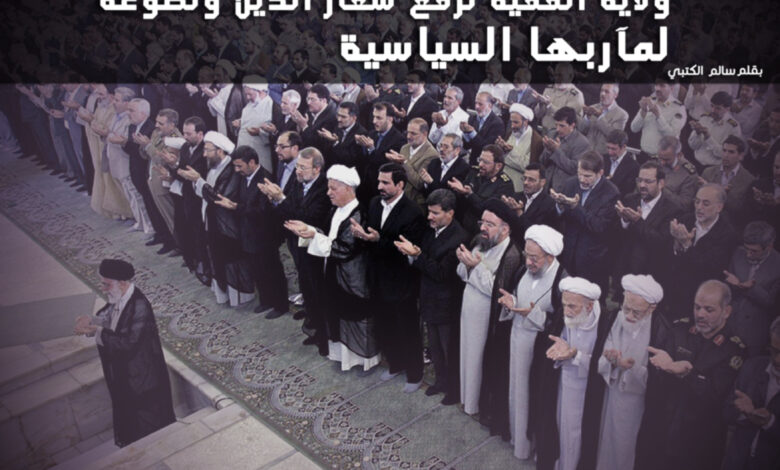
The guardian jurist (vali-ye faqih) system on which the mullahs’ regime in Iran is based derives its existence from the adaptation of religious slogans to serve politics, governance and authoritarianism in a way similar to the principle of ‘rule of God’ (hakimiyya) according to the Muslim Brotherhood. Guardianship is the Shia version of hardline Sunni movements who politicize religion to rise to power.
The region is tired of the Iranian regime raising religious slogans and claiming being keen on helping people in other countries, while this system destabilized many of those. It is the direct cause of the displacement of millions of Arabs internally and abroad.
One of the reasons for the continuation of this policy is that Iranians practiced paper-shuffling for a long time. And at the heart of this game was the promotion of the regime as a religious Islamic system and not a politician one. Some researchers even consider it the most important tenet underlying Shiite political thought.
Velayat-e faqih has historical roots in Shia tradition in light of the absence of an ‘infallible religious leader’ (imam ma’sum). The term first appeared at the end of the first quarter of the nineteenth century in a book called Awaid al-Ayyam by Mullah Ahmad Naraqi. It was called back from history by Khomeini to tighten the grip of his regime on Iran under the guise of religion and for allegedly possessing exclusive power from God Almighty, which is, incidentally, the same idea promoted by Sunni extremist organizations, specifically the Muslim Brotherhood terrorist organization, who interpreted Quranic verses on ‘rule of God’ narrowly in order to practice marginalization and monopolize rule in Sunni Arab and Islamic countries.
The supreme leader idea is close to the Brotherhood’s concept which Hassan al-Banna, the founder of the Muslim Brotherhood copied from other historical groups. He built the foundation of absolute rule in the group through a strict pyramid system. Obedience to the leader of the Muslim Brotherhood is an obligation just as it is for the Supreme leader in the Iranian political system. Just as the leader selects his elite from the Brotherhood, a group of mullahs who hold the title of ayatollah are selected by the cleric leader.
Western studies of the Iranian regime consider it theocratic. Although this category is heavily dependent on the appearance and constitutional structure, such as the mullahs’ rule, use of religious slogans and vocabulary at all occasions, analysis of the foundations of this system suggests that is very similar to Sunni militant groups thought which uses Islam as a cover for their desire to rule in many Arab and Islamic countries, while they are essentially political groups.
The Iranian regime is working in accordance with a political orientation and not religion; for example, it does not practice the principle of consultation (shura). Instead, it has invented unique religious mechanisms to exercise control. They appear transparent but they are in fact apparatuses of dictatorship and tyranny. There is severe preemptive monitoring of those who want to run for elections in Iran. They are assessed based on loyalty to the Supreme Leader. Everyone who does not recognize this regime is eliminated immediately. There is an arsenal of councils and specialized bodies controlled by hardliners to prevent any change in the hardline Iranian regime, including the Guardian Council and the Assembly of experts and the Expediency Council, which ask questions and give answers in the same time.
Velayat-e faqih is also not a pan-Shiite theory; many Shiites reject it. Some prominent Shia scholars reject Khomeini’s orientations in this theory. Among those is Ayatollah Hossein Montazeri, who announced total rejection of the idea of the control by the religious leader on matters of religion and life. He has been under house arrest until he died in 2009. the theory was not recognized by many Iraqi and Lebanese Shiite leaders like Ali al-Sistani, Mohsen al-Hakim, Mohammed Ali Al Husseini, the Secretary General of the Islamic Shiite high Council in Lebanon, which is considered the official reference for the Shiite community in Lebanon, noting that the inter-Shia dispute does not revolve around the theory but the limits and applications of the theory.
Khomeini believed that the supreme leader has the absolute state of religion and politics in the country. velayat-e faqih is somewhat similar to the Pontifical system which prevailed in Europe during the Dark Ages or Middle Ages, which saw the absolute control by the papacy on the affairs of religion and politics and things in life, but Europe has succeeded in getting rid of it since nearly five centuries whereas some Sunni Islamic groups have tried and failed to apply it in recent years.
The Iranian regime which follows this approach rules according to this thought since 1979. The leader still controls all the affairs of life in Iran. The qualifications of the supreme leader according to the Iranian constitution seem vague and elastic and difficult to measure. Knowledge, justice , chivalry, modern jurisprudence, courage, acumen, intelligence, management skills are among those. He completely dominates the system through specific constitutional provisions, as well as through some two thousand representatives of the ‘Hujjahs of Islam’ deployed in all institutions, ministries and agencies of the country at home and abroad.
This is a theory that holds religion slogans to achieve political goals set by its proponents.