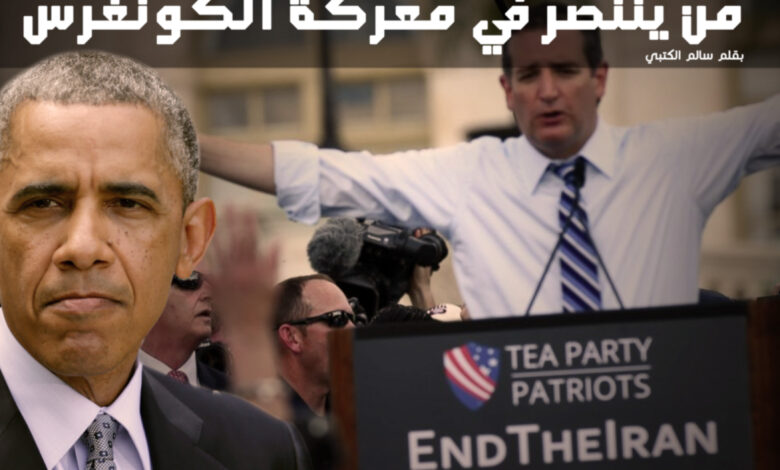
There is an anticipated battle in the US Congress as members vote on the Iranian nuclear deal during the month of September. Some might think that this battle is only about the victory of President Obama and his presidential team or the victory of the congressional majority of Republicans and their allies.
But international news agencies are counting the number of positions by members of Congress and their attitudes toward the agreement on a daily basis. The White House also celebrated that the number of supporters of the agreement of members of the Senate reached 28 members, which means that there are only six votes in order for President Barack Obama to veto a possible rejection by the Congress of the nuclear agreement. The president needs the voices of two-thirds of the House of Repts. and the Senate to counter attempts by Republicans to block the agreement.
In the HoR, Obama needs the support of at least 146 members for securing passing the agreement in the Council, where about 69 House of Representatives Members already support the agreement, and competition often revolves around attracting around 140 Member who did not declare their positions definitively out of 435 Members of the US House of Representatives.
What is happening in the corridors of American policy during the current period is worth pursuing research about it as it highlights the American policy dynamics. Some American commentators consider that one of the raging political battles for lobbyists as well as being a parallel battle at the level of attracting positions of the American public about the agreement. Obama is not fighting the battle alone, but shares it with the presidential team, especially his Secretary of State, John Kerry, and a large number of US organizations, in the face of the Republicans, along with the most prominent lobby in the United States, AIPAC, which mobilized its political and financial propaganda to push for rejection of the agreement on parliamentary and popular levels.
The problem of the Iranian nuclear deal is that it does not allow for political adjustments and only relates to the zero-sum equation. The impact of the results of this vote in the upcoming US presidential election of 2016 plays a prominent role in heating up the atmosphere and pushing the two sides to make their maximum efforts in order to win the battle. President Obama relentlessly sought to persuade a number of members of Congress during the recent holiday, spending even more time communicating with some lawmakers.
Minor consequences
If the agreement gets rejected by the Congress despite the presidential veto and is passed, it would be a political defeat for Obama. It would mean a political victory not only for the Republicans but for Israel and pressure groups opposing the nuclear deal, first and foremost, AIPAC. But the battle itself had minor consequences such as the fact that the fierce struggle for the defense of the agreement pushes the Democrats to control the implementation of the terms of the nuclear deal with Iran strictly even if it requires military escalation against Iran, in the event of any violations of its clauses.
This is in the interest of the Arab Gulf states, which are concerned about the results of this agreement, in the sense that the US internal control and monitoring of the implementation of commitments by the US president regarding Iran’s ability to acquire nuclear weapons will be subject to oversight and accountability by the US and its allies and partners in the region.
This agreement connects some adversaries around common interests. It links Iranian hardliners to the Republicans. Iran’s Revolutionary Guards were critic to the agreement and hope the Republicans can prevent it.
In the next showdown in the battle of Congress, among the possible scenarios:
* The first most likely scenario is that the agreement passes with two-thirds rejecting and one-third agreeing and then Obama resorts to the presidential veto.
If Obama wants to make a historic political achievement, he will not risk linking his name to a US foreign policy failure in the event of Iran’s success in deceiving Washington and getting away with a nuclear bomb that will threaten Israel.
Thus, Obama during the remaining period of his presidency will not be a lame duck in dealing with Iran specifically, and will seek to impose control over the implementation of the agreement, especially since the issue is not only about making history but also the chances of the Democratic Party in the upcoming presidential elections.
We must not forget that there is a number of House Democrats that have joined the Republicans in rejecting the agreement, pressuring the White House to be cautious. We should also not forget that the whole thing is linked to Israel’s security. The White House undertakings are precise in this regard. Any failure here will be employed in the upcoming elections.
* The second scenario regards Obama’s failure to secure a third of the votes in both houses of Congress, so he could not use the veto which means the final failure but this is unlikely.
* The third scenario is that the Republicans fail to make the two-thirds majority and the White House hopes so but this is not likely.
Arab position
Some Arab and Gulf countries welcome the agreement and want it to be strict. The United States would be liable to watch the implementation of the agreement.
The Iranian nuclear agreement signed a year and a half before the next US presidential election also raises questions about the extent to which the next president will be committed, especially if they are a Republican. Some candidates say the agreement is not dangerous, some promises to annul it, while the most prominent Republican candidate Jeb Bush said it is a “farce”.
The electoral stage course of events is subject to propaganda and electoral calculations and considerations. It is hard for the Republicans with their historical attitudes and political heritage to agree with Iran. If implemented, the agreement still risks collapse.