It is hard to be convinced that groups and organizations that falsely raise slogans of Islam, are working in isolation from anti-Arab and anti-Muslim forces.
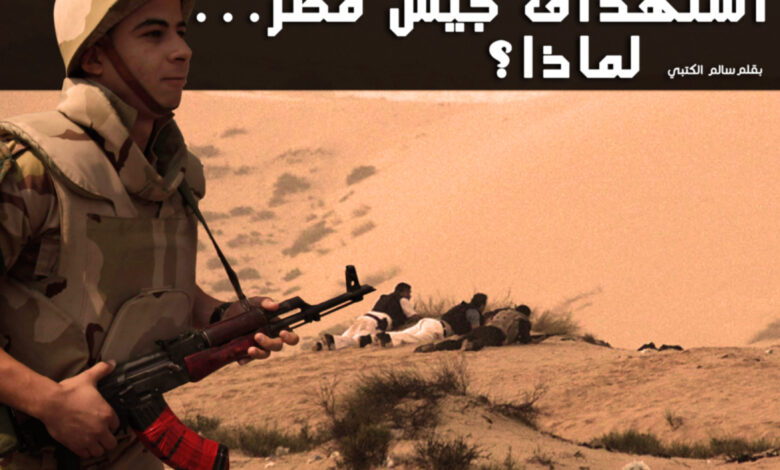
Upon the collapse and the dismantling of the Iraqi army after the US-led invasion in March 2003, and after the exhaustion of the Syrian army and the dispersion of its efforts and its limitation in about 25% of the Syrian territory, plans targeting Egyptian army seem appealing for any regional or international parties seeking to pounce on the rest of the Arab countries.
Spreading regional chaos represents a universal strategy of regional and international powers. As for the tools and tactics used to achieve this vital goal, they are multiple and variable, including the organization of Daesh and the Muslim Brotherhood. Therefore, what the organization “Ansar Bait al-Maqdis” which is loyal to Daesh is trying to do in the Egyptian Sinai is only trying to control a spot of land to convert it later into a starting point for ongoing armed action so as to drain the capabilities and capacities of the Egyptian army.
Egyptian Experts confirm that the Egyptian troop participation in operations in Sinai represents only a small percentage of the strength of the Egyptian army. It is a ratio that Egyptian President Abdel Fattah al-Sisi himself estimates at about 1% of the size of the Egyptian army. This is true because the majority of this army is involved in securing the Egyptian borders with Libya and Sudan, and the proportion of military equipment found in Sinai represents only a small percentage of the arms of the Egyptian army. But we must realize that the problem of wars in the era of asymmetric threats is not related to the size of armies or their equipment or their capabilities or their military and operational superiority levels, but is linked mainly to their capacity to cope with unfamiliar threats to traditional armies, which threats stem from organizations and groups with a high-capacity to move and maneuver and escape. Therefore, these organizations represent a challenge to the armies that are used to ground wars and major confrontations in the face of other armies that rely on military strategies that can be addressed. In addition, arming conventional armies in the world is based on patterns and structures made to address opposing strategies and plans of the armies of other countries, and in accordance with the military experience gained during wars through which their capacity and expertise, accumulated over decades, are reinforced.
Fourth and fifth generation wars depend to some extent only, on confrontations and military capabilities, and the most important and most dangerous aspect in their strategies includes a mix of media tools (via both traditional and new media) and economic, psychological and political tactics. This is why some people may not understand the inability of some armies in the world, including the US army, which is the most sophisticated humanly and technically, to eradicate terrorist organizations from the land and deserts they hide in. Perhaps some of these people believe that the continuation of these organizations is an expression of their strength and ability that surpass the capabilities of some of the armies they are facing, and this is generally not true, because the nature of the confrontations that take place on the ground, limit the traditional operational capacity of armies, and require training and rehabilitation plans commensurate with the nature of the new enemy. Also, the nature of these organizations and groups differs from the nature of armies, and standards of victory and defeat themselves are different on both sides.
For example, we all notice that Hamas launches some old primitive rockets at Israeli cities, which stirs the panic of civilians and makes the army launch large-scale military operations using air forces and rockets and ground forces, and these operations cause heavy losses to the Palestinians and the infrastructure of the movement. However, the movement’s leaders claim victory in the face of the Israeli army just because they managed to survive, regardless of their human and material losses and the losses they caused to Palestinian civilians at the human and physical levels. The standard of victory for the movement is the ability to survive. As for armies, they are seeking to achieve goals that can be discerned only in the event of a war against similar armies. Armies are also subject to criticism and accusation for their inability to eradicate such movements or causing civilian deaths despite the pre-realization that the tactics of the militias and movements are based on a hit-and-run approach, and on hiding among civilians whom these organizations use as human shields and then claim civilians are being targeted by hostile regular armies!
Just as Hamas did in Gaza, Lebanon’s Hezbollah made the same claim of victory in several wars with Israel, although it brought destruction and devastation on whole Lebanese cities, but the survival of its leader, Hassan Nasrallah, is the most important criterion that means the victory over Israel for the party and its regional sponsors!
This is how these unconventional wars change the concept of victory, and therefore they cause a shift in strategies as a result of the problems faced by regular armies in these confrontations which impair their mental image in many cases.
Some may believe that targeting the Egyptian army is due to the hostility of these organizations towards the current political regime in Egypt, and this reflects just a part of the subject and not the whole of it, because targeting the Egyptian army is a strategically vital goal for some regional and international powers, regardless of the policies of President al-Sissi and the internal conditions prevailing in Egypt. At the same time, we cannot completely surrender to the idea that the interests of Israel and the United States lie in maintaining security and stability in the Egyptian home, or that Israel’s interest is incompatible with the presence of Daesh or Hamas or Al-Qaeda on its border with Egypt. In light of the above, we can raise an important question, which is: Which is better for the security of Israel, is it the collapse of the Egyptian army, God forbid, which will result in a huge chaos in sisterly Egypt with its massive population, and an enormous disorder that can last for several decades, God forbid, or is the survival and cohesion of the Egyptian army and its acquisition of additional military strengths and experience is the best option for Israel and its security?
The answer to this question may not need an in-depth analysis or a big research effort in the light of the unprecedented strategic security felt by Israel since the absence of the Iraqi army from the scene after its collapse, and after it has become unable to cope with terrorist organizations on its own, let alone fighting in wars against states! Add to this the tremendous erosion of the Syrian military capabilities and the involvement of the army in several internal conflicts and wars with terrorist organizations and sectarian and factional militias.
The matter is almost settled for the benefit of the Arab armies’ disappearance or in the worst estimates their concern with extended conflicts that drain their capabilities, destroy the morale of soldiers and restrict their focus on the gangs they are fighting inside, all the way towards the new Middle East. In this context the executive roles and tools used appear, such as the Muslim Brotherhood and Al-Qaeda and Daesh, which owns an obvious religious political agenda, which the organization announces to the public through the means of social communication. But the extension and the expansion of the organization to this extent, and the fact that it is trying to appear as a superpower able to fight more than one war at a time, this trend is impliedly supported and welcomed from other forces whose goals converge with the goals of this malignant organization, which offers the best free services to the enemies of Arabs and Islam. It is hard to be convinced that the leaders of such organizations and groups that falsely raise the slogans of Islam, operate in isolation from the forces hostile to the Arabs and Muslims, especially as the history of these organizations testifies about their collaboration with the old colonialism and about the fact that they were serving it.