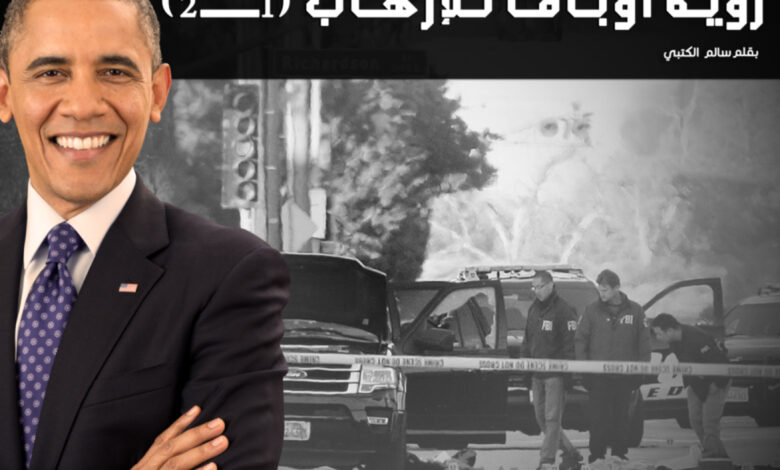
In his speech in the summit of the White House on countering violent extremism, which was held recently, US President Barack Obama spoke in great detail about the American vision of terrorism and how to deal with it during the next phase. The speech of President Obama included several important points. First, he focused on the idea of American values and that these values are the essential foundation of American leadership of the new world order. He addressed, for the first time, the concept of victory over Daesh according to the American perception.
This perception is based on the complete eradication of the organization by means of political, intellectual, religious, cultural and military confrontation, in the sense that achieving a military victory over the organization will not end the war against it. Perhaps this explains clearly the statements of President Obama and American officials that the war against terrorism will continue for two or three decades, on the basis that the confrontation at all levels to eradicate terrorist ideology is a continuous and extended battle. This is somewhat true, but perhaps this is the first time that a US official speaks in detail of facing terrorism intellectually without prioritizing military action.
In addition to the foregoing, the President statement has involved other important points that are not disputed between countries in war against terrorism, but what raises suspicion and doubts in his statement is that he linked terror to practices by some Arab regimes, specifically regarding freedoms and political reform and restrictions on free speech and what he described as the contempt of the people, without indicating that the emergence of terrorism, mainly in the Middle East, was due to Israeli occupation and the Palestinian cause and its spiritual, national and religious dimensions for Arabs and Muslims. The American policies in the Middle East has also caused problems that terrorist organizations used as an excuse to ignite the fire of strife and violence in many countries of the region.
In his statement, President Obama was keen to completely avoid responsibility for the emergence of terrorist organizations that he blamed Arab governments for.
Any objective analyst realizes that the US president will not admit of course the responsibility of his country’s policies of the emergence of terrorism regionally and globally, but it is not logical to try to victimize oneself and preach tips on how to tackle terrorism.
Obama called the leaders of the Arab states to do more to eradicate terrorist ideology and that is not a matter of dispute. Most Arab countries and their leaders have engaged in a strong, strict and decisive confrontation with these criminal organizations. However, Obama did not address the parallel responsibility of Western countries from which thousands of their Muslims nationals went to Iraq and Syria to join Daesh.
If terrorism has extended in some Arab countries because of the policies of their leaders and their regimes, how can we explain the thousands of Westerners, including dozens of Americans, who joined Daesh? The irony in this context is that the statistics show that the members of the organization from European countries may outnumber those from Arab countries whose policies are accused of nurturing extremism.
The responsibility of confronting terrorism is an international responsibility. There is no need to lay charges, especially as extremist organizations emerged two decades ago or prior in well-known conditions. There is no reason to avoid this responsibility and everyone should cooperate earnestly to cure this epidemic.