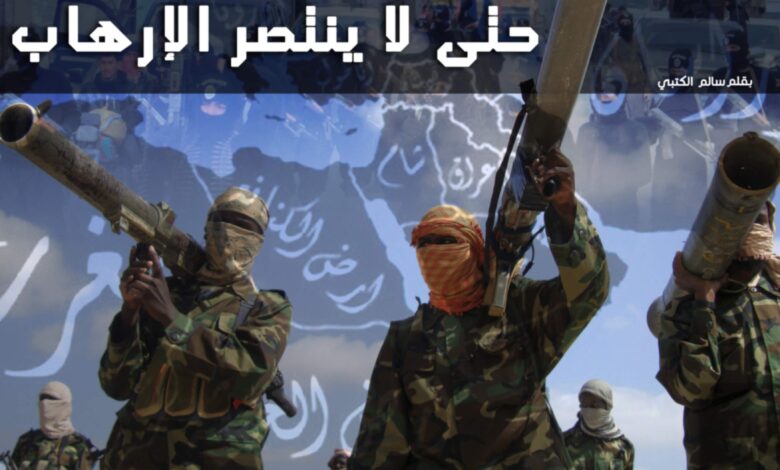
Those who follow the current developments in the Middle East are aware that terrorist extremist organizations achieve moral and political victories by exploiting regional conflict and the complexities and intricacies of interest between regional and international powers and parties.
One of the most dangerous tactical crossings terrorist organizations cross through is the exploitation of the rule: “the enemy of my enemy is my friend”. Through this rule, terrorist organizations found themselves positioned in one box, on common ground with countries deemed hostile and that classify these organizations as terrorist!
There are opinion articles and reports that have emerged over the last days in the Western newspapers calling for the adoption of the principle “the enemy of my enemy is my friend”, to deal with crises in the Arab countries. The journalist Patrick Cockburn in the newspaper Independent on Sunday said that this method is the only alternative available to tackle militant groups that pursue the thought of “Al Qaeda”. With regard to the drawbacks that make this alternative a strategic threat in the near and long term, it is not a suitable option, at least morally, a dimension of which politics calculations are devoid, but this moral dimension seems needed very urgently in some files, especially those related to dogma or ideology.
In Syria and Iraq, for example, the interests of the Arab states cannot be in supporting the Shiite militias in order to fight ‘Daesh’!! And by the same token, the interests of these countries in Yemen cannot stem from betting on the support of the Muslim Brotherhood in order to fight the Houthi expansion!
The calculations of logic and strategic interests of the Arab states and peoples should proceed from the support to the national state sovereignty and legitimacy before anything else, and this is incompatible with any attempt to consolidate the positions of the illegal militia groups, which are described conceptually as sub State actors or organizations, and which are now the source of the most dangerous threat to national state sovereignty in the Arab region.
And certainly one of the reasons of security and stability threat in the region is the decomposition of the national state and the spread of chaos in a way that is opening the way for the proliferation of sectarian organizations and groups that have in common extremism and terrorism, and use religion as a slogan and a cover while they are all aiming at pouncing on the rest of the influence of the states and playing their role, and perhaps the Lebanese Hezbollah represents the best realistic example of that.
The strategic calculations of Arab countries must not and are not supposed to proceed in such cases from short-term visions or tactical considerations operating according to the principle “the enemy of my enemy is my friend”, as soon everyone will find themselves in the face of this “friend” that will necessarily seek to translate his participation in any military effort into political gains, which in turn detract from the legitimacy of the State and reduce its real sovereignty and influence.
The exit, then, is to rely on the counter-principle “the enemy of my enemy is not necessarily my friend,” and this logic in strategic thinking is betting on the national state only, preserves its sovereignty and influence, and considers any terrorist or extremist organization as hostile to the national state, regardless of creed or religious sectarianism.
There is no doubt that it is difficult for countries to move along sectarian calculations because such calculations are alien to the idea of the state itself, and this is one of the secrets of the decomposition and collapse of the national state in many parts of the Arab and Muslim world. When sectarianism is present, the national state becomes absent, by extension, and that is the dialectic of history, it is even one of the most prominent lessons learned over the centuries.
If some regional powers take sectarianism and sectarianists as agents to gain influence and strategic expansion, it is therefore necessary to address such policies and not confront them with the same arms, because confronting them with the same arms benefits hostile organizations and militias that also reject the logic of the state and seek to deepen the manifestations of chaos and turmoil.