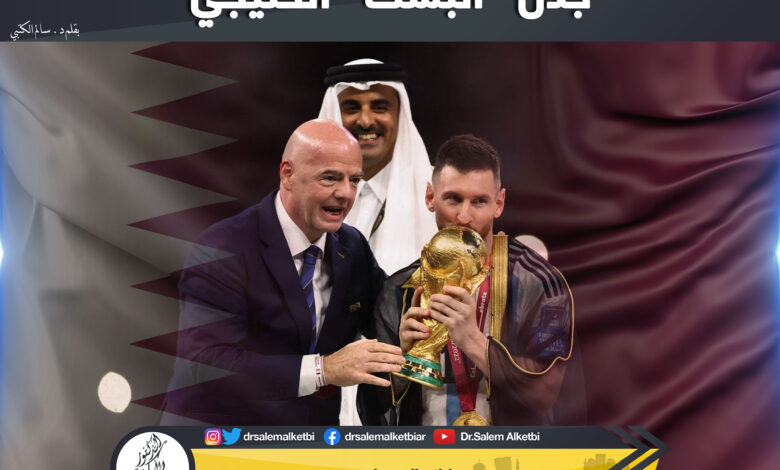
No photo from the last World Cup attracted more attention than the image of Argentine star Lionel Messi wearing a Gulf bisht while receiving the trophy. The Emir of Qatar, Sheikh Tamim bin Hamad Al Thani, placed the bisht on Messi’s shoulders, ending the scenes of the tournament celebration in Gulf uniform in a way that caught the attention of the world public.
This impressive shot is a magical combination of sports, politics, public relations, advertising art and mental image. It received a multiplier effect because it appeared after a match that many called “the greatest” in the history of the World Cup final, becoming the most outstanding shot in the history of the World Cup and in the career of one of the legends of soccer of all time.
The shot sparked as much controversy worldwide as it went viral. It reignited the political controversy that has accompanied this particular tournament from the beginning and for many months and years before. Most Arab tweeters on social media were proud of the shot and admired Qatar’s thinking on the matter.
Others, however, voiced their outrage and criticism, whether it was because they confused politics with sports or because, in their opinion, the bisht covered the jersey of Argentina’s tournament winner Lionel Messi.
Some said Qatar wanted the Bisht to distract from its human rights record and bribery allegations in the European Parliament. Messi wearing the bisht was one of the “sportswashing” moves Qatar has made since the tournament began. The Guardian newspaper went further, suggesting that the images of Messi wearing a “black bisht” were a moment of return on Qatar’s investment in the tournament.
The Telegraph newspaper spoke of a “bizarre act that ruined the greatest moment in World Cup history.” In between is a third group that sees a symbolic image for the coexistence and meeting of cultures and the role of soccer as a bridge builder between societies and nations.
They felt that the tradition itself was not new; Brazilian Pelé had already worn the Mexican sombrero after his country won the World Cup title in Mexico in 1970. But even that was argued against, saying that it was a headgear and not a uniform that covered the player’s entire attire.
Others believed that the situation was in favor of Qatar, but the timing was inappropriate in the calculations of the Argentine team, whose captain’s shirt went buried under the bisht. All the above opinions did not bring any new positions, as they largely expressed the positions of their owners and sympathizers from the beginning of the tournament to its conclusion.
A look at the picture suggests that there is a prior agreement with Messi that he would wear the bisht at that moment. The Emir of Qatar, accompanied by the FIFA President, moved towards the captain of the Argentine national team to present him with the trophy, dressed in a uniform of the Gulf, which has a deep cultural symbolism. Messi was certainly not surprised.
The Emir of Qatar will not put himself in a position where he could embarrass himself or fail, which would mean squandering all the organizational success from the last 12 years and a return estimated at $220 billion. What confirms the validity of this hypothesis is that Messi wore the bisht throughout the scene of the Cup celebration.
He did not take it off within seconds of putting it on, as would have been expected if it had not been coordinated before. Objectively, this shot was a smart use of the art of political PR. Despite all the criticisms, regardless of their justification and motives, the scene will stand historical par excellence.
No picture of the 2022 World Cup ceremony will appear without the bisht that the Emir of Qatar laid on the shoulders of the Argentine captain.
Qatar used the historic moment of a tournament watched by about half of the world’s population, more than three and a half billion people, to document the hosting of the tournament, its identity and its culture not only in FIFA’s records but in the collective consciousness of mankind. Qatar has tied itself to the historical and human legacy of the tournament.
With this shot, it was able to add an Arab touch to the victory scene of a team supported by hundreds of millions of people around the world and a fan favorite international soccer star. Regardless of the controversy surrounding the shot and its motives and the behind-the-scenes moments in its making, it will remain a historic image, all the more so because it featured a legendary player.
It was his first tournament victory in the history of his participation in five editions of the World Cup since 2006. The tournament is over, but the bisht photo op will go on, as Messi becomes one of the most famous international figures to have worn this traditional Gulf suit. Such images remain iconic in human and sporting memory, whether we like it or not.