The visit reflects the resumption of the atmosphere of “brotherhood” in the Emirati – Qatari relations, and a return to normality and the disappearance of the temporary turmoil these relations experienced over the last period.
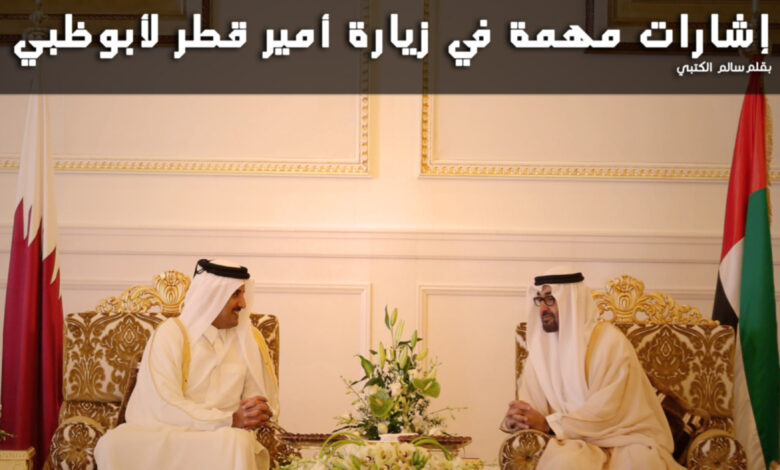
There is no doubt that any moves between the leaders of the Gulf Cooperation Council (GCC) are of interest to observers and experts at the regional and international levels, particularly what is happening at the level of the Emirati-Qatari relations, specifically the visit of the Emir of Qatar Sheikh Tamim bin Hamad Al Thani to Abu Dhabi recently. This interest on the parts of observers and experts is for several reasons. First, the growing strategic weight and prestige of the Gulf cooperation Council (GCC), and its becoming an active and influential player in the vital issues in the Middle East, which translates in monitoring the diplomatic and political moves of these states.
Second, this visit reflects the resumption of the atmosphere of “brotherhood” in the Emirati – Qatari relations, and a return to normality in the relations and the disappearance of the temporary turmoil these relations experienced over the last period.
Third, the visit confirms that there is coordination between Doha and Abu Dhabi about regional hot files, and undermines the analyses claiming the existence of a conflict of interest or strategic duels on roles and gains in a number of regional issues such as Syria and other issues.
It makes sense that we are all convinced that the idea of nations having the “same” views and visions and perceptions has completely collapsed, and analytically, it is excessively naïve to believe in such an idea in the light of the enormous complexity and competition in international relations. Hence it becomes natural that international interactions result in variations and differences in views on the interests of countries in several issues. The basic criterion for measurement is how the parties of the relationship deal with these differences, and their ability to create political alternatives that maintain interests and bridge differences through the search for confluence, as this is the nature of interactive international relations in the Twenty First Century.
Sheikh Mohammed bin Zayed Al Nahyan, Abu Dhabi Crown Prince’s remarks during his meeting with the Emir of Qatar accurately reveal the authentic Emirati orientation towards strengthening the unity of the GCC and upholding the interests of the peoples of the GCC countries, as well as the interests of the Arab peoples in general. He said that this visit “reflects the deep fraternal ties between the two countries and promotes the march of the Gulf cooperation Council towards more harmonious work, compatible with the higher interests of the GCC countries”. He pointed out that the UAE under the leadership of Sheikh Khalifa bin Zayed Al Nahyan, President of the State shall endeavor to foster closer solidarity and cooperation and synergies between GCC citizens in the face of all challenges and threats that affect the security and stability of the region. These attitudes, in their entirety, reflect the significant historical depth of the UAE’s foreign policy, and are not mere words of courtesy, but rules and standards of the political and diplomatic performance of the UAE. They reflect such great care of the wise leadership in the United Arab Emirates for the unity of the Gulf in this sensitive historic phase.
Cooperation and solidarity, then, returned to the top of the agenda of Gulf-Gulf relations, and there is a clear political will to uphold these inherent values in the relationships between brothers, which in itself is not a transient matter in the atmosphere of the Gulf relations. It is about the unity of leaders of the GCC countries throughout the history of the region, a basic characteristic based on a rooted conviction of the inevitability of common destiny among the peoples of the GCC countries, The historical heritage, as Sheikh Mohammed bin Zayed Al Nahyan said, and relationships of affinity and kinship in our region are all factors that impose themselves on the agenda of decision makers in these countries and are hard to ignore.
What more strikes me, personally, in the communication between the leaders of the GCC countries is that any step in this path is like a new ‘serum’ that offers invincibility and immunity to the Gulf in the face of attempts to separation whether from regional powers or major powers that are seeking to impose their plans that reflect their interests and strategic visions for the Middle East in the Twenty First Century, and in the heart of these is the re-engineering of the region in accordance with new geopolitical standards that do not take into account the interests of the Gulf and the Arab peoples.
The presence of the Emir of Qatar in Abu Dhabi, as well as mutual visits which took place between the leaders and officials of the two countries recently, provide important clues to on the fact that relations have recovered and gained in momentum and returned to the normal track, characterized by smooth flow of communication, dialogue and consultation, without obstacles or barriers or complex calculations. This in itself is an important sign that these relations can overcome any disparate views and reach common convictions that put the interests of the two brotherly peoples in the focus of attention and at the top of the goals, especially that the strategic challenges and threats around us worsen, which makes cooperation an inevitable and an inescapable choice, as the status quo of the Arab scene with its terrifying and confusing details puts on the shoulders of the leaders of the GCC countries a historic responsibility to save tens of millions of Arab peoples, beginning with Syria and the Yemen, through Iraq and Libya, from the clutches of darkness scenarios and unknown fates, not to mention the support of the rest of the brotherly Arab states in the face of internal instability, so that the Arabs pass the threshold of the second decade of the Twenty First Century with minimal losses.