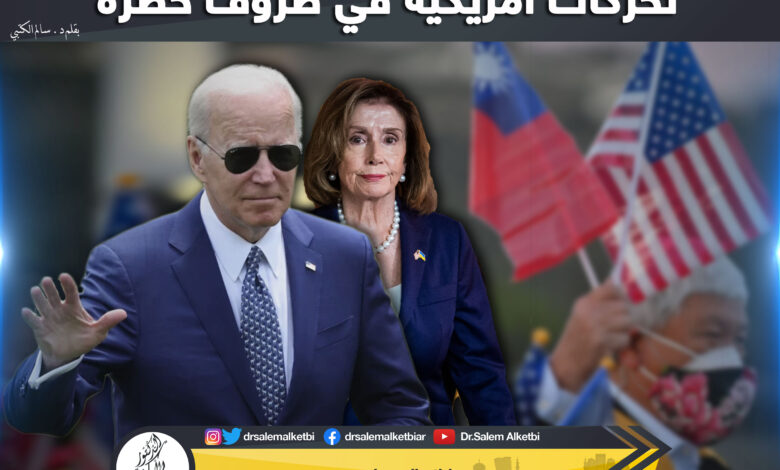
The repeated recent US actions toward Taiwan cannot be viewed separately. They cannot be called spontaneous. Rather, a more accurate conceptual characterization is provocative behavior that pours oil on the flames of escalating international tensions and raises serious questions about Washington’s intentions and goals behind these actions.
Until recently, many believed that US House of Representatives Speaker Nancy Pelosi’s visit to Taiwan in early August had taken place without coordination or a green light from President Joe Biden.
Some have dismissed the rationale for the visit as a personal move by the top Democratic lawmaker in the US House of Representatives to claim a qualitative political victory ahead of the midterm congressional elections as the highest-ranking US official to visit the island in 25 years. But a series of visits by members of the US Congress a few days later is worth pausing for.
And not just those visits, but also the passage of US Navy ships through the Taiwan Strait, provoked China’s outrage. The US Seventh Fleet described this as a reaffirmation of the US’ commitment to free passage through the Strait. These carefully calculated US maneuvers, no observer can disregard, are definitely not in the interest of global security and stability.
It is complicated to repeat such actions and for Washington to expect the same response from China every time – restraint and cautious handling of the situation. China is not the country it was two or even a decade ago. Rather, it has amassed, and will continue to amass, elements of overall power and the US understands this well.
It is therefore difficult to put much stock in China’s strategic patience in dealing with such crises. Repeated Chinese threats are not heeded any longer, as the US continues to increase pressure on Beijing and undermine its image and reputation as an emerging international power.
This is markedly different from the calculated pressure exerted by previous US administrations, including the Trump administration. The US is taking imprudent risks under Biden. There is a growing global belief that US foreign policy is becoming more impulsive and reckless than under Trump.
The continuation of military support for Ukraine while sacrificing the interests of European societies facing the worst energy crisis in modern times, and the excessive practice of brinkmanship in the Taiwan case, despite all the sensitivity of the international environment, which would not withstand any other war of heavy caliber, are examples of this.
It is well known that there is an attempt in American circles to rev up the pace of strategic confrontation with China, or at least to persuade it to withdraw from supporting Russia and to exploit China’s desire to continue its development path without falling into the trap set for it.
The fact is that staving off a confrontation with China is in the latter’s interest and weakens the US chances of maintaining its role as the dominant international power. Pelosi’s visit and other moves are therefore only a prelude to provoking the Chinese dragon to abandon its caution and engage in a military conflict that will exhaust its growing strength.
This explains why these moves will continue for the foreseeable future. Of course, it cannot be said that the Biden administration is unaware of the current international situation and its sensitivities. He opened his term by announcing the comeback of the US.
But he seems to have a different subjective interpretation of this return. The US is indeed back. But they are again provoking crises and driving wars and conflicts instead of calming them.
China, for its part, has so far managed the crisis over Pelosi and others’ visit to Taiwan and brought things under control. And it has not allowed itself to be provoked. That is par for the course in Chinese culture.
This Confucian wisdom has spared the world from a crisis more serious, influential, and profound than the crisis in Ukraine. The US should be aware that it is rapidly losing its standing in the world. It is no longer about being a responsible power acting within the framework of international law and principles, but about being a guarantor, even in theory, of that law and those principles.
But it is gradually slipping into a position that makes it a threat to international peace and security in the eyes of many. This contributes to and even accelerates the spread of chaos and unrest in the world. Perhaps the escalation of conflicts and crises we are witnessing in various countries and regions is a wake-up call to the danger of the next stage in international relations.
Everyone is aware that the potential threats are no longer limited to traditional and non-traditional sources, as recognized by most experts, but are also about a lack of control over the world order. This tempts many in the world to violence and fuels new conflicts, wars, and tensions.