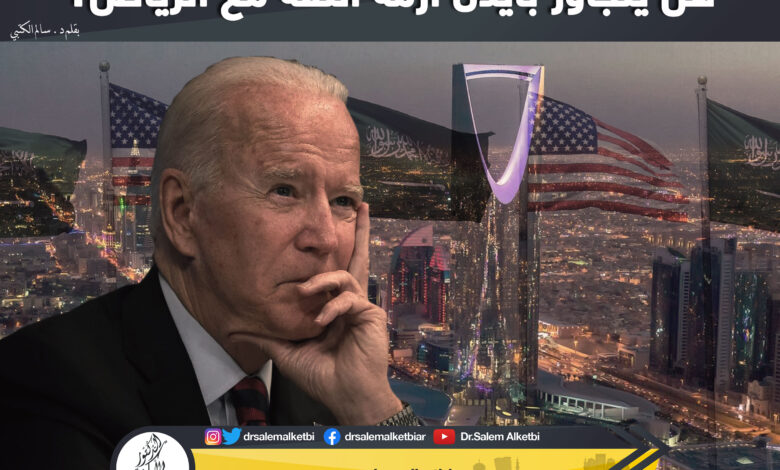
President Joe Biden, who is preparing to visit Saudi Arabia in the middle of this month, put relations between his country and one of its most important strategic allies to the test when he made commitments that everyone knew from the start would have strategic implications primarily for the US and not for the other side, Saudi Arabia.
The evidence suggests that the Middle East is changing at an accelerated pace.
Saudi Arabia, with its young Crown Prince Mohammed bin Salman, is in the process of designing a new strategic reality, turning a new page in its relations with Turkey and renewing the path of partnership between the two countries, strengthening relations between his country and the countries of the region to reduce tensions and calm the regional atmosphere, as well as increasing interdependence between the countries of the region in achieving security and stability, in the face of the ambiguity of the US withdrawal from the Middle East.
This has led many observers to conclude that a new strategic reality is emerging in the Middle East that does not include America.
Ironically, President Biden’s policies based on a negative attitude toward Saudi Arabia have encouraged Saudi efforts to accelerate diversification of international partnerships and create a system of interdependence among other partners in the Middle East and internationally.
This has contributed to Saudi Arabia becoming an influential force in international politics and decision-making after the outbreak of the Ukraine crisis. It is not just about energy policy. But also about partnerships, alliances and trade exchanges with other international powers such as Russia and China.
Against this backdrop, President Biden’s upcoming visit to Saudi Arabia appears to be a historic event that some are calling a US rush toward Riyadh. Some see it as a pivot to correct the mistakes of US foreign policy. But I see it as an attempt to move beyond a period of American miscalculation.
What happened was not a mistake that can be corrected or forgotten, but a catastrophic misjudgment of the importance and weight of the partnership between Washington and the Gulf states. The chief executive and his presidential staff misjudged the situation because they thought the Gulf partnership was all about oil.
This, of course, was not just a misjudgment of US policy, and anyone who surveys the literature of recent years from specialized US strategic research institutes can easily conclude that this very “idea” dominated the thinking of the US political elite to a degree that can be described as hysterical. The Gulf is not just about oil, in fact.
But what has happened in Saudi-US relations already since President Biden’s arrival in power was a unique opportunity for Saudi foreign policy to change the rules of this historic partnership according to a new strategic reality and the leadership’s vision of Saudi interests in the 21st century.
This turned what some saw as a challenge to Saudi policy into an opportunity that Saudi Crown Prince Mohammed bin Salman took full advantage of to advance his country’s interests by building a broad network of international relations in such fields as the economy, trade, investment, and energy.
The main issue is that the capitals of the GCC countries are no longer firmly convinced of the US commitment to the security of its allies in these countries. Doubts precede any declaration of commitment by the US. Simply put, there is no longer a link between actions and words, between what is announced and what is done.
The entire partnership formula is now in the crosshairs of revision and rethinking by Gulf countries. Historically, this is an opportune time for Saudi Arabia to rethink its policies and alliances, without implying a rupture of the historic alliance between Riyadh and Washington.
What has happened has been a clever use of the field of political maneuvering that has resulted from Washington backing down in its relations with Riyadh, believing it could pressure and bend it to its will, unaware of the new strategic changes and facts that have occurred on the international stage, whether as a result of the coronavirus crisis or the outbreak of the Russian war in Ukraine.
Saudi Arabia and the rest of the Gulf Cooperation Council (GCC) certainly have no reason to abandon their historic strategic alliance relationship with the US. The issue is not a change in policy by these countries, but a divergence of democratic/republican views at the US level. To be sure, the ball is now in President Biden’s court.
His upcoming visit to the Kingdom is a critical juncture for Saudi-American relations, at least for the remainder of his presidency.
The outcome of the visit will be a key indicator of his ability to overcome the existing crisis of confidence, address the fallout from the past era, and engage with a Saudi partner commensurate with the importance of this partnership and the magnitude of the challenges shared by the two countries.