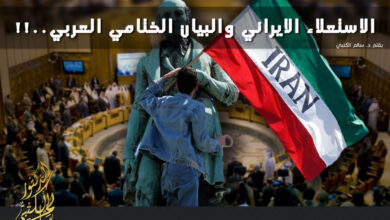
In Iran, the people who take power and hold high positions may vary. But they all agree on what they see as the constants of foreign policy, which the Supreme Leader draws.
At the forefront of these constants is the position on the occupation of the three Emirati islands (Greater Tunb, Lesser Tunb and Abu Musa). Here, Iran’s position is rigid, ignoring the legitimate rights of states, and insisting on continuing to occupy the territories of others, despite the full realization that such a policy is one of the most important obstacles to the existence of normal relations throughout the Gulf.
Historically, Iran’s political discourse towards the three occupied Emirati islands differs only in the vocabulary and the manner of expressing what the mullahs consider a firm position on this issue that affects the sovereignty of a neighboring state.
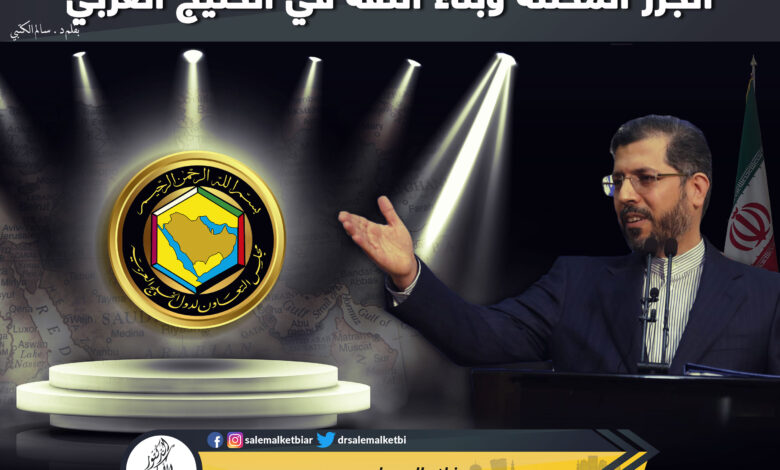
“The three islands definitely belong to Iran,” Foreign Ministry spokesman Saeed Khatibzadeh said in response to a Gulf Cooperation Council (GCC) statement on the occupied Emirati islands. “Issuing repeat and jejune statements will not change the reality: they are Iran’s forever,” he added.
“The GCC should know that its unacceptable claims and false accusations against Iran, as well as repeating outdated issues, are not the solution to regional problems as well as those of these countries.”
“The region needs to change the perception of dependence on the outside towards constructive treatment among the countries of the region and adopting an understanding vision rather than an exclusionary one.” As if the occupation could gain legitimacy over time. This is, of course, a flawed vision and contrary to international law.
There is the conscience and memory of societies that cannot give up any part of their territory occupied by others. This Iranian tone in dealing with the issue of the three occupied islands or in the official positions issued by the GCC confirms that nothing changes in Tehran.
And this is regardless of attempts to improve the image and make “public relations” statements that promote ideas totally contrary to Iranian behavior on the ground, such as talk of “good neighborliness” and “regional cooperation.” The mullahs have an egocentric understanding of these concepts that strips them of their true meaning.
Quite simply, Iran believes that maintaining regional security involves dominating the countries of the region and imposing its hegemonic influence on the foreign policy of neighboring countries.
Iran wants to be the gendarme of the region, which would mean a diminution of the sovereignty of these countries and their right to build networks of strategic relationships, alliances, and partnerships that serve their national interests. The mullahs start from a condescending view that does not correspond to the reality of things, nor to regional power relations for that matter.
They see their regional neighborhood in a narrow vision that does not take into account the changes that have occurred in recent years in various areas of national power.
Such a vision also ignores international laws and conventions based on well-established principles that are supposed to be respected by all states, foremost among which are the right to sovereignty, good neighborliness and non-interference.
Curiously, every new Iranian regime, despite having no elegance in foreign policy making, begins by repeatedly referring to its desire to strengthen relations with neighboring countries.
“Some Gulf countries, which seek to impose their anti-Iranian views on other countries and try to receive support from countries outside the region, should instead focus on regional talks and confidence building to support diplomacy in the region,” the Foreign Ministry spokesman also said. These insinuations are, of course, targeted.
Yet Iranian politicians overlook the reasons for what they see as hostility from some GCC countries toward Iran. They ignore that this is not the Iran of the people and history, but the Iran of the regime. The GCC states are well aware of the need to respect geographical calculations and the importance of normal geopolitical and geostrategic relations.
However, these convictions cannot be translated into reality in the face of repeated attacks on the sovereignty of these countries: by occupying their territory as is the case with the three islands of the Emirates and interfering in the affairs of these countries, as has happened repeatedly in Bahrain, or by arming sectarian militias that attack the vital facilities of neighboring countries, as has happened with the Houthi group in Yemen.
Certainly, trust cannot be built on the ashes of realities. Clarity and candor are indispensable foundations for preparing the climate for dialogue, cooperation, and whatever else is necessary to achieve security and stability. All this has nothing to do with the great powers or the alliances between them and the GCC countries.
Iranian behavior is the determining factor in the trust equation. Thus, Iran’s habitual rhetoric on the occupied islands of the UAE, and rejection of any political or legal alternative or solution to reach a just settlement, reflects only the intransigence of an arrogant regime over its regional neighborhood, which expects others to submit to its tight-lipped vision.
Ultimately, ensuring stability in the Gulf region begins with removing the causes of tension. It is not about imposing the visions and beliefs of one side or the other, especially on the issue of the Emirati islands.
The UAE has already proposed rational solutions, either direct dialogue without preconditions and within a specific timeframe, or referring the whole issue to international arbitration. But what is happening is that Iran is hiding behind a position that has no legal basis. It seeks to impose a fait accompli and this is just a characteristic of a hegemony from the old colonial era.