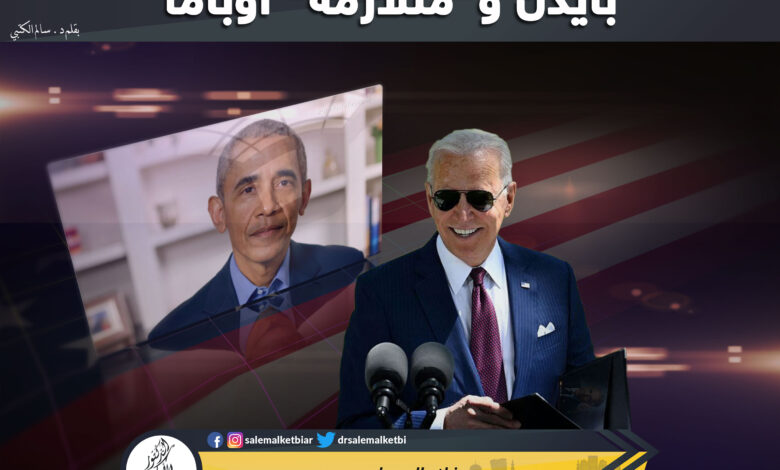
President Biden’s foreign policy hardly comes up in conversation unless the policies and leanings of former President Barack Obama are mentioned. Some reports even suggest that Obama is not that far from policy-making in the White House right now. It is almost as if Obama is a backstage president.
This may not be an issue for administration officials. But it is certainly of concern to many others, both East and West. US policies during President Obama’s two terms made catastrophic mistakes that cast a long shadow, including the nuclear deal signed between the P5+1 group and Iran, or JCPOA.
Former President Obama’s shadow lingers in the current US administration. Key figures in this administration were part of the Obama-era White House. The current president served as his VP for eight years.
There is every reason to believe that the current US administration is replicating Obama’s policies or taking a similar approach, especially on issues such as the Iranian nuclear question. President Biden himself seems to think about this.
Case in point, since winning the election last November, he has been at pains to say that his presidential term will not be “a third term” for former President Obama. “We face a totally different world than we faced in the Obama-Biden administration,” he said, adding that former “President Trump has changed the landscape” but made “America alone” instead of “America first.”
However, White House Press Secretary Jen Psaki has said in the past that President Biden consults regularly with his predecessor Barack Obama. Obama discusses a variety of issues with Biden.
Biden and Obama have maintained regular contact, Psaki said. But she did not say exactly how often the two presidents would talk. She expected the consultation to continue during Biden’s presidency. Former President Obama, meanwhile, said in a television interview that President Biden “doesn’t need my advice,” saying he will help him in any way he can.
In all fairness, presidents take advice from their predecessors – an old tradition that only Trump had not kept up with.
US presidents typically benefit from former presidents’ experience, whether in dealing with some tough matters, as happened when then former President Jimmy Carter played an important diplomatic role on some issues, as well as Eisenhower’s role in advising then President John F. Kennedy in the Cuban missile crisis.
Indeed, the strong working relationship between Obama and Biden is undeniable. They worked together for two presidential terms, eight years as president and vice president, from 2009 to 2017, so it’s only natural that the White House press secretary describes them as friends. And that’s despite their “their differences in temperament and in approaches to policy-making.”
The description is not further from the truth. Obama said in 2017 that they had a “bromance,” and Biden offered him a “friendship bracelet” in 2019. Now, Biden’s real problem lies in the specific handling of the Iranian nuclear issue. From the start, he wants to do more than just veer from Trump’s policy on the matter. And he sure doesn’t want it to be a follow-up to Obama’s either.
But everything points to it being a continuation of this policy for the simple reason that all the current main actors involved are former champions of this policy. They cannot look beyond their previous positions or acknowledge, explicitly or implicitly, their shortcomings and inability to achieve their goals.
Moreover, there is every indication that the Biden administration has fallen prey to Iranian manipulation and manoeuvring, as it was champing at the bit for dialogue and negotiation faced with the conspicuous intransigence from the Iranian regime’s representatives in Vienna.
Biden says he walked into a different world than that of Obama and Trump. Yet he is playing by the same old book, without accounting for the geopolitical changes in this world. This leaves a lot of room for ambiguity and speculation about his intentions not only towards the mullahs’ regime, but also towards America’s historical allies and partners in the Middle East.
The predictable outcome here is that it will be hard to live up to his stated primary goal of restoring US standing and global influence. There are more important indicators for me, as a Gulf observer, to size up how much different Biden and Obama are, such as the White House’s position on Middle East allies.
Here in particular, we notice much similarity, not to say conformity. There’s a tendency to reduce US commitments to its Gulf partners. A deep rift exists with Israel as well.
It is a disagreement that the Biden administration is trying to put in the context of relations with Prime Minister Netanyahu and not with Israel. But the views of senior Israeli leaders on the US going back to the Iran nuclear deal are in line with Netanyahu’s. This reminds us of the gulf that ran through Israeli-American relations in the last year of Obama’s tenure.
As it turns out, Biden has no problem following the footsteps of former President Obama in terms of approach and policies. Biden was not far away when those very policies were being drawn up. He wasn’t just there to execute. He was a key partner in shaping it as an eight-year vice president. The real problem, then, is what is likely to come between the US and its traditional allies in the Middle East throughout in the Biden era.