It is safe to say that the Iranian mullahs’ regime has reached a point where it has become a real strategic problem for regional and international powers. The obvious bottom line is that this regime is now moving out of the orbit of international order and law. It is on the road to joining the ranks of states whose behaviour is extremely unpredictable.
As a result, it is even more difficult to confront it and contain its threats. The danger of the mullahs’ regime is compounded by the fact that they persist in their behaviour taking advantage of two unfortunate contexts.
The first is the fractured position of the major powers on the threat posed by this regime, detrimental to security and stability in the Middle East and the world at large.
Second, the superpower that holds sway over international decisions – the United States – does not have effective alternatives and strategic options to dissuade this regime from defying the global community’s will.
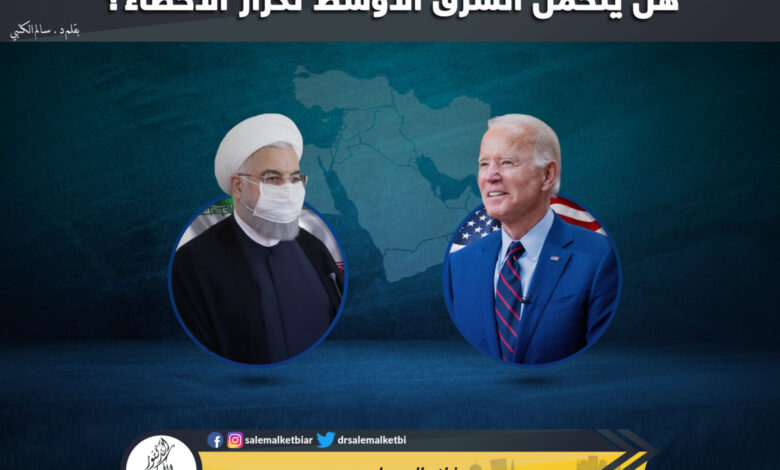
Before anything else, it is worth saying that no one disagrees with President Joe Biden’s approach to finding a way out of the Iranian nuclear crisis through diplomatic means. No one in the region really wants to see a flare-up in such a strategic region for the entire world as the Gulf.
That being said, diplomacy has historically failed to persuade suicidal regimes such as the mullahs’ to respect this approach and subscribe to a no-winners-or-losers logic by accepting fair negotiating rules.
No one doubts that President Biden and his team understand the Iranian ideology and attitude, given past political experience. But it is fundamental that the United States take the opportunity to consult with friendly nations on finding a third was—between the options of war and no return concessions—to deal with Iran’s mullahs.
It is worth noting that President Baden has so far not spoken much with most of the leaders and heads of state allied with the United States in the Gulf and the Middle East. The US is supposed to share ideas, discuss all alternatives and suggestions, and express its foreign policy intentions on the most important issue of concern to its allies.
What worries me most as an observer and researcher of the Iranian question is the bromide that US officials are giving Iran’ mullahs. No, this language has nothing to do with the positive signals one finds in ordinary international relations. Rather, it is a kind of wheedling. Enough for one Arabic newspaper to call this approach “mullah pampering.”
Perhaps the recent statements by US envoy to Iran Robert Malley are the perfect illustration. In his remarks, he expressed a desire to engage in a dialogue that would satisfy Tehran. In an interview with BBC Persian, Malley explained that the US has come to realize that sanctions against Iran create a problematic situation. The US is not sold on the sanctions, which he described as a failed policy.
“What we’d like to do is talk to Iran in whatever format the Iranian government is comfortable with, to get to the position in which we can lift those sanctions in compliance with our commitments under the deal.”
One thing is true, these statements may be targeted and deliberate, particularly through the channels through which they were made. They seek to satisfy the ego of the mullahs and provide them with a media victory and fictitious propaganda by recognizing the failure of the policy of maximum sanctions, maybe. This may be true even though this admission is totally contrary to the reality, which suggests how much Iran has lost as a result of the sanctions.
But these US political tactics are not at all appreciated by the mullahs. They see them as a sign of weakness in the Democratic administration. This is why they are getting tougher and more exacting in their demands. This explains how they have rejected all the proposals for negotiations launched by the European mediators agreed to with the United States.
Surprisingly, the tone of the American official, who is probably the most familiar with the thinking of the Iranian leadership in President Biden’s team, was softer than that of French President Emmanuel Macron. Macron called on the mullahs to act responsibly and not to escalate the nuclear deal situation.
The problem with the Biden administration’s Iran strategy is that, so far, it is modelled on former President Barack Obama’s approach. Obama approached the mullahs with soft words to reach a nuclear deal without heed to the security and stability requirements of US Gulf allies.
A warning is in order: things are going to get out of hand in view of this new US search for a way to the negotiating table with the mullahs. Geopolitically, the Middle East is not the same as it was in 2015, and the consequences of the painful experience brought about by the nuclear deal signed at that time are there for all to see.
The scale of the dysfunction and chaos caused by Iran’s military expansion is unmistakable. Nor is it a mystery that the fragile situation in this part of the world makes it an explosive environment that will not tolerate further strategic mistakes in dealing with risk factors.