Iranian leaders are trying to calm anger in Iraq and Lebanon. They fear losing their growing sectarian influence, and with it the allegiances that have developed in several Arab countries in recent years.
However, under the current circumstances, what the Iranian regime fears most is the realization of the domino theory. Due to the similarity of causes and factors of protest and popular anger, demonstrations of revolt may cross the border between Iraq and Iran.
In Iran, the situation is much more serious than in Iraq and Lebanon. Because of its policy, the Iranian regime has been subjected to the most severe American sanctions in history. The regime has pledged to spend generously and waste the resources of the Iranian people in the sectarian militias of the Arab region.
A recent report by the US State Department ranks Iran as the world’s leading country that supports terrorism.
State Department Counter-Terrorism Coordinator Nathan Sales told a press conference dedicated to the 2018 US report on terrorism that the Iranian regime had spent about $1 billion to support its agents in terrorist groups.
During a year of US sanctions, Iran’s sales fell from 2.5 million barrels to 120,000 barrels, US special envoy to Iran Brian Hook said in an interview with Al Arabiya TV. He added that the sanctions have caused the collapse of the oil sector in Iran. “The Iranian regime is economically weak today because of the sanctions compared to the situation two years ago,” Hawk said.
The sources of popular anger in Iran have not been addressed. They remain in the ashes of silence for fear of the brutality of the Revolutionary Guards. In recent years, the Revolutionary Guards have repeatedly and iron-handedly pursued the opposition and persecuted those who oppose mullahs’ policies.
Last year, some 150 Iranian cities witnessed mass anger, protesting against the deterioration of living and economic conditions. Today, the situation is worsening due to the impact of US sanctions that are almost ending Iran’s oil exports.
In June, the World Bank revised its forecast for the Iranian economy for the third time in 2019 as part of its assessment of the world economy. Iran is at the bottom of the list ahead of Nicaragua, with a negative growth of 3.6%, then adjusted to 4.5%.
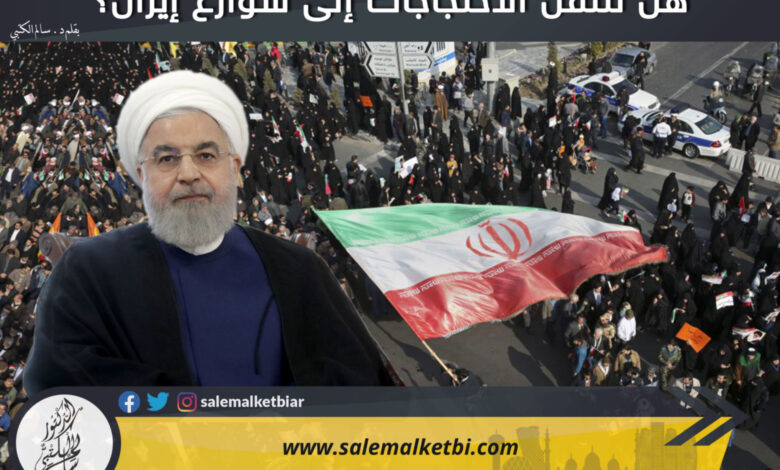
The question is now: Will popular protests spread to Iran?
The answer is difficult to establish given the difficulty of predicting the dynamics of the anger of the peoples of the Middle East in recent years.
Several scenarios can be noted, including the high probability of the transfer of demonstrations of anger against the mullahs to the Iranian street, especially if Iraqis and Lebanese succeed in meeting their demands and encouraging their states to adopt policies of reform, reducing corruption and prosecuting corrupt people.
The mullahs’ regime still treats the outside world differently. The regime’s view of the anger in Iraq and Lebanon at destructive sectarian policies will inevitably change if there are protests in Iran.
The mullahs know that it is very likely that their regime will collapse as a result of the fragile economic situation. The regime can fall apart at any given point in time. Thus, it responds to any manifestation at the current level of the most serious violence and cruelty, especially at the beginning, to deter other Iranian cities from joining the movement.
In addition, it is equally likely that the mullahs’ regime, in the presence of signs of an outburst of popular anger, could trigger a major external crisis to divert the attention of the Iranian people and the world from internal crises. The mullahs, in their current state of mind, could launch a regional military adventure to divert the looks of the world.
In conclusion, the explosion of the Iranian street has become a possibility. The situation in Iraq and Lebanon is escalating and the regime’s sectarian policies are failing in both countries. Billions of dollars have been spent to strengthen Iran’s expansionist regional influence.
However, the mullahs’ regime, which is in a disastrous suicidal mood, risks bringing further crises to the region in an attempt to escape the debacle and confrontation with the Iranian people.