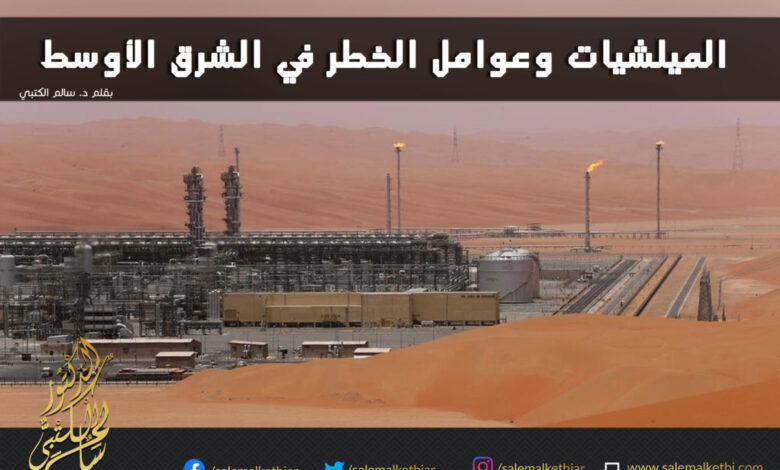
The terrorist attack on the natural gas plant in the Shaybah oil field in Saudi Arabia “is a serious threat to the world’s energy supply.” The UAE did not overstate when it said as much.
The attack represents an unprecedented development in the level of risk posed by the proliferation of armed sectarian militias in several countries in the Middle East. The militias that operate on a foreign agenda are behind chaos and unrest in all the conflict-ridden countries, in Libya, Syria, Iraq, and Yemen. Militias have become the virus that is gnawing in a dilapidated body. The virus has caused not only the collapse of states but also waves of migration and asylum for millions of people. They do not yet know their fate and are putting pressure on the economies of many countries of the world.
It is now clear that the militias are seeking to replace the national state in some countries of the region. This is confirmed by the recent speeches of Hassan Nasrallah, leader of The Lebanese Hezbollah. Nasrallah has issued threats of war and joining regional powers such as Iran in the event of foreign military strikes.
In the face of his threats, the Lebanese state is completely absent. The militia leader spoke without taking into account which country the militia belongs to. The militia engages in foreign policy and international relations in disregard of the state.
The same thing is happening in Yemen. The Ansarollah militia acts like a state within the state. It attacks another country without considering the consequences of this behavior and its effects on the Yemeni state. Not only did it attack Saudi Arabia, but in the recent incident it went on to attack a strategic facility that is closely tied to global energy security. It is as if Ansarollah were carrying out the instructions given to it by the leaders of the Iranian Revolutionary Guard.
The common denominator of these middle-eastern militias is the Iranian regime. It turned these militias into sectarian military arms acting as surrogates serving its expansionist agenda—it cares not about the sovereignty of the Arab states to which these militias belong, or international norms and laws for that matter.
The Middle East has become a model of the enormous threat and challenges facing every nation-state. It is as if the fate of Middle East is the militias, to the extent that talking about the national sovereignty in some of its countries has become kind of absurd.
Certainly, Ansarollah would not have dared to carry out this attack without the right factors and circumstances. One is international inertia and silence in the face of successive attacks by these militias with missiles and drones on vital civilian installations inside Saudi Arabia. Two is the international silence on the practices of the Iranian regime, which threatens day and night to use its sectarian arms to undermine security, stability and stoke fires in the Middle East.
It makes threats unchecked, as no single condemnation or fleeting statement from a UN official to warn the mullahs’ regime against tampering with regional security and stability.
The Iranian regime knows that employing the Houthis in its conflict with the world is an important pressure card. Its plan is to break the blockade and international isolation and dodge the economic collapse brought by U.S. economic sanctions. The regime knows that targeting oil installations in Saudi Arabia is an important pressure card not only against Riyadh, but against all international powers. Unfortunately, these practices are only faced by further concessions and normalization of bullying and violation of international laws.
The international silence and wait-and-see in our region does not necessarily mean maintaining a minimum level of calm; it can help ignite a raging war. Such a military conflict could badly affect the global economy, which is already reeling under the weight of the trade war between China and the United States.
Continuing global silence therefore portends a strategic catastrophe. These militias and their warlords are unaware of the consequences of their insane actions and their complete submission to orders and instructions issued by the Iranian Revolutionary Guard. As long as the Iranian regime is under U.S. sanctions, the IRGC risks igniting a conflict that might hurt everyone.