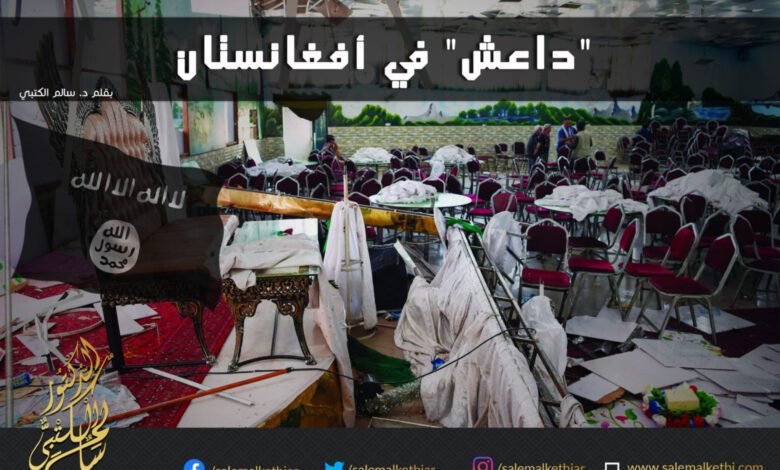
Daesh has returned to the center of the news and events. The terrorist organization committed a bomb attack during a wedding in Afghanistan. Dozens of innocent victims perished in this criminal attack. It seems that this barbaric suicide attack has no other purpose than to spread terror and send a strong message that the group still exists in Afghanistan.
This style, as specialists know, is typical of Daesh; it had followed it in the early days in Iraq and Syria. It targets civilians and undermines security and stability, spreading terror in as large an area as possible, in order to discredit the security authorities.
Then, in the absence of the State, it is responsible for controlling the chaos resulting from its practices. Then he began to carry out the first stages of his project by applying the theory of “management of savagery.” The theory serves as the intellectual and organizational basis for the organization’s activities over its various life cycles.
After the fall of his supposed state in Iraq and Syria, Daesh came to realize that it was urgent to prove that he was able to resume action. The coming period will probably be marked by intense activity in several “test” areas. We are talking here about Libya, Afghanistan, and perhaps Yemen and other regions affected by chaos, insecurity and the collapse of state power under the yoke of sectarian conflicts and the scourge of armed militias in these countries.
The eye of an observer cannot overlook some of the revealing elements of the suicide bombing in Afghanistan.
First, negotiations resumed between the Taliban and the United States, which are in the final stages of concluding an agreement to end the nearly two-decade-long US military presence in Afghanistan. Daesh sees the potential for a security vacuum as a result of the withdrawal of American forces, which the organization will exploit and expand. It will then enter into a possible conflict with the Taliban and Afghan government forces.
Second, the recent terrorist attack took place in a Shia-majority region of Afghanistan. Daesh has already practiced this type of criminal method in Iraq, igniting a sectarian conflict with an attack against the Shiites to provoke a counter-reaction and provoke confrontations. The confrontations would be used to recruit members of the Sunni population to join the organization. This practice therefore risks undermining the Afghan government’s efforts to establish security and stability and eradicate sedition factors in a country that has suffered for decades from many wars and conflicts.
Daesh’s danger is not as easy to get rid of as one could imagine. Abu Bakr al-Baghdadi made a recent appearance in May, revealing the organization’s continued “jihad” and promising to wage an attrition war against its “enemies.”
These battered organizations do not give up; their ideology differs from that of States. They feed on the so-called “jihad” and their members derive their sources of funding from persuing their ideas, either on self-interest, or under the guidance of entities with transnational interests or by convergence of the objectives of these two parties, which is often the case.
Afghanistan is a vital focus for the organization because of weak development, lack of state control and Taliban’s grip in many areas. It is also expected that the group will find support from several foreign actors who have an interest in both curbing the influence of the Taliban and using this organization as a scarecrow in the game of nations and the strategic conflicts that have Afghanistan fell into for decades.
Certainly, Daesh has no religious or political “ideas” that can be debated or refuted. It is a parasitic ideological organization dedicated to violence and carnage, and recruits dissatisfied young people in search of glory and odd life. It is not like previous generations of terrorist organizations; it is particularly hostile to everyone. The group has a blind conception that goes against morality, civilized human life, and is hostile to all nations, societies and religions, even though it has taken Islam as its slogan. Its ideologues see only their own interests and dreams of a so-called caliphate that they build on ruins and where they allow themselves all forbidden things.
History has seen such absurd ideas, and there is no other solution than to wipe them out once and for all through strict security control in conjunction with mitigating such factors as underdevelopment, poverty, social injustice, corruption, and joblessness. These conditions have pushed these thousands from dozens of countries to become Daesh members. The Muslim world is not the only one concerned. Scores of young Muslims from Western countries have joined this group in Syria and Iraq for reasons that warrant study.
Even though Daesh was defeated militarily in Iraq and Syria, the idea it holds is still alive under the ashes. Maintaining their existence is the very essence of terrorist organizations.
They have the ability to trim their sails to suit different environments.
According to estimates by the security services, the number of elements of this organization, which spread after the disintegration in Syria and Iraq, varies from 20,000 to 30,000 fighters. They did not return to their countries of origin for fear of being prosecuted and imprisoned. In addition, its cells have spread to areas such as Libya, the southern Philippines and Afghanistan.
Applying pressure and pursuing Daesh in all countries and regions of the world is of utmost concern for global security and stability. Even if its so-called state is gone, its violent ideology may always linger.