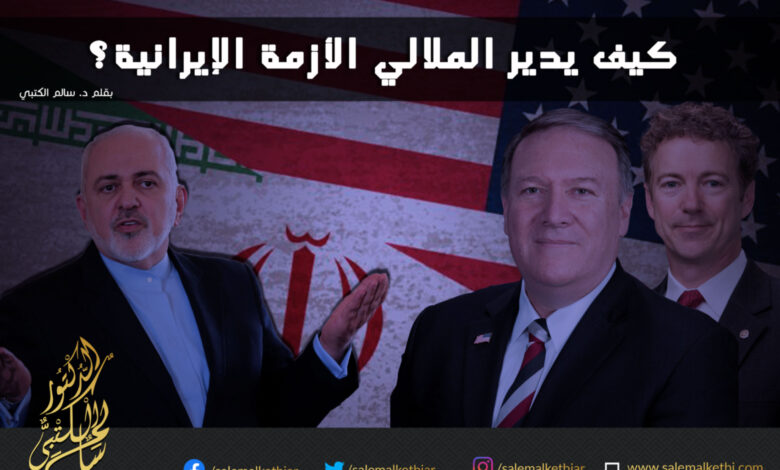
The United States called for direct and indirect negotiations with Iran through Secretary of State Mike Pompeo, Republican Senator and Senate Foreign Relations Committee member Rand Paul in a meeting with Iran’ Minister of Foreign Affairs Javad Zarif in New York last month. But all demands were refused by the Iranian mullahs’ regime. However, this does not mean that the mullahs reject political solutions and prefer the military way.
The Iranian regime’s strategy is to go as far as possible in implementing the brinkmanship policy. They continue to play the finger-biting game against the Trump administration while keeping a grip on the crisis so it won’t spin out of control.
From time to time, they send occasional signals to confirm the desire for a political solution. One of the signals is the call by Iranian Foreign Minister Mohammad Javad Zarif to US President Donald Trump to reject what Zarif called the “thirst for war” of US National Security Advisor John Bolton.
Zarif equaled diplomacy with prudence, “not weakness,” in a kind of coded message to the US president that the Iranian regime will accept a political solution after it dug itself into a hole and brought down a US drone. This clearly tells how much the mullahs fear war. Nevertheless, they refuse to negotiate with the current conditions.
If the mullahs’ regime fears war, why does it not yet accept calls to negotiate its way out of the crisis?
The answer is simply that what is happening at this stage is a political conflict of will.
President Trump and the mullahs are trying to strengthen their position and improve the conditions of the negotiations by maximizing warmongering threats and draining each other’s energies.
The mullahs are not in a hurry either. The damage has already been done since the Iranian economy is on the verge of collapse, so there is no point in making any concessions at this stage. As a result, they view the resilience and threat of suicidal military escalation as a strong card that could lead the White House to rethink its calculations and change its political position.
For his part, President Trump puts his money on the idea that fearing economic breakdown will lead the Iranian Supreme Leader to give up and swallow the bait as he has done before when he felt great danger.
Against this backdrop, how will the two sides react?
If we are trying to understand their crisis management, it looks like both parties get cautious and avoid misunderstandings and escalation if the situation spirals into tension.
Tension can suddenly come with a decision from one of the parties, as with the shooting down of the US Global Hawk drone. The White House then exercised self-restraint and managed to promote its politically restrained position as avoiding Iranian civilian casualties. The White House thus set a new rule of engagement: if there were American casualties in any Iranian attack.
The Iranian side is doing the same thing. The Revolutionary Guard militias have received several military strikes in Iraq and Syria.
There was no immediate reaction though. The US-Iran confrontation is not limited to the waters of the Strait of Hormuz; it is also taking place in Iraq, Syria and Yemen. These battlefields may be of top priority to Americans than what is happening in Gulf waters.
The United States is seeking to limit the ability of the IRGC to threaten Israel’s security. This objective, it seems to me, is more relevant than other strategic ones, such as reducing Iran’s threat to maritime shipping in the Gulf.
The latter is an international objective shared by all regional and international powers concerned, while ending or reducing Iran’s presence in Syria in Iraq is a priority for the US.
All told, the mullahs’ regime is aware that it has little time to resolve its crisis through political means. The time available to do so will end with the US presidential election, after which President Trump, if he wins a second term as expected, will be free of any electoral constraints or promises. By that time, the decision to launch a military strike to subdue the mullahs will be easier than today.
Thus, the White House’s success in perpetuating increasingly severe sanctions against the Iranian economy until early next year will push the mullahs to change their minds and accept the negotiations. The condition for this is that the scenario is well presented in a way that does not embarrass the regime in the eyes of its supporters, at home and abroad.