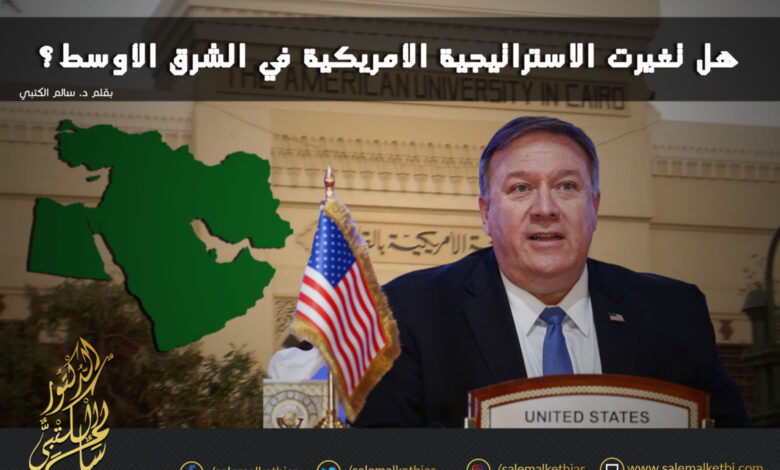
From the American University in Cairo (AUC), US Secretary of State Mike Pompeo delivered an important speech in which he presented the strategy of President Donald Trump’s administration in the Middle East. The speech outlined the US foreign policy for the next phase.
Pompeo stressed that his country would keep cooperating with its allies through “diplomacy” to expel Iranian militias from Syrian territory. He cited “Iranian regime’s aggressive adventurism” as a reason for the US commitment to support Israel’s military supremacy.
Pompeo also said the US vows to fight against terrorism, despite withdrawing from Syria, echoing what President Trump said in his visit to US forces in Iraq on Christmas. Trump had pointed out that the US military presence in Iraq fills in for the US forces withdrawing from Syria if there be need. In other words, the US can launch air strikes against terrorism from Iraqi territory.
Pompeo implied that Trump may order new missile strikes on the Syrian army in case it uses chemical weapons again. “He’s willing to do it again, although we do hope that he does not have to.” Clearly, the Trump administration is as much to deter Daesh as it is determined to pull out from Syria.
In a clever diplomatic move, the State Secretary used withdrawing troops from Syria as a pressure card on Iran, reminding that “America has always been, and always will be, a liberating force, not an occupying power. Can you say the same about Iran?”
Perhaps the US wants to use the legitimacy card to pressure Iran, seeking a UN resolution that views Iran’s military presence in Syria as an “occupying power.” This particular part, however, raises questions about the Russian and Turkish military presence in Syria.
Pompeo probably intended to send an implicit message to Russia and Turkey as well. Washington wants to list any foreign military presence in Syria as an “occupying power.” This diplomatic pressure card might appear strong, but the intertwining interests of the US, Russia and Turkey in Syria and, the comparable US military presence neighboring Iraq make it less effective.
The US State Secretary affirmed that Iran expanded the geographical scope of its military threat. Pompeo stressed that “The work to curb the regime’s deadly ambitions isn’t confined to the Middle East,” calling on all countries to cooperate to counter the Iranian expansionism.
The message was likely for the EU, which has a different way to dealing with the expansionist Iranian project. The EU and the US sharply disagree on the Iran nuclear deal. Ever since the Trump administration was the first and so far only party to exit, the EU doubled down on keeping the deal from collapsing.
Pompeo also issued a warning to Lebanon’s Hezbollah that the US would not allow its military status to continue, especially with regard to Hezbollah’s deployment of rockets directly aimed at Israel.
Pompeo proposed mechanisms for the implementation of the strategic objectives he mentioned in his speech, including establishing a coalition comprising the US, the GCC countries, Egypt and Jordan. His call for Middle Eastern countries to go beyond “old rivalries” to confront Iran signals a US desire for a comprehensive peace between Arab countries and Israel, so that Tel Aviv would engage in efforts to deal with Iran.
Overall, Pompeo did not add anything to what the Trump administration had announced previously and what was said in meetings held between US officials and their Middle Eastern counterparts in the past few months, but his speech came as a formal declaration of the era of building a US-led alliance to confront Iran.
Pompeo’s speech outlined a new US strategy in the Middle East—involving all the countries of the region in an effort to counter Iran’s expansionist project—yet he did not link between the use of diplomacy to rid Syria of Iranian militia and the planned coalition, nor did he mention anything about how to reach the set objectives.
The main point in his speech is that the Trump administration takes the Iranian threat seriously and vows to counter it by working with its allies in the Middle East as President Trump shifts US foreign policy away from unilateralism to holding all parties responsible for their own security.
The difference between Trump and his predecessor, Obama, is that the current president does not want to put any material or military burdens on the US to defend its allies, favoring leadership from behind.
In the Trump doctrine, everyone should bear the financial and human costs of any new plans, although achieving such plans is not to the interest of the allies exclusively but also to the strategic interest of the US, given the importance the Gulf region and the Middle East hold inside the Beltway.