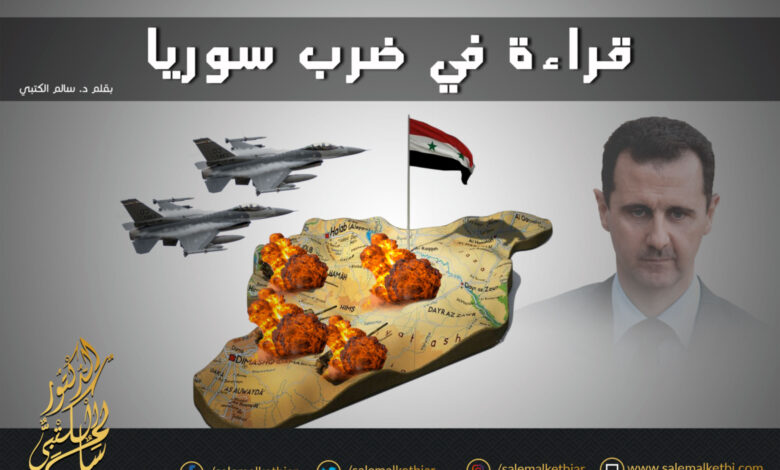
The US, the UK, and France launched a missile air strike on chemical weapons sites in Syria. Media outlets went to analyze the dimensions of the strike, its consequences, possible repercussions, and the reactions of various parties.
This strike made it clear that major powers are mainly concerned about media conflict and not politics. Leaders of major powers are keen to win the battle of media before that of missiles.
Trump’s tweets have become an engine of international politics. States’ leaders and military officials use traditional media to announce their positions. Politicians are merely interested in winning local and international support, regardless of the achievements on the ground. The attack revealed that US-Russian relations are stable and that there is no intention to wage a world war. The air strike denies a lot of media analyzes.
To ensure that the crisis did not escalate into confrontations between the US and Russian forces in Syria, US Defence Secretary, Jim Mattis, was a key player in determining the timing and objectives of the strike. Russia was informed of the list of targets without being informed of the timing of the strike. Hitting these sites did not harm the Russian forces in Syria. Russia leaked the information to the Syrian regime. The regime later left the facilities empty. The aim of the attack was to destroy Syrian capabilities that produce chemical weapons.
The air strike proved the failure of the UN Security Council to resolve the Syrian crisis. The Council was unable to take any decision over the crisis and has become an arena to exchange accusations among the representatives of major powers.
The strike came as an implementation of the US formula of doing anything, as Nikki Haley said. The US representative to the UN had earlier called on to take serious and fast decisions. Trump said missiles “will be coming, nice and new and ‘smart'” but he later used an unclear speech. The attack is an embarrassment to the Russian president. Russia’s envoy to the UN said the strike was an insult to President Putin. The message of the strike was not only military but also political. The future of Syria is not only an Iranian-Russian affair. Regardless of the balance of power on the ground, the US will decide Syria’s fate. Russia, being close to benefit from its heavy investment in Syria, won’t accept that.
The Kremlin feels insulted by the US, France and Britain. Britain’s determined participation in the attack is a challenge to Russia on the backdrops of Skripal scandal that is still intensified between the two countries.
How would Russia react? Russia won’t make any direct response but will carry out its mission in Syria. Taking into account the positions of relevant parties, Russia has discovered that Turkey is not a reliable partner in dealing with the West. In an unprecedented way, Ankara sided with the US position and welcomed the strike.
Any talks about a Russian-Turkish-Iranian alliance are an illusion. Turkey is experiencing unprecedented strategic confusion. Ankara wants to blackmail all parties and achieve Turkey’s interests.