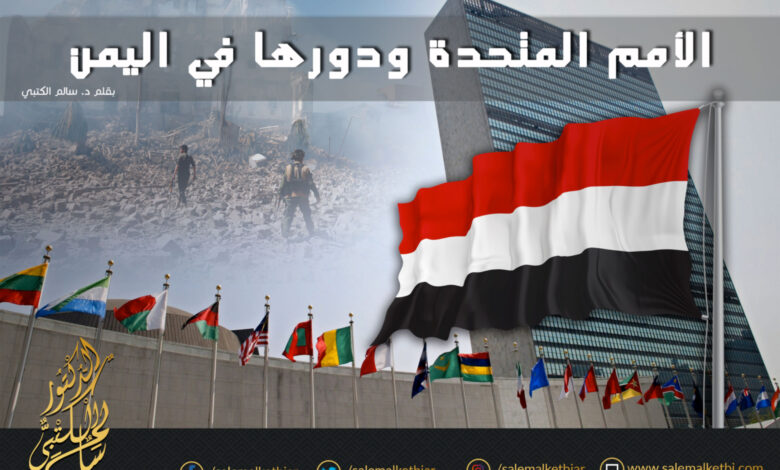
The position of the United Nations on Yemen appears to be a matter of confusion. The international organization and its staff deal with the situation with false equivalence, treating the same way those who provide support and assistance to the Yemenis out of fraternity and terrorist militia serving the agenda of an ambitious, expansionist foreign country.
International organizations should not operate without taking into account the context of the crisis, the motivations and efforts of each party to reach a political settlement, yet their reports on humanitarian situations, based on statements by anonymous sources and questionable statistics, cast doubt on their credibility and role as neutral mediators.
The Arab alliance is well aware of the humanitarian situation in Yemen, as evidenced by the huge assistance provided by the Arab alliance countries to Yemen. For example, between April 2015 and April 2018, the United Arab Emirates provided aid to Yemen about AED 13.82 Billion ($ 3.76 billion) to help more than 13.8 million Yemenis, including 5.3 million children. The United Nations has already praised the contributions of the United Arab Emirates and Saudi Arabia and their rapid humanitarian responses in Yemen. These contributions have supported about 7 million Yemenis a month in 2017. The UAE has provided $ 465 million of about $ 2.1 billion, the cost of the United Nations Humanitarian Response Plan for Yemen, as well as logistical assistance provided by the Arab allied forces to facilitate humanitarian assistance.
Last month, negotiations to reach a peace agreement in Yemen collapsed in Geneva after the Houthis refused to participate. However, the United Nations did not issue a formal statement condemning the Houthis’ decision, thinking that giving them time would help build trust and arrange a new meeting.
Because of the Houthi militias’ intransigence, unwillingness to peace and desire to control the fate of the country, millions of Yemenis suffer from hunger and poverty. Still the UN mission team in Yemen, known for its unfair treatment of the Arab alliance role, was given an extension by the UN Human Rights Council.
Indeed, the situation in Yemen needs more professional treatment by the United Nations human rights teams. It is inconceivable for the UN experts to equate State armies operating in accordance with declared rules of engagement to irresponsible, control-seeking militias.
Due to the complexity of the situation in Yemen, it is difficult for UN human rights teams to come up with firm conclusions just by visiting one or two anonymous witnesses. This led to the preparation of reports with questionable accuracy and in the interest of the Houthi Party to the extent that the Houthis are focused on the management of humanitarian crimes and hold their responsibility to the Arab Alliance, and we have all followed how to discover some United Nations headquarters were by the Houthi militias to hide, and how they use containers for humanitarian assistance in the transfer of arms, gear and other crimes and practices. The international teams, which overlook many of these practices, should be well aware of them. The recent vote in the Human Rights Council for the extension of the mandate of the United Nations Panel on Humanitarian situation in Yemen, is hurting the chances of a political settlement and encourages the Houthis to persist in their conspiratorial plot against the people of the brotherly Yemen.