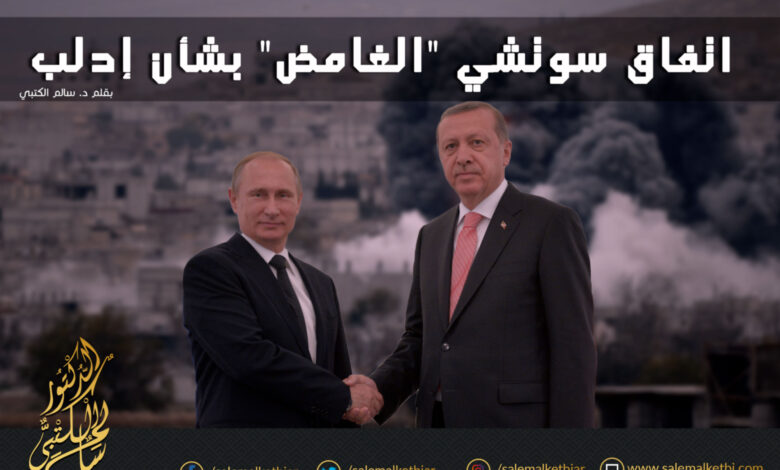
The planned military operation in Idlib has been postponed, sparing some three million Syrian civilians a humanitarian tragedy that was perhaps the most dreadful in the twenty-first century, but the bad news is that the Russian-Turkish agreement on Idlib governorate was vague and raises many questions.
Russian President Vladimir Putin said he agreed with President Recep Tayyip Erdogan on a demilitarized zone between the Syrian government and the opposition forces. Planned to be established in October 15th, the area will span over 15 to 25 km and be subject to security patrols by Russian and Turkish troops. The agreement also includes withdrawing all heavy weapons from the zone and that terrorist organizations, including al-Nusra, must stay outside the area.
This agreement may be a response to repeated international appeals on the need to avoid a humanitarian catastrophe if the Syrian regime launched a comprehensive military offensive to regain control of Idlib. Russian Defense Minister said that no major military operations to recover the territory will take place.
Official statements did not provide many details about the substance of the agreement. Surprisingly, Iran did not take part in the meeting. It is as if Russia wanted to make it clear that the Syrian crisis is a Russian affair and that Iran is no partner in determining the fate of the country after the civil war.
The Sochi meeting came after the failure of the trilateral summit held 10 days ago between the Presidents of Russia, Iran and Turkey, to reach a compromise. Observers concluded that the Turkish viewpoint failed at first before the Russian–Turkish agreement that came a few days later, and that adopted a different proposal from that of Iran, which was a proponent of military engagement.
Sure, there are important secret understandings reached between Presidents Putin and Erdogan. Russia has shared Iran’s perspective before it suddenly abandoned the idea of military action. Ankara’s proposals appear to have met a Russian desire to avoid a NATO “trap”. If military strikes are launched against the Assad regime, Russia would find itself in a very delicate situation of a direct military confrontation with the US-led alliance on the Syrian land.
Recent days and weeks have seen many shifts in attitudes, as Turkey has categorized the “Sham Liberation Authority” (formerly Al-Nusra) as a terrorist organization, to which the SLA responded by calling on fighting secular Turkey. The two sides have had an unspoken alliance since the beginning of the Syrian crisis, however.
Turkish calls to “avoid bloodshed” in Idlib collided with the Russian president’s determination to “liquidate terrorism definitively “. President Rouhani said “fighting terrorism in Idlib is an essential part of the mission of restoring peace and stability to Syria, but this should not be painful for civilians and not be guided by a scorched earth policy. ” Did the Sochi agreement reflect the will of the three parties to maintain their alliance in the face of a crisis that threatened this very alliance and put it into a difficult test?
More details about the nature of the demilitarized zone are needed. Will it be intended for Syrian civilians or will it be an outlet for terrorist organizations to exit the province and hand it over to the Syrian army? And then what? What is the fate of the terrorist organizations and how will the Russian goal of eliminating them altogether be achieved? Do these organizations accept the scenario of the transition from Idlib to the demilitarized zone in isolation from civilians who were used as protective shields against any military attacks by the Syrian army and its allies?
The vague aspects of the agreement are likely to be the subject of undeclared understandings, but there is certainly an agreement that the Turkish plan should be given a time frame so that the Russian strategic gains in Syria can be preserved and Moscow does not enter into a confrontation that may end up with other parties becoming key partners in determining the fate of Syria. The deal also serves Iran’s objectives. Tehran fears being targeted by a US military operation under the guise of responding to Syrian army attacks against civilians. The agreement also spares a massive refugee crisis that could have eliminated the remaining opportunities to save its economy and destroy the gains of the Turkish army from incursions into the Syrian territory.
Remarkably, the Russian-Iranian-Turkish talks reported over the past weeks did not include the Syrian regime or any Arab power for that matter.
The coming days may hold surprises, but they will inevitably unveil the details of this agreement and the understandings that have been made between the three powers now controlling the fate of the Syrian country and people.