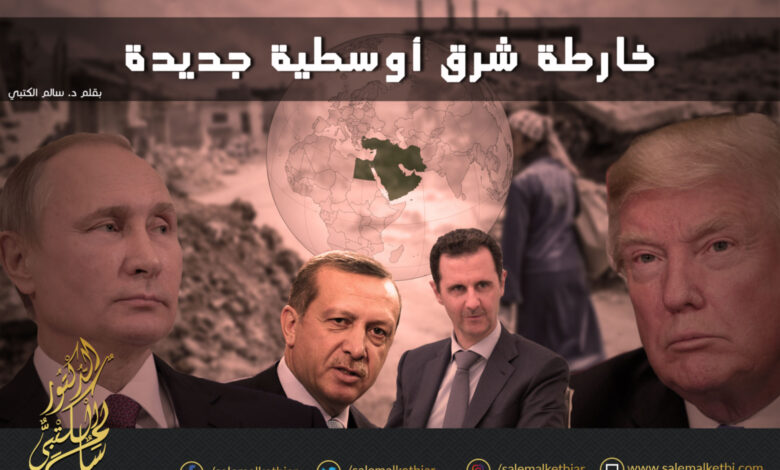
Developments in Syria are paving the way for a new geostrategic mapping in the Middle East.
The conflict in Syria will surely end. But this end will push for a regional and international geopolitical repositioning.
The Syrian crisis has put the relations between Turkey and the NATO at stake. President Erdogan called on the alliance to fulfil its responsibilities against the terrorist threat to Turkey.
“Hey NATO, where are you?” Erdogan said. He urged the NATO to come to Turkey saying it is a member of the alliance. We have always responded to your call to participate in wars in Afghanistan, Somalia and Lebanon, Erdogan said asking the NATO, why don’t you join us in our war against the terrorism that threatens our borders?
Erdogan’s call seems to be a fake one. The man tries to send a negative message to his people, a message that the NATO is not Turkey’s best partner, accusing the alliance of double standards. This will open the gate for Turkey to make new alliances with Russia and Iran and explains the new geopolitical redeployment in the region.
Turkish president’s statements reflect his disappointment with the NATO and its neutral stance concerning the Afrin operation in Syria. The Turkish army is facing a military dilemma in Afrin. Erdogan had thought the military operation would be an easy task but found the opposite.
Ankara is highly concerned with the recent controversial move by Washington in Manbij. The US army is not likely to leave the city, a fact that may lead to a clash with the Turkish army.
Erdogan has opened Pandora’s Box. His plans in Syria backfired, bringing interests of major international powers to Turkey’s borders. Over there, the focus has shifted from safeguarding civilians to protecting gas and oil fields. Also, Turkey became the number-one destination for refugees fleeing the conflict and fears of the future partition of Syria into spheres of influence.
Senior Adviser to Iranian Supreme Leader, Ali Akbar Velayati, said that “Iran must recover the costs it paid in Syria,” adding that the Syrians were “ready to pay with oil, gas and phosphate minerals.” Iran covers its malicious colonial ambitions with the pretext of defending the oppressed. The Iranian fake statements were unveiled when the moment of truth manifested itself like the sun in broad daylight.
The US insists on staying in Syria and promoting the Kurds as a new ally in the Middle East. The establishment of a Kurdish State is only a matter of time. The US is keen to confront the Russian-backed Syrian army, Iran and Hezbollah’s influence in the East Euphrates region. The Trump administration faces Turkey’s ambitions to control the region near its borders. Reportedly, there is a troop of 2500 American soldiers in a geographical area of about one-third of the Syrian territory.
The Syrian regime seeks to besiege the rest of the country and take control of its oil and gas, being under the control of Kurds. The major powers included in the Syrian on-going conflict want to take advantage of oil and gas. The Syrian regime also seems confused as the US asserts that its troops will stay without a time limit. Some twenty US military bases have already been established in northern Syria and nothing indicates they are leaving anytime soon.
Russia is a major player in Syria. But Putin knows better than risking a direct confrontation with the US to support al-Assad’s regime. A direct US-Russia confrontation in Syria could escalate, in the worst case, into a third world war, especially as Israel wants to limit the influence of Iran and Hezbollah in the region. The conflict over the Mediterranean gas pipelines contributes to intensifying tensions in the Middle East.