Amid incalculable and accelerated developments in the Middle East, Russia’s role is growing, not only in Syria, but across the region.
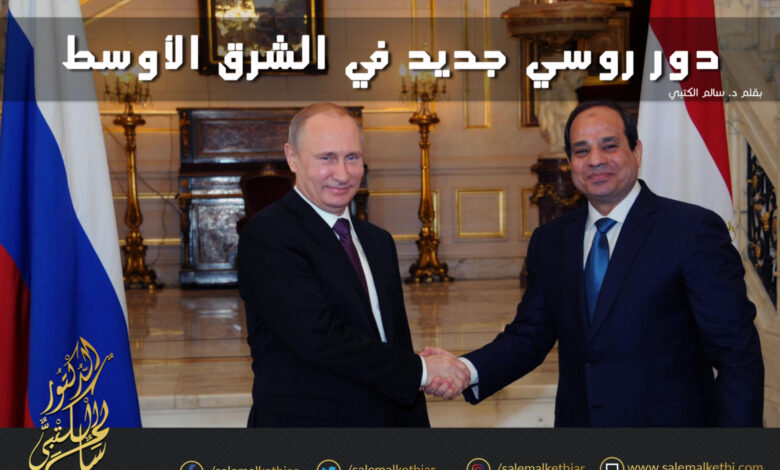
On December 12, Russian President Vladimir Putin visited Egypt, signaling what might be called a new Russian role in the Middle East. Hoping for a fourth presidential term, Putin is determined to reshape the role of his country in this vital region of the world.
In Syria, the tactical alliance between Russia, Iran and Turkey shares interests and gains after the defeat of Daesh. Russia and the United States have different objectives in Syria; still Russia is taking the alliance to the next level: the political settlement of the crisis in Syria, a necessary step to the reconstruction phase. Coordination with Egypt and Saudi Arabia seems necessary at this point.
The next stage in Syria for Russia is going to be re-floating the Syrian regime on the Arab and international scenes. The major powers have embraced realism and accepted to postpone the discussion on the fate of the regime. The discussion needs coordination with Arabic countries, especially Saudi Arabia, given that Egypt has no prior stance on the regime survival but just wants to see a nationally cohesive and terror-free Syria.
Syria is not the only topic in Putin’s Egypt visit; other topics like economic and strategic interests attracted the attention of the Egyptians to Russia. The “quick and concentrated” visit, as described by one Egyptian official, saw the launching of a nuclear power project. In the run for a second term, President Sisi would bet on the project and on bringing Russian tourists back to Egypt as well as the seven billion dollars worth of economic deals to be signed with Russia. While President Donald Trump is embarrassing his Middle Eastern allies, including in Egypt, the Russians are making progress in the region starting from Egypt.
Another bet for Putin is Saudi Arabia. The two actors are working together on Syria. Recently, the Saudis spoke of turning relations from rivalry to partnership and exporting Russian liquefied natural gas to Saudi Arabia. A new strategic reality will, therefore, make its way to energy markets. After the launching of Project Yamal LNG in Russia, the bilateral cooperation will shift relationships andthe network of interests and alliances regionally and internationally.
Public Investment Fund of Saudi Arabia and the Russian Direct Investment Fund are even talking about over 10 billion dollars of joint investments.
Putin is using the decline of the US influence to make Russia not replace the US but take part of the global game of geostrategy, most interestingly in the Middle East. Through shared interests and business and economic ties, Russia is redefining its role. In doing so, it is making more strategic options available for the Arabs.