The Green March we are commemorating with our brothers in Morocco these days constitutes a rich topic worthy of study. From my point of view as a researcher, special attention should be paid to certain aspects of this event, namely the strategic planning and the consideration of alternatives available to deal with a crisis (the Moroccan leadership had quite limited options at that time).
In reality, His Majesty late King Hassan II was quite experienced and aware of historical facts, so he knew how to make the right decision, at the right time, and for the benefit of his country and his people. The Sahara issue has been of vital importance for Moroccans. Out of wise political insight, the leadership had resorted to soft power to pressure Spain into accepting the conditions of Morocco at the time.
The understanding of the strategical balance of power in the region was behind the choice to resort to crowd demonstration. The march could have possibly engaged Morocco in a direct conflict, but ‘wisdom is better than strength,’ and tremendous moral pressure was put on Spain.
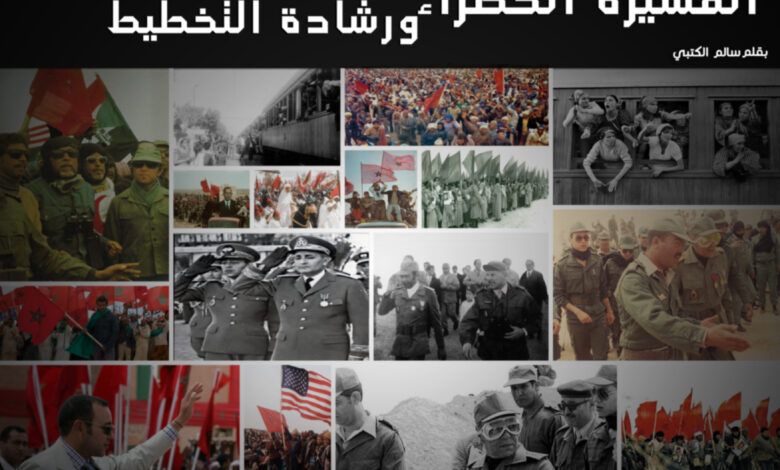
They came from all part of the Kingdom: on the sixth of November 1975, massive crowds answered the nation-wide call by the monarch. The volunteers set off for the Sahara, peacefully expressing the legitimate demands to regain sovereignty over their land.
Through the Green March, political will has motivated the call for the restoration of the Moroccan authority over its entire national territory.
After 75 years of Spanish occupation of the southern regions, determination yielded liberation, using a mixture of popular pressure and political planning. Planning, organizing and commanding the civil ‘troops’ was not an easy task. Late King Hassan II made sure the situation would not slip into violence by focusing on the one main goal i.e. forcing the colonial authority to sit at the negotiating table and sign a formal agreement to end the control of the Moroccan Sahara territory.
The Green March was not a regular huge mass demonstration; the point was mobilizing and capitalizing on the masses in order to earn specific strategic gains. The political and strategic planning can be seen on many levels: the mobilization plan, gathering hundreds of thousands of participants, ensuring their security and their safe transportation, and minimizing the amount of time between the declaration and the implementation of the plan.At the same time, negotiations were being held with foreign and international parties involved in the issue, in an attempt to transform the tactical move into a strategic gain.
However, failure was a possibility, in case the political and strategic gains were not attained. Some historical narratives even suggest that His Majesty King Hassan II was actually considering to resign in the event that the march would fail to reach its objectives. Such an event would have been extremely embarrassing to His Majesty, reputed for being a reasonable leader responsible for the consequences of his decisions. But rational planning crystallized after the Green March had started. The Moroccan leadership was accurate and capable to seize the moment, maximizing the strategic gains, backed by the population. The people had genuinely expressed their support to the positions and decisions of the leadership, as a representative of the voice of the nation, towards the Sahara. Morocco eventually gained the upper hand.
The moment when the great king had decided to put his political career on the line for the sake of liberating a part of the land of his country was historic and decisive. The king knew his undertaking could fail, but he knew too that what he had planned to do was in fact an act of heroism. So, the people came from different parts of the country. Women were reserved a ‘quota’, so they could participate in the liberation of these territories. Through their involvement, they represented the role the Arab and Muslim women can have in liberating and defending the homeland.
Planning the Green March had taken about two months before it was formally announced. The elaboration of the plan, information sharing and institutional coordination were all done in complete secrecy. If the plan had been exposed, it would have been compromised by foreign actors. Some historians hold that the Green March project faced challenges at certain points. This was the case when Spain deployed its troops to obstruct the progress of the crowds of civilians. Its efforts, however, failed to stop the numbers of people determined to recover an integral part of their land.
While I have been reading stories and narratives about it, I realized that the Green March was in fact a major national achievement, added to many turning points in the chronicles of our Arab nation. Military and field planning, important financial funding from inside and abroad, well-organized movement of the masses, were all there to turn that project into a success.
However, an aspect that is often overlooked was the heroic tactic of redistributing the Moroccan forces to instantly replace the Spanish troops once they give up the land. That step had secured the control of the territory after the plan’s implementation, preventing any security and military void in the liberated area.
Today, the Moroccan leadership’s legacy of competent management continues with His Majesty King Mohammed VI. Through his informed policy towards the Sahara issue, he has proven to be a wise and rational decision-maker. The case that witnessed a historical national struggle of our Moroccan brothers is, once again, managed by a judicious leader. Along the way, the king continues to carry out many development and modernization projects, foreseeing the future of an Arab country with a proud history.