As expected by some observers and specialists, things are getting more complicated in the conflict on the two fronts of Iraq and Syria. Fiery statements issued by regional and international parties reflect the sharp divisions in attitudes, and assert that the coalition against terrorism is no longer as it started, but is witnessing divisions in attitudes and visions among some parties.
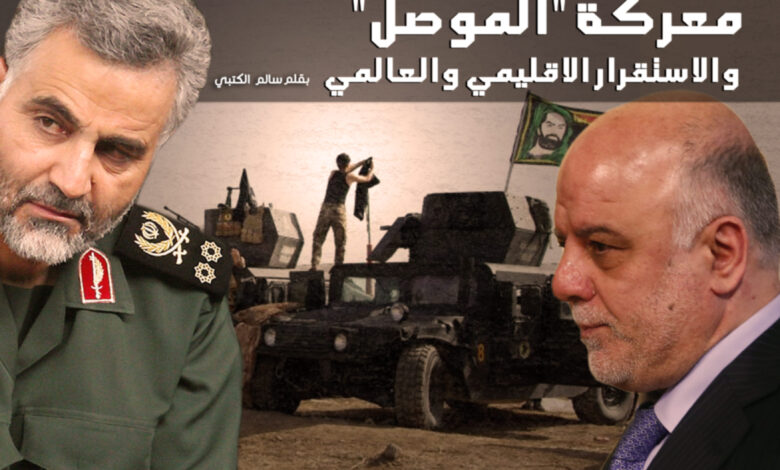
The Battle of Mosul is one of the hot spots in the Middle East now. Defeating Daesh and expelling its members from the city and recovering it will likely not be the end of the issue nor the start of the return of calm to Iraq’s second biggest city. The city of Mosul has recently turned into an arena for conflict reflecting a dangerous sectarian regional division. There is a direct military intervention of some regional powers in this battle, there is an ugly sectarian military intervention by Iran in addition to a distasteful bias on the part of the Iraqi government headed by Haider al-Abadi towards the Iranian sectarian practices aimed at emptying Mosul of its inhabitants, and at manipulating the demographic map of this ancient city with a Sunni majority.
There are also logical fears expressed by Saudi Arabia through its Foreign Minister Adel al-Jubeir recently in an interview with CNN where he said, “What worries us is that the Shiite fighters will enter Mosul, and will be involved in bloodshed and mass killings, as they did in Fallujah, which may lead to negative consequences and would increase sectarian tensions in Iraq. This is the biggest danger we see. I think that this vision is the rational entrance to the Iraqi government if it really wanted to rise above its sectarian loyalties and affiliations and act as a government of a large Arab country like Iraq”.
The fact that the battle of Mosul is characterized by this ugly sectarianism is one of the causes of the sectarian crisis taking place. The problem will not be limited to some of the countries in the region, as these sectarian practices strongly attract terrorism and extremism organizations. Abadi had to avoid this in order to preserve the unity of its people and to ward off more dangers during the next phase.
My personal conviction is that Haidar al-Abadi,, who appointed General Qasem Soleimani as a military adviser to the Iraqi government, despite his official position at the head of the militias of the Revolutionary Guard, cannot prevent the militias of the Shiite mobilization forces from interfering in the battle of Mosul, or even limit their field work scopes. These militias have a separate leadership moving in line with the orders it receives from Tehran, not Baghdad. Therefore Abadi only copes with facts and tries to appear in control, despite the fact that everyone is fully aware of the limits of his miserable control on what is happening in Mosul and other Iraqi cities, where the Shiite militias penetrated as is evident to all.
No one can deny that the expulsion of Daesh from Mosul, followed by the beginning of mass killings of Sunni Iraqis, as happened in the city of Fallujah and elsewhere, represents a new real disaster that could lead to a widespread sectarian regional conflict. Allowing such practices represents a revival to Daesh and the rest of terrorist organizations, as these practices are the best propaganda confirming what these organizations say on the defense of Iraq’s Sunnis, and that they are engaged in a sectarian war and other lies promoted by the websites of these organizations.
The battle of Mosul may be a defeat for the organization Daesh in Iraq, but will not necessarily be the beginning to achieve security and stability in this ancient Arab country. What happens is beyond the political and strategic logic, and Iraqi government’s allowing to Shiite militias to go to battle on a sectarian basis could set fire in the whole region.
The continuation of Iraq at this pace of sectarian management will not bring to this brotherly country stability or an assuring future. The continuing of the Sunni-Shiite conflict, and the attempts to weaken the Sunni and Kurdish components in the political process, in which attempts the former Prime Minister Nuri al-Maliki plays an influential role, will bring only devastation and destruction and will consecrate the Iranian influence over Iraq.
It is certain that the American side is trying to expedite the resolution of the battle of Mosul before the next presidential elections as an important step added to the current Democratic administration, and a direct support to the position of Democratic candidate Hillary Clinton in these elections. But al-Abadi has to realize that the liberation of Mosul does not mean setting an end to the tragedy of Iraq and the Iraqis. The most important challenge in this battle is purely humanitarian. The social fabric of the city of Mosul has been and remains at a significant risk, whether by Daesh and its persecution of Christians and Yazidis, or by what is coming at the hands of the Shiite sectarian militias and their inevitable reprisals against Sunnis from the city’s population.
The international community and the United States specifically are responsible for stopping any sectarian hostilities against the Sunni Muslims of Iraq in Mosul, and for obliging Iran to withdraw its militias immediately after the battles against Daesh. Otherwise, everyone should expect more humanitarian and terrorist crimes in a region that can no longer bear more disasters.