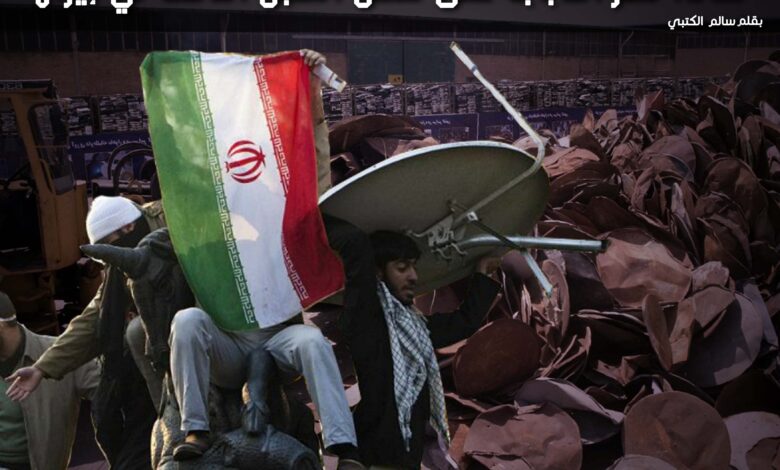
Basij News, the pro-Sepah news agency, reported that the local authorities destroyed about one hundred thousand satellite dishes and other devices for receiving TV broadcast. The agency reported the commander of the popular mobilization forces Gen. Mohammad Reza Naqdi saying that ‘a million people participated in this program.’
At a press conference for an official ceremony prior to the operation, the Iranian Gen. justified the operation saying that ‘satellite TV stations generally lead to corruption and harm the culture of our society, contribute in the higher divorce rates, drug abuse and the lack of security.’
Iranian law prohibits the possession and sale of television broadcast reception devices. There are fines imposed on violators, up to about $3,000.
These devices are not available in the market, but they are discreetly present in all parts of the country and used by the majority of citizens. For a long time, Iranian political currents disputed this law. The Minister of Culture Ali Jannati has called for ‘loosening’ it.
He pointed out that about 70% of Iranians violate it, while President Hassan Rohani called the ban on dishes ‘unhelpful and counterproductive.’
Such a senseless conflict has critical connotations. It refers to the identity of the real ruler of Iran. In the Vilayat-e Faqih theocratic regime, the Minister of Culture and the President seem like spectators, as they do not possess the slightest authority in the application of their policies or decisions. The true power seems in the hand of the Revolutionary Guards, who are behind the ban act and its implementation.
Also, the ideology of the regime seems fragile and weak that it fears the influence of satellite television and satellite dishes. While it does not cease to proclaim the popular support it has, the regime chases TV ghosts ignoring the solution to Iran’s real problems as it looks for excuses to evade facing them.
No sane mind would believe that the satellite channels are behind the high divorce rates, or a direct cause of the spread of drugs and the lack of security. How are they even related to drugs and security? If such allegations were well-founded, all the countries of the world would be mired in drug addiction.
The traditional and new media greatly influence the audience. In recent years, the media, especially social networking services, have contributed in changing the face of the Middle East.
A regime that keeps it revolutionary guards alarmed in the face of satellite dishes is miserable and insecure, not to mention it is out of date.
Iran is aware that the oriented and inflammatory media influenced the overthrow of regimes, through marketing deception, illusions and conspiracies to peoples that kept, for years and decades, their trust in what they see on the screens. They considered the media the official source for information and facts, just to wake up to see the tragic shifts that happened in the recent years.
The latest example of the role of the media and its impact is the CNN Turk. It was a major player in foiling the attempted coup in Turkey. The channel relayed the appeal from President Erdogan for his people to come down to the streets and support the system in the face of the coup. The Iranian regime fears not that kind of impact, but exposing the practices foreign – regional and international – and the hostile policies of its leaders.
The system has the exclusive right to broadcast television and radio. The Supreme Leader of Iran appoints the head of the Radio and Television Organization and oversees media policies. This shows that the system is worried about ideological foundations. His supporters know its founding principle cannot stand in the face of open debate and that they merely represent the remnants of ideological systems that have collapsed, disintegrated, or are only present in countries such as Cuba, Iran and North Korea.
Leading the campaign against satellite dishes, Gen. Mohammad Reza Naqdi claims that the television networks weaken family relations, education and the ‘politeness’ of the children and young people in schools and with their parents.
But the reality is that the Iranian regime fears the facts or is deeply concerned about TV and news programs that sensitize the Iranian people to see what is going on around them: the Iranian regime’s conspiracies, intrigues, machinations in the region as well as its military interventions in which it spends massive amounts from the money of the Iranian people, while they suffer from poverty, corruption, rising prices, inflation, human development problems, as well as environmental challenges (inviable Iranian cities in light of record-high rates of pollution). The system that continues to mobilize its forces in the face of satellite dishes is miserable, insecure, out of date.