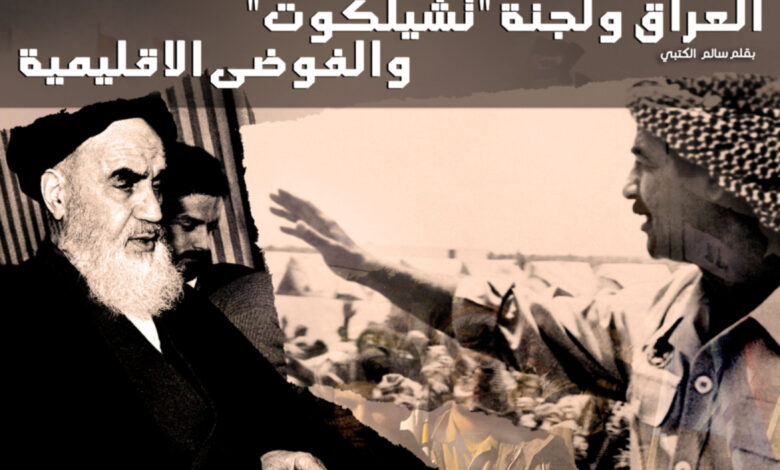
It is true that Iraq is suffering an unprecedented existential and decisive crisis for this ancient country in the modern era, but it is also true that the reason for this regretful state is sectarian policies adopted by the Shiite parties and officials, most of whom clearly support the Iranian regime. It would be misjudgment to say that the situation in Iraq now is a direct result of the fall of Saddam Hussein’s rule. Everyone knows the situation in Iraq while Saddam was sitting on his throne, and everyone also knows that the illusions of Saddam and his foolish policies are what opened the door to the implementation of the plans of conspirators and foreigners to control the fate of Iraq and the entire region. Let us remember the historic initiative that the late His Highness Sheikh Zayed bin Sultan Al Nahyan tried to present to the Arab summit in Egypt in March 2003, to adopt and submit to Saddam Hussein in order to save the future of Iraq, shortly before Saddam’s adventure, the invasion. The initiative sought to save Iraq and its people and was enough to rescue Iraq and the whole region of the tragedies that have taken place and still exist, but the initiative disappeared or more precisely was hidden in the corridors of the Arab summit at the time, where HH Sheikh Abdullah bin Zayed Al Nahyan said the famous statement in the first of March 2003 in Sharm el-Sheikh, in which he said, “The Arabs have lost, unfortunately, by refusing to even discuss the Emirates initiative, the last hope to resolve the Arab Iraqi crisis”, which means that there was some sort of anticipation and assessment of the strategic risks involved in the regional scene at the time by the United Arab Emirates, which some claim they are now pushing for the mess !!
I say this on the occasion of the emergence of a wave of lamentation and self-flagellation on former Iraqi President Saddam Hussein after the results of the British inquiry into the Iraq war in 2003, so we must be aware of many things. First that the investigation was not designed to search for criminal responsibility for the deaths of hundreds of thousands of Iraqi soldiers and civilians during the war but to identify the historical responsibility for Britain’s involvement in this war that caused the suffering of hundreds of British families; and the second thing is that these results should not overshadow the parallel and concrete facts, such as Saddam Hussein’s role in the regional confusion happening so far in the region since his ill-fated occupation of the State of Kuwait in August 1990.
Britain or another country does not feel sorrow and remorse for the victims of the invasion of Iraq, as some imagine. The premise in such calculations and investigations is self-criticism and drawing lessons politically from past experiences, and clarifying facts to present and future generations. The report of the Commission of Sir John Chilcot, chairman of the commission of inquiry into the role played by Britain in the invasion of Iraq, clearly pointed out that “military action might have proven that stopping Saddam Hussein was necessary at a later stage but it was not the last resort at the time”, and that “when the British soldiers, men and women, were sent to Iraq to risk their lives, there was no imminent threat”. The problem for Britain is that former Prime Minister Tony Blair has not exhausted peaceful options to disarm Iraq at the time, and that time had not come yet for military action.
What concerns us as nations and peoples of the region in this report now is that the current painful reality for Iraq was not absent from the strategic estimates in the pre-invasion phase, as the report bluntly said, “The infighting risk in Iraq, and Iran’s relentless seeking of its interests, and regional instability and al Qaeda activity, all these things have been clearly identified before the invasion”, and with regard to land intervention, the British Council of Ministers, the report says, was aware of “the inadequacy” of the US plans.
It is necessary to pay attention to the fact that the results of the investigation of the Commission, which was formed in 2009, after the withdrawal of the last British troops from Iraq at the request of former Prime Minister Gordon Brown, and whose report addresses the period from 2001 until the withdrawal of British troops, and came after seven years of work and interviews of a large number of witnesses and after the examining of thousands of documents, examine the limits of the political and legal responsibility for the death of more than 200 British people, including 179 British soldiers, as well as for spending more than 8 billion pounds to participate in the war, according to estimates reported by the British newspaper The Financial Times, and therefore do not examine the fate of Saddam nor the responsibility for his death.
I do not adhere much to the view that the issues in the region have become out of the United States’ control and strategic perceptions for the management of the post-Saddam Hussein stage at the regional level, a stage that ended with the emergence of “Daash” and its control over a large part of the territory of Iraq and Syria. My basic conviction is that “Daash” and other terrorist organizations are only tools in the fourth generation wars, which appeared actually after the large US casualties in the wars in Iraq and Afghanistan, which prompted strategists to devise new “tools”, or to employ existing ones, or to create an environment for their appearance. And here, I cannot keep up with those who say that the “Daash” virus has been synthesized in the US intelligence labs, but the evidence confirms that this virus was employed directly or indirectly and very accurately to achieve US strategic goals in the post-creative chaos. “Daash” or Iran and its militia would not have expanded in Iraq without a series of “actions”, and I do not say systematic errors, that caused the situation in Iraq to turn into chaos.
These practices, which aim at achieving the objectives of major states and powers are the ones that launched the monster of terrorism from the “bottle”, and the countries of the region or the Islamic religion or Salafism should never be held accountable for this situation. Islam is not a new product so that it could produce all that terrorism now, it is a religion upon which is based a civilization that is deeply rooted in history, and linking it to terrorism seems now like an oversimplifying that disrupts things and empties them from their real strategic dimensions.