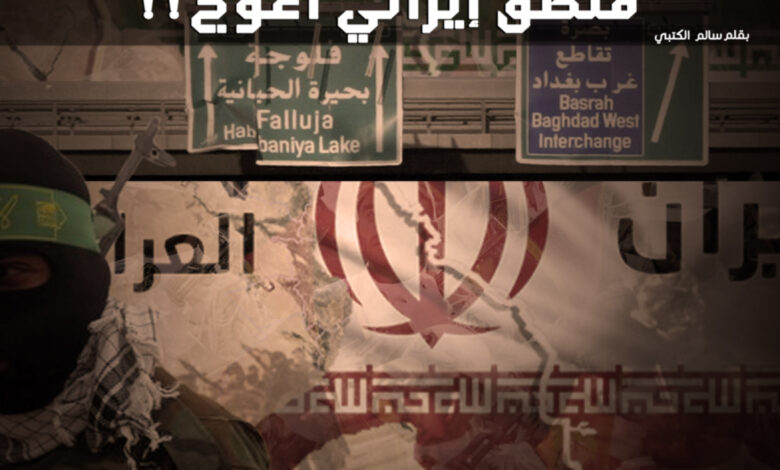
I do not feel a big surprise when I notice that Iran and its officials are the primary source of news about the conflict and developments going on in in Iraq. Iranian officials were preceded by their Iraqi counterparts in announcing the results of the Iranian military operations in Fallujah, and considered that what happened is a “divine victory,” and senior adviser to the commander of the Iran’s Revolutionary guards Corps’ Al-Quds Force, Iraj Masjedi said: “Aleppo and Fallujah and the rest of Syria and Iraq are the first line of the axis of resistance,” and that “defenders of the holy place,” a label that is given to Iranian Shiite militias involved in military operations in the two countries, “will stay there until the elimination of the last individuals of the Daash organization and other terrorist and takfirist organizations.”
What concerns me in this statement is that Iran no longer hides its intentions and future military plans and strategies. The Iranian Tasnim site reported Masjedi saying that the fighting in Syria and Iraq helps “deepen the security of Iran,” and defends the country’s borders, saying that Daash and what he described as “Takfiri groups backed by Saudi Arabia and Israel “are working on the occupation of Iraq and Syria in order to reach Iran”. Masjedi felt that this was enough to be a justification for Iran to stand alongside its allies, such as Afghanistan, Pakistan and Lebanon, to ward off these threats from the country.
Intentions here are crystal clear. Iran is now operating as a regional hegemon moving in a broad strategic perimeter in isolation from the international law, and it imposes its will to everyone and then openly states that it is not wanting to give up its illegal military presence in Arab countries that have their own sovereignty, under the pretext of maintaining Iran’s security and building a repelling wall in the face of alleged plots.
If we take into account this Iranian twisted logic, the world would turn into a real jungle, and scenarios would be open-ended, which would make it difficult for the mightiest authors of drama to predict their course. This type of mob thinking flouts all the agreements and understandings and the rules that found and frame the limits of sovereignty and influence, which international relations are founded on and on which the United Nations was established in the mid-forties of the last century.
How a country like Iran can openly state its occupation of two Arab states to maintain its security? If there is anyone who recognizes this colonial act, how can the world be looking for a real end to terrorism? And why not everyone understands that the terrorist organizations and groups feed on sectarian conflicts? And that these conflicts are among their most dangerous tributaries and recruiting and polarization attractions, in a region where religion represents a super sensitive topic to its peoples.
No one disagrees with the goal concerning fighting the terrorist Daash organization, but the disaster is that this goal becomes a guise or cover for the occupation of other countries and for achieving the strategic interests and implementing colonial projects that are called from the crypts of history. Let me say it frankly, Iran does not want the Daash organization to be defeated until it helps it complete the full control plan over Shiite areas in Iraq, and tighten its grip on Syria, as it is unthinkable that Iran feels intimidated by the Daash organization, while not feeling any concern towards Israel, which it claims day and night to be its arch-foe.
The question, then, has nothing to do with the security of Iran. If each state that chased an organization felt threatened by it, then the United States would have occupied Iran itself, which is home to al-Qaeda leaders and provides shelter for their families, and is considered the only state in the world that sponsors terrorism and formally allocates budgets to it of its national income, and ignores the suffering of its people and the spread of poverty and social and moral epidemics among its sons.
There is another point related to the logic of Iranian statements. Iran that wants to convince everyone of the threat of the Daash organization to its national security, refers through the words of Assistant Chief of Military Staff, Brigadier General Masoud Jazayeri, that it has tremendous military capabilities, “the hidden ones larger and more important”, and that these capabilities “if they were revealed wholly, would surprise the United States,” as he put it. The question here is, if Iran claims to own “enormous” military capabilities able to provoke dreadfulness to the United States itself, how then to explain its fear of a possible incursion of an organization that is primitive militarily and organizationally and intellectually like Daash? This strange contradiction confirms that the matter has nothing to do with Daash or terrorism, and then I have no doubt that this obnoxious Daash phenomenon is the product of the Iranian Revolutionary Guard laboratories, in order to be a persuasive strategic cover to help achieve Iranian targets in the occupation of Iraq and the intervention in Syria.
Iran wants its regional neighborhood to believe its new strategic faith based on hegemony, which is reflected in playing a military role outside the Iranian border, in order to “hunt down enemies,” as claimed by Iran, and this strategy is the opposite face of confirmed regional chaos, and the international community must be aware that silence in the face of the Iranian talk will bring disaster to everyone, and it makes the idea of eliminating terrorism quite unattainable no matter the amount of efforts exerted at the intellectual, security, religious, cultural and educational levels, because igniting–Shiite-Sunnite- sectarian conflict in this region is a guarantor to providing all the “oxygen” terrorist organizations need for decades to come.