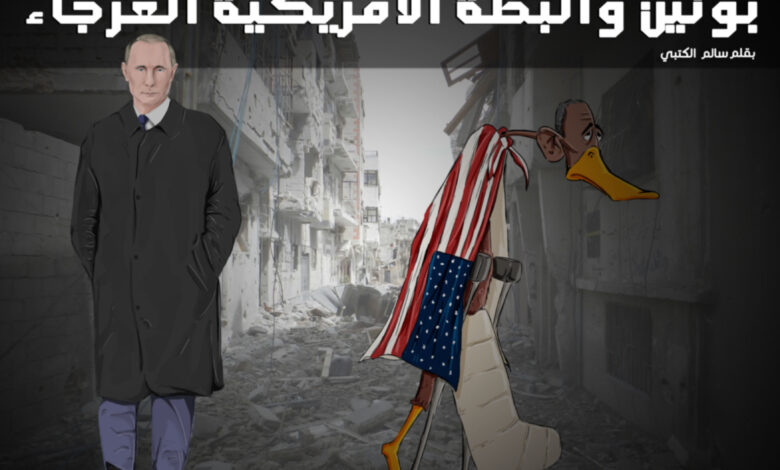
There may be no evidence that US President Barack Obama already lives the “lame duck” phase at the end of his term more than “helplessness” expressed by the Secretary of State, John Kerry, in his commentary on what is happening in the Syrian city of Aleppo, when he said that the conflict in Syria, “is out of control in a lot of areas,” the Secretary of State of the sole super power dominating the world order did not achieve any breakthrough at the level of control over the violence against civilians in the second largest Syrian city, saying only that “there is a need for further effort and there is no guarantee of success,” which makes me feel pity towards Kerry, who “has no tools”, and who competes with international officials in expressing only anxiety and resentment.
And certainly, the miserable situation in Syria reveals several analytical dimensions the most important of which is that Russia is not out of the Syrian scene as everyone thought when President Putin has decided to withdraw most troops from Syria, but his strategy toward the Middle East is still based on a rough interference in the Syrian crisis for the sake of maintaining Russia’s role in this important Arab country, which means that the change in the Russian position regarding this issue, is may be represented in the alleviation of Russia’s adherence to the staying of President Bashar al-Assad in power in Damascus. This does not mean that the Kremlin agreed to the departure of Assad by force, as Russia is quite sensitive to the idea of change by force, or through so-called “revolutions”, being fully aware of what is behind these “revolutions” and the real actors behind the scenes. The master of the Kremlin, with a background in intelligence, knows the reality of the “fourth generation” wars led by the United States to bring about change in the Middle East under the guise of democracy and freedom of expression.
In light of the foregoing, Putin does not actually defend President Bashar al-Assad, but is seeking to undermine the fourth generation warfare strategy, and to prove its failure and that it will open the doors of evil on the entire world, first and foremost the Western countries themselves. It seems that Putin senses the next stations of these wars in the event of their success in Syria. There are candidate stations where the “wave of change” will move, and among these stations is Tehran, and perhaps Moscow itself. And here, we must note that Gen. Valery Gerasimov Head of General Staff of the Armed Forces of the Russian Federation considered recently that what is happening in Syria is only a “color revolution”, that is, according to the Russian conceptual description a way to conduct a coup d’etat, which explains the Kremlin’s hard-line stance toward the overthrow of Bashar al-Assad by force.
Russia’s military intervention in Syria was not as expensive as some believe after President Putin himself said that it was “the best training of Russian troops” by virtue of the fact that “actual battles are the best ways to confirm and test readiness,” and that it cost the treasury of the Russian Defense Ministry, only about 33 billion rubles (about a half-billion US dollars), so the issue for Putin is not only a training space and a show of force and strategic influence, and therefore it was not a surprise that he said recently that the door is still open for the return of Russian troops to Syria “in a matter of minutes if necessary.” .
Syria, for Russia, is only a global influence battle, and an objective equivalent to the Ukrainian card, which the West seeks to shake in the face of Russia. And President Putin is aware of the weakness of the position of his US counterpart Barack Obama in the last year of his term, as Obama has actually, not only in words, turned into a “lame duck” unable to do anything, and suffers increasing pressure from Congress to derail the nuclear agreement concluded with Iran, and his most important dream in his last months in the White House has become to keep the agreement alive, regardless of whether or not to implement it.
The problem that some experience in understanding President Putin’s strategy lies in the fact that they see him from a “Soviet” perspective, believing that he is trying to revive the Soviet influence, and this is not accurate, nor logical. In fact, Putin seeks to prove the status of Russia as a major power that deserves more respect from its NATO opponents, and so he is trying to confirm the Russian “long arm, to prove this and grab the strategic appreciation. If we follow the steps of the Kremlin on this path, we will easily realize that it goes on in accordance with a thoughtful approach: it began with the war with Georgia in 2008, then it annexed the Crimea in 2014, which enticed Putin to expand and to disturb the United States in other areas of influence, especially as it comes to Syria, which is the most traditional ally of Russia in the Middle East.
There is another dimension with respect of the “Atlantic” nibbling and eating Russian traditional spheres of influence, as it pounced on Gaddafi’s Libya, without any coordination with Russia, as well as the dimension related to terrorism in Chechnya and the Central Asian republics and other areas.
The most important point is that Putin realizes that President Obama is unable to formulate a genuine strategy to deal with Syria, and that all that he aims at now is preventing Russia from holding new areas of influence waiting for the next master of the White House to deal with this file. The most serious side is that the weak position of the White House extends on its partners and allies in the Syrian crisis, and this is why the Turkish President seems so tense, and Europeans almost absent from a crisis that directly affects European security.
In light of the foregoing, the coming months seem pregnant with a lot of developments in the Syrian crisis. All parties are seeking to exploit the retreat of the US “lame duck” and its hesitation, and then the scene seems open to all probabilities.