While watching the developments of the political crisis in Iraq, my attention was recently caught by a report published by the “BBC” network, entitled: “Poverty Forces Iraqis to Sell Their Kidneys”, where the network dealt with a painful reality for models of Iraqi families, suffering from “extreme poverty, like millions of Iraqis,” as described by the report.
I read in this report what saddened me about the situation of this ancient Arab country, particularly in relation to the manifestations of poverty and deprivation on which the report cited real stories, and I was amazed at the case of some Iraqis who collect the remains of bread in the streets to eat them, and how some Iraqis resort to selling expensive parts of their bodies in order to get money to feed their families! The report indicates how the trade of body parts has become profitable in Baghdad given the widespread poverty in the country!
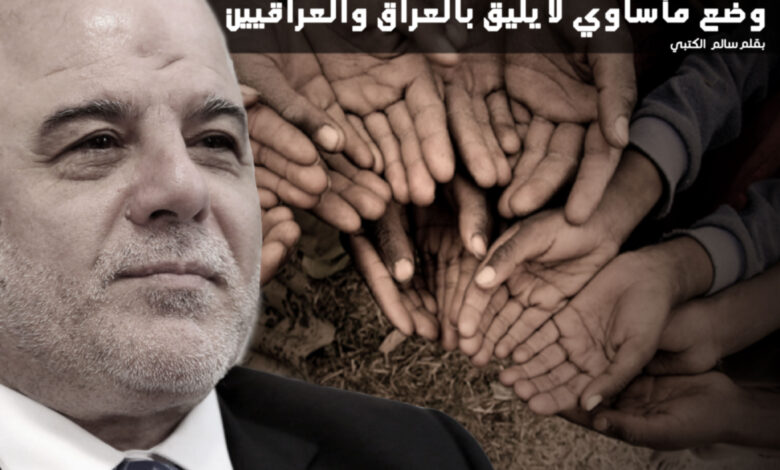
It is no secret that Iraq is a significant oil country, both in terms of production or proven oil reserves, and has a variety of resources able to pull it out of the dire developmental situations where about at least a quarter of its population lives. And the story of corruption in Iraq is known to all, and does not need further rumination of “tales”, stories and figures to prove it. But what is surprising amid a flood of corruption and worsening piles of administrative and functional mold in the country is Mr. Haider al-Abadi, who only gives empty statements and rhetoric slogans on the fight against corruption since he took office in August 2014. He announced that the year 2016 is the year of the eradication of corruption, and did not move one iota towards the implementation of the reforms he promised since last year, and though he openly admits that corruption has “gnawed” the body of the Iraqi State! One of the problems of Abadi is that he is an illusioned politician who is trying to sell dreams to people. He said weeks ago in a public conference that Iraq was “on the verge of an era of victories and reforms,” although he acknowledges that the country has lost about 85 percent of its oil revenues due to the collapse of oil prices. The problem of this kind of leaders is that they trade the dreams of their people and choose to sell illusions, moral painkillers and pills of “political anesthesia” to the poor and the needy, which is a problem with catastrophic proportions the risks of which exceed the geographic borders of countries.
It is difficult to accept such a staggering level of poverty in an oil country like Iraq, and it is also difficult to make the right of millions to a dignified life dependent on an obnoxious political conflict which aims to win the lion’s share of the ruling “cake”. It looks that the political scene of Iraq is in its melancholy close to the Lebanese political scene, and the common denominator between the two is odious authoritarian sectarianism practiced by parties and groups loyal mostly to parties and regional powers, and are working to their advantage and implementing their goals, whether in Iraq or Lebanon. And Abadi and other Iraqi politicians like to blame the collapse of oil prices, and this is partly true, a part of the truth, but not all of it, as the corruption surrounding the Iraqi oil contracts causes enormous bleeding to the wealth of the Iraqi people, some of whom are looking for a mouthful of bread and resort to selling one of their kidneys in order to provide living expenses. And corruption is also obvious in the continued smuggling of Iraqi oil.
Since the “three presidencies” infection contaminated the Iraqi political arena, including greedy partaking and a hateful sectarian conflict, inertia has become the master of the situation in this country, and Abadi does not recognize or acknowledge the failure of his reformist project despite the fact that more than a year and a half have passed after his taking office without his achieving of any significant progress as to the promises he made. One may say that Abadi faces sharp partisan divisions that impede his desire to implement reforms through a government of technocrats able to meet the aspirations of the Iraqi people. This argument is not convincing for a Prime Minister who is leading a failed government as recognized by all parties and political forces, and thus he only can admit defeat and leave the task to those who can tackle it.
What I’m basically interested in in the story is not the political conflict that has infected Iraq, nor the prime minister’s failure to implement reforms, but the simple Iraqi citizen who suffers from the absence of a clear prospect to save him and help him, as it is painful to read about the Iraqi brothers selling parts of their bodies and then wonder at the extension of “Daash” and “Al Qaeda” in Mesopotamia, the land of ancient civilizations!! One of the exits of saving Iraq is the need for Iran to lift the hands of its militia, its leaders and Revolutionary Guards off this Arab country, and that the GCC countries play a vital role in restoring ancient Iraq to its natural milieu, and its Arab nation.