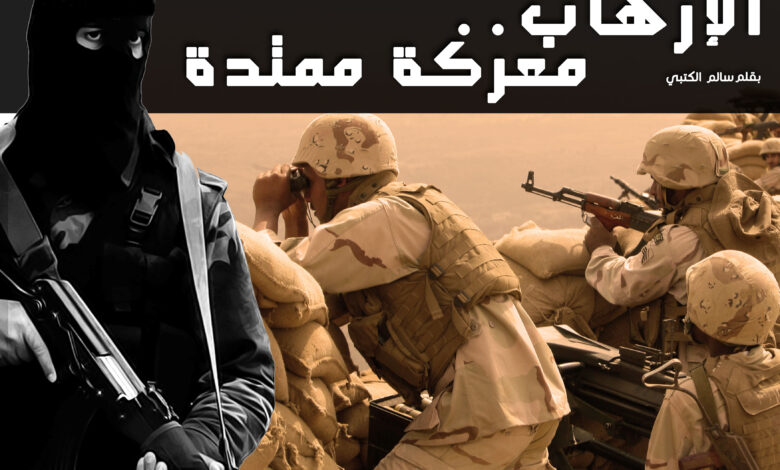
After every terrorist crime in a country or geographic region in the Arab world, some people come to wonder: did not the army control the whole of this region? And how this is happening despite the fact that the army and police are carrying out ongoing military and security operations?
The truth is that there are two sides of such questions. The first one is related to backgrounds and motives behind the question itself; some people take advantage of such criminal attacks and consider it an appropriate opportunity to question the efficiency of the armies and to challenge them, but what is more, is that some of those who are lacking in loyalty and patriotism go as far as gloating and ridiculing and undermining the efficiency of the army and police and seek to degrade them. The other side of these questions stems from genuine national motives and seeks to understand what is really happening out of fear and concern for the police and army in the face of these criminal elements.
In the battle of terrorism and in addressing its organizations, there are errors committed inadvertently and there are in parallel, strategic realities that are absent popularly and the media ignores highlighting them analytically.
We mean by professional mistakes those which some commit when taking the initiative to launch sonorous media and press titles and slogans like directing a serious blow to terrorism, and the eradication of terrorism and other attractive titles that may relieve the hearts and eyes for some time, but these same titles soon cause suspicion at later time periods in the event of a new terrorist offense, not to mention that the haters and the hostile media exploit these titles and use them later to challenge the efficiency of the armies and their combat capabilities, and to make people question the military as well as to seek to drive a wedge between the people and the military.
The absent strategic realities relate primarily to the nature of the war against terrorism, which is different from any other battles or wars. It is a war that extends in terms of time, and cannot be completed in one round, often experiencing continuous loops between ebb and flow, and is subject to extreme considerations and factors. To prove this, suffice it to mention the experiences related to wars against terrorism at the current stage, where it is difficult for the mightiest armies and forces that have an advanced technical armament, to eradicate terrorist organizations completely, and perhaps the ultimate success at this level lies in the pursuit of the elements of a terrorist organization and the cleaning of them from an area after their “expulsion”. This does not necessarily mean their elimination but is like a geographical deportation of the terrorism risk, as is happening in Iraq and Syria now, where several areas and cities that were under the control of “Daash” are recovered, but the organization itself is still fighting and directing its strikes in other areas. The terrorist enemy has key features, the most salient of which are ambiguity and uncertainty. Armies are facing for the most part well trained and well-armed agile gangs, as slippery as mercury, and with deeply rooted ideology, while armies are inherently ineligible to hunt down criminal individuals, and their efficiency at this level is not a measure of their combat capabilities in any case. The US army itself stumbled in the face of terrorist organizations in Iraq and Afghanistan despite advanced equipment and arming and high-level training. What I want to say is that the battle of terrorism has an extended nature, and its danger does not lie only in the areas of concentration of the terrorist organizations elements, but also lies in the minds that are inhabited by extremist ideas, and the channels of communication, persuasion, recruitment, mobilization and organization, and therefore we are facing an integrated community battle, part of its burden falls on the shoulders of armies and security forces, while a large part of it falls on community institutions, which are responsible for the drying up of sources and the closure of canals and tributaries that feed terrorist organizations with the human element; if those tributaries are closed and if the sources of terrorist ideology are dried up, the ability of terrorist organizations to renew their blood and regain strength would become an option whose chances to be achieved are virtually null. To my view, terrorism is like the acquired immune Deficiency Syndrome (known as AIDS). It causes the erosion of communities’ immunity in the same way that “AIDS” undermines human immunity, so communities in the face of terrorism have a continuing need to enhance their immunity and strengthen self-immunity in order to respond to viruses that can kill these communities, despite the dwindling risk of these viruses and their weakness in normal cases, or in the face of a healthy body, so terrorism is the most dangerous disease facing communities in the present era, and deserves that the whole community faces it, in deeds not in words. What is observed is that there is almost certainly a need for the role of the community and institutions in the fight against terrorism, but what happens on the ground is that the most serious threat facing communities and states is often left to armies and security forces without any societal movement on the part of educational and media institutions. From the near past experiences, we can draw useful lessons to face terrorism, the most important of which is the need for community rejection and ostracism for any radical thought, since radical thought, by nature, paves the way to what is more serious, as it is a favorable environment for the growth of extremism and terrorism in later stages, so the consecration of central humanity and religious values such as moderation, tolerance and acceptance of others is a very necessary issue for the future of the Arab and Islamic societies, and without them, talking about the fight against terrorism and extremism seems fruitless. We have to support our troops in the war against terrorism, and we must not stand idly by as passive observers of what is going on around us, but it is necessary for us to be loyal to our future generations through combating this malignant intellectual epidemic and through eradicating its roots from our homes, streets, mosques and schools.