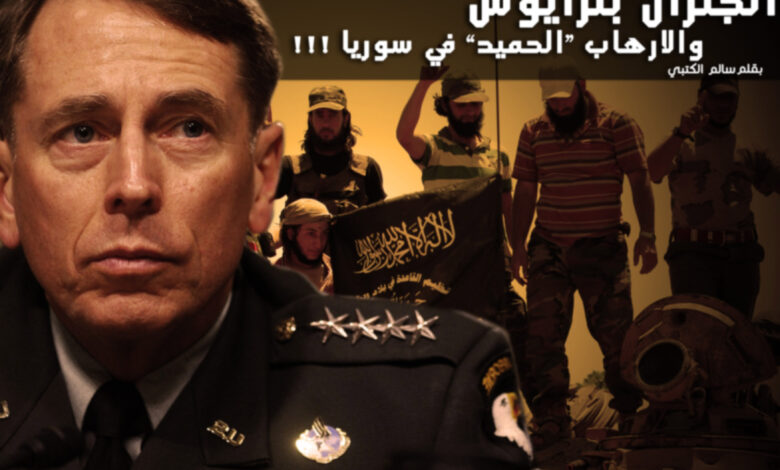
Gen. David Petraeus, the former director of the CIA, is an official and expert who has great knowledge on the details of the complex situation in Iraq since the US invasion in March 2003. Sometimes, knowledge can be a double-edged sword. It can nourish any real political orientation to pull Iraq from the cycle of repeated failures it has been through for years and help find effective alternatives to counter the threat of Daesh terrorists in Syria and Iraq. It can, per contra, push for action to prolong and complicate the crises in Iraq and Syria.
Days ago, Gen. Petraeus came after a short period of silence calling his government to include ‘some’ fighters from Al-Nusra Front, the Al-Qaeda offshoot, in the expanded US-led alliance to fight Daesh in Syria.
Against a backdrop of these controversial and dubious statements, the media was divided, raising fears and anxieties. Conspiracy theories about the complex files of the area surfaced again. These responses were normal reactions to such questionable a position by the former US official now working as an adviser to the American policy.
It is quite unconvincing to say the world’s most advanced army failed to stop the advance of Daesh to justify resorting to fighters from Al Qaeda—a sworn enemy of the United States—to do so. The intentions of the Americans about Daesh’s ideological propagation and expansion in Iraqi and Syrian territories are far from clear. American officials claim that eliminating al-Baghdadi’s group may take up to ten years. This strategic calculations appears illogical even discreditable. Washington wants the group to survive in many of the Arab and Islamic countries at least over the next decade as a tool for intimidation.
Assuming this is the case, General Petraeus’ comments are another attempt to reshuffle the cards in the region and provide alternatives that have once proved tragically unsuccessful. It is absurd to assume the existence of ‘moderate’ terrorists in Al Qaeda, in which case the United States itself would be accused of prosecuting so-called moderate Al-Qaeda members. It is also stupid to say moderates can engage in the regular alliances to fight the terrorist and extremist organization of Daesh.
This evident idea is not absent from the minds of American plan makers. They are capable of directing the course of events for their advantage using various direct and indirect tools. Following the US approach here therefore constitutes a strategical risk with predetermined results, pretty much like sleeping at the wheel.
General Petraeus says that some members have joined al-Nusra Front for opportunistic rather than ideological motives and that the United States should attract and use them in some way. But do you select the opportunists from the ideologists? What guarantees that the terrorist members in al-Qaeda would not have access to money and logistical support and training the members prepared to fight Daesh in Syria are supposed to receive?
Petraeus was successful in turning the situation in Iraq in 2007 in favor of the US, deploying about 30 thousand US troops and persuading Iraqi Sunni tribal leaders not to cooperate with Al Qaeda. However, now, he is not proposing an effective alternative but an idea as opportunistic as the terrorists he wants to involve in fighting Daesh.
The danger here lies not only in the opportunistic nature of his suggestion—after all war is deceit—but also in the fact that disastrous consequences could arise if the opportunists later join whoever pays them. Moreover, the move could degrade the moral values behind the war against terrorism, dividing terrorism into ‘good’ and ‘cancerous’. No sane person would shake the hands of a terrorist group, even if the purpose would be defeating even dangerous ones.