Translated from the Arabic original, first published in Elaph on October 23, 2026. An earlier English version appeared in Israel National News on November 25, 2026.
When Iran looks for someone to monitor its opponents abroad or to target American and Israeli interests, it does not always look for an adherent of its project; it may find what it needs in a person who wants money, a criminal who sells his services, or a sympathizer with a political cause who is easily lured in that cause’s name. The task may begin with a photograph of a place or a piece of information about a person, while whoever issued the assignment knows the purpose it will serve. In this way, Tehran can use individuals bound to it by neither ideology nor loyalty, widening the circle of operatives without widening the circle of those convinced by it.
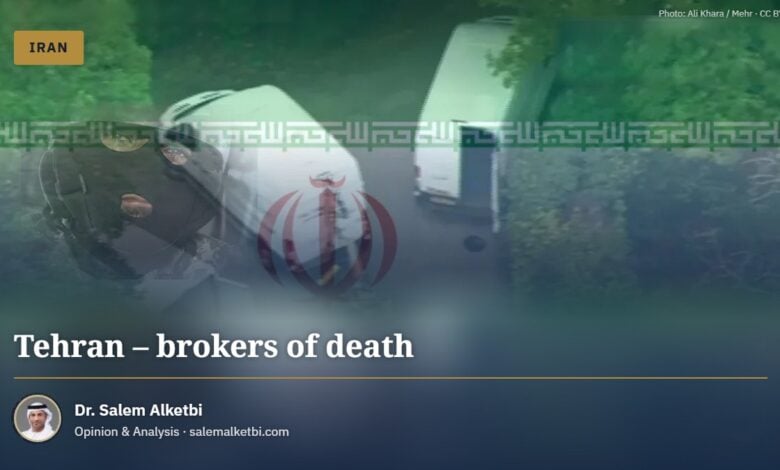
Recent events in Britain show how far this kind of recruitment can go. Near the Royal Air Force base at Fairford, arrests on September 27, 2026, led to an investigation into a suspected plot to target the base. On October 12, the British government stated its assessment that the plot was most likely coordinated in Iran and that its direction by the Revolutionary Guard was almost certain, and pledged to pursue the criminal networks Tehran uses and their financing. On the same day, a joint international statement condemned Iranian attacks, citing a campaign that targeted Jewish communities, Iranian journalists and American interests in Europe.
The motives for responding to these assignments vary with the people and settings Tehran targets. In some Arab settings, Iran exploits regional conflicts, sectarian identity and the claimed sanctity of destroying the State of Israel to find people who will respond to its assignments, since political mobilization gives the recruit a language of justification, and the group linked to him gives him relationships of trust and social cover. Many observers recognize that the Palestinian cause is a thriving trade for regimes that use it to justify their policies and serve their interests, then throw it in the wastebasket once its usefulness is spent, only for another regime to pick it up and resume trading in it.
Naturally, the regimes that trade in it change, while the Palestinian cause remains unresolved. Through this trade, Tehran lures the region’s people into working for it, marketing espionage against their own countries and the targeting of its adversaries as sacred and noble services, while it reaps the gains and the recruits pay the price.
This trade extends online, into accounts that borrow the symbols of the Palestinian cause and offer money in return for cooperation. Recorded Future, a firm specializing in digital intelligence, identified a recruitment network linked to the name “Handala” and assessed that it most likely belongs to Iran’s Ministry of Intelligence, after tracing the links between its accounts and how they promoted one another, and it found Arabic messages in the network combining political rhetoric with offers of money.
While political rhetoric gives some recruits a justification for cooperating, money alone may be enough to draw in others. On October 16, 2026, the Norwegian Johannes Natland was sentenced in Britain to 20 years’ detention after being convicted of conspiracy to murder, having been offered 25,000 euros to carry out an assassination. The Associated Press reported that his recruitment began during an online game, while police said he received the assignment from a person in the Foxtrot network, which Britain and the United States have sanctioned for organizing violence against Jewish and Israeli targets on Iran’s behalf.
The benefit of paid recruitment is not limited to securing an operative. In the State of Israel, Iran also buys the ability to reach places and people that a foreign officer would find hard to reach as easily, and an Israeli’s need for money may be enough for him to accept the first task without becoming a supporter of Tehran. In its warning published in September 2024, Israel’s domestic security agency, the Shin Bet, described how users of job sites, money channels and cryptocurrency platforms are targeted with paid offers that begin with tasks that seem simple and then move toward arson and harm.
A person may accept the first task without knowing its place in the wider plot, since photographing a place does not necessarily reveal to him who will use the photograph or for what purpose. While the handler assembles scattered services into a single operation, the person holding the camera need not know what the middleman knows, nor need the middleman know all the leadership’s aims.
Money may intertwine with political loyalty and personal relationships in the same case, and the operatives’ knowledge of the purpose of their assignment varies; some are unaware of the goal, and some may avoid asking about it so they can keep collecting money, while the apparatus keeps its aim to itself and buys from each one what it needs.
In Germany, scouting targets and searching for an assassin came together in a single plot. On October 15, 2026, a Hamburg court sentenced two men to eight and a half years and four and a half years in prison in a case of espionage and preparing attacks on Iran’s behalf. According to coverage of the trial, the court was persuaded that the main defendant was linked to the Revolutionary Guard and the Quds Force, that he scouted targets including the head of the Central Council of Jews in Germany, the president of the German-Israeli Society and a Jewish shop in Berlin, and that he enlisted his partner to search for someone to assassinate the society’s president and to supply that person with a weapon.
Tehran also relies on gang leaders to secure assassins. In the United States, the price reached $500,000 in the plot to assassinate the Iranian-American journalist Masih Alinejad, and two leaders of the gang involved were each sentenced to 25 years in prison in October 2025. Then Asif Merchant was convicted in March 2026 in a plot to target American politicians and officials. According to the Justice Department’s account of his testimony, he was tasked by the Revolutionary Guard with finding members of the “mafia” to carry out tasks including assassination, but the person he enlisted informed the authorities, and those he took for hired killers were undercover agents.
Yet the variety of recruitment channels and intermediaries shows that Tehran is building a capability that extends beyond its ideological supporters, a method that gives it flexibility in choosing people and distributing tasks and makes it harder to trace the link between the operative and the party giving the orders. But concealing this link does not erase it, nor does it prevent counterintelligence agencies from tracing it back to the source of the assignment.
The confrontation between Iran and its adversaries does not always stop at exposing and pursuing operatives outside Iran; fierce, retaliatory Israeli strikes reached the intelligence leadership deep inside Iran during the wider war. In March 2026, the Israeli military announced that it had struck more than ten Ministry of Intelligence headquarters, then announced that it had killed the minister, Esmail Khatib, in Tehran, linking his role to running operations against Israeli and American targets around the world and to targeting Iranian dissidents, and describing his targeting as a weakening of the command-and-control system.
This is where the flaw in Tehran’s calculations appears: it can buy a new operative after the previous one falls, but replacing a handler, a command center and relationships built up over years is harder than recruiting a hired hand. In my assessment, these external operations widen the circle of adversaries pursuing Iranian networks and give the State of Israel additional reasons to target Iran’s leaders deep inside Iran.
A state that exports assassination and sabotage through intermediaries cannot decide alone where the confrontation ends, nor assume that the borders it crosses to protect its interests will go on shielding its agencies and leaders from an angry response.