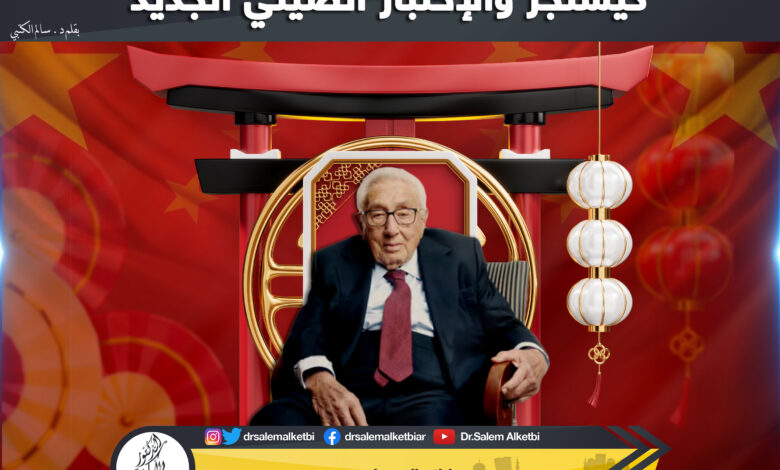
No one in the world of politics is unaware of the worth of the veteran Henry Kissinger, the former US Secretary of State, who has a notorious and celebrated reputation. Nicknamed the Swamp Fox and Henry the K., he is one of the political and diplomatic geniuses who had a big hand in shaping international relations during the twentieth century.
The “formalization” of Sino-American relations was one of Kissinger’s most important roles in the world of diplomacy. Through his position as Secretary of State during the time of the former US President Nixon, and by using the famous “ping-pong diplomacy,” he paved the way for dialogue between Beijing and Washington. His efforts culminated in the historic visit by President Nixon to China in the 1970s, where he met with its historical leader, Mao Zedong.
Kissinger, who has crossed the age of one hundred by a month or a little more, recently came back to the limelight through an extraordinary visit to China. There, he met with President Xi Jinping, who expressed his hope that Kissinger would continue to step up and make a positive impact on normalizing Sino-American relations. During their meeting, the Chinese President said, “52 years ago, Sino-American relations were at a critical juncture.”
He also emphasized that China will always remember its “old friends” and Kissinger’s personal role in fostering Sino-American relations. He added, “Chairman Mao Zedong, Premier Zhou Enlai, President Nixon, and you, personally, with your unique strategic vision, made the right call for Sino-American cooperation and set in motion the process of normalizing bilateral relations, which brought benefits to both countries and changed the world.” He highlighted that China and the US are once again at a crossroads, and both sides must make fresh decisions.
The Chinese President spoke to Kissinger, saying, “I hope that you and other wise individuals in the US will continue to play a helpful role in getting Sino-American relations back on the right track.”
Kissinger also had meetings with Wang Yi, the head of the Chinese Communist Party Central Committee Foreign Affairs Commission Office, who is considered one of the prominent experts in Chinese diplomacy, and with Li Shangfu, the Chinese Minister of Defense, who refuses to meet with representatives from the Pentagon.
The former US Secretary of State stressed that “neither the US nor China can afford to treat the other as an adversary” and emphasized that war would not lead to anything beneficial for either side. The centenarian called on the current leaders of both countries to be wise and urged the defense ministries of both nations to restart bilateral relations.
Wang Yi spoke highly of “Kissinger’s historical contribution to the development of Sino-American relations,” adding that he still plays an “essential role in improving mutual understanding between the two countries.” He pointed out that the current US policy towards China “lacks the wisdom of Kissinger and the courage of former US President Richard Nixon,” affirming that “trying to transform China is impossible, and blocking and containing China is even more impossible.”
China sticks to the core principles proposed by President Xi Jinping, which are mutual respect, peaceful coexistence, and mutually beneficial cooperation. China sees these principles as the right path to establish healthy relations between the two major countries. On the other hand, the US continues to go back and forth between attempts to keep communication channels open with Beijing and applying strategies aimed at hindering China’s economic rise.
Kissinger’s visit is primarily aimed at warming up Sino-American relations. It comes after visits to Beijing by the US Secretary of State, Antony Blinken, the Treasury Secretary, Janet Yellen, and Special Envoy for Climate Change, John Kerry. It seems that Washington is hoping to replicate the successful mission of Kissinger half a century ago.
However, judging from the statements of the experienced American strategist, he is trying to put the brakes on the deterioration in relations between the two powers. He fully understands that the international strategic environment and the balance of power between Washington and Beijing are not the same as they were five decades ago. Today is different from yesterday, and China does not need American approval to regain its position in the UN.
I believe one of the prominent messages conveyed by Kissinger is an attempt to persuade Beijing not to lose the US for the sake of Russia. The best option for China is to work together with Washington or, at the very least, avoid upsetting it and steer clear of providing military support to Russia in the Ukraine war. There are indications of Western concern about a potential escalation in the war fought by NATO proxy with Russia in Ukraine, especially after the US supplied cluster bombs to Kyiv.
Despite maintaining strong relationships with Chinese officials and being used to visiting Beijing, with his last visit occurring in 2019, Kissinger’s recent visit carried a special weight and came at a time with important implications. Although the US administration sought to downplay expectations regarding the visit and stated that Kissinger was not visiting as its representative, the roles played by former American officials in similar circumstances are well recognized. Hence, it remains certain that Kissinger’s visit will be closely listened to in DC afterward.
It is believed that the seasoned veteran will stick to his viewpoint: the need to steer clear of getting into a cold war with China, as he sees China as fundamentally different from the former Soviet Union. He points out China’s vast diversity in power resources, extending far beyond the military aspect, which was a significant weakness for the Soviet Union and led to its collapse.
In contrast, China appears to be heading in a different direction and is moving closer to economic superiority over the US. Not to mention Chinese dominance in critical sectors such as artificial intelligence and its role as the world’s factory, as a clash with China could have a global impact on economies, both in the East and the West.