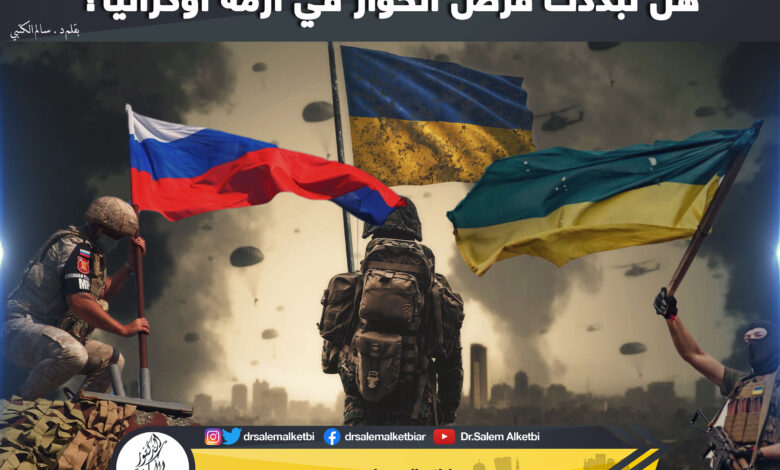
The crisis in Ukraine has recently seen major developments. Many observers were relatively optimistic when the Russian side signaled a willingness to negotiate, to which Uk raine responded with conditions for negotiations.
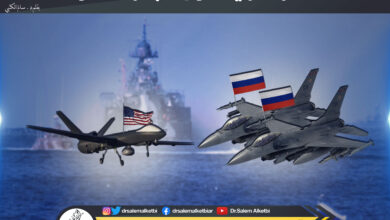
But the chances of the expected breakthrough have plummeted after two important decisions: the first was Russian President Vladimir Putin’s announcement that the newest frigate, the Admiral Gorshkov, equipped with the new Tsirkon hypersonic missiles, will join the Russian army and become part of the Northern Fleet.
Putin stressed that the frigate’s missiles will allow Russia to strengthen its security against all threats. On the other hand, Germany and the US agreed to deliver armored combat vehicles to Ukraine together with France – an important step to strengthen Ukraine’s combat capabilities in the confrontation with Russia. This decision comes months after Kiev’s pleas.
It is a decision that reflects the West’s resolve, especially in light of Germany’s change of heart to continue supporting Ukraine, which called the move a “great victory.”
The West’s decision to supply combat vehicles to Ukraine is a response to some of Kiev’s demands, which has repeatedly called for some 700 combat vehicles to support infantry forces, as well as 300 Western tanks to improve the ability of its forces to penetrate Russian positions along the battlefront. The first demand has already been met.
But the Western allies have refrained from supplying tanks, at least for now.
The significance of this decision by the West is that it contrasts with earlier positions in which the US and Germany had warned against supplying armored vehicles to Ukraine, which Russia interpreted as an escalation against Ukraine, and that this move is a calculated disregard for a possible Russian response, especially in response to Moscow’s threat of hypersonic missiles, which greatly irritates the West.
For its part, the US not only supplied Ukraine with armored vehicles, but also agreed with Germany to supply Ukraine with a US-made Patriot system to strengthen its air defenses. Signs point to a gradual escalation of Western military support for Ukraine, while the chances of a dialogue platform to resolve the crisis are dwindling.
It is likely that both sides are now inclined to strengthen their military positions on the ground to try to pressure the other side to soften its recently announced conditions and demands in the negotiations, especially now that it has become clear to everyone that the Russian and Ukrainian conditions for starting negotiations are difficult to meet.
It is very likely that Ukraine will subsequently be equipped with Western tanks to attack Russian forces, so that the Ukrainian army will move from defense to offense.
Light armored vehicles often suggest that Ukrainian forces should be more capable of defense than defense against Russian tank attacks, that they have some leeway to move around cities, set ambush traps, support offensive operations, etc. Analysis of events also suggests that the war in Ukraine will continue and possibly escalate in the coming months.
It can be expected that the Ukrainian army will try to force Russian troops to withdraw from the territories they occupy, especially if they subsequently receive modern Western tanks. Russia will also continue bombing Ukrainian infrastructure to increase pressure on the Ukrainian leadership to surrender.
Western military support for Ukraine is likely to continue in the near term, especially after Germany abandons its reluctance to supply arms directly to Kiev (Germany was previously involved in a trilateral swap deal in which Ukraine purchased arms). One of the reasons for the new escalation is that Russia’s bets on reducing military support to Ukraine have not panned out.
The White House continues to provide military support to Kiev. But there remains a fine line between different objectives in this complex war. The West is wary of provoking Russia into escalating the military conflict, attacking Atlantic targets, or even using weapons of mass destruction.
Everyone knows that Putin will not accept the defeat of his army in Ukraine. Therefore, the goal of the Russian and Western sides is likely to be a stalemate or a tipping point between calculated or limited escalation and all-out war, and it also depends on the perceptions of each party what they consider an appropriate negotiating point with minimal strategic losses.
Reaching this point could undoubtedly cause friction between Kiev and its Western allies. Given the nature of Ukraine’s demands as a precondition for the negotiations, such a disagreement is entirely to be expected. The point here is not to assess these demands, which Kiev considers necessary for the start of negotiations and which Moscow categorically rejects.
Rather, it is about the nature of a possible formula that might be acceptable to all sides to end this war, often difficult to negotiate under the current circumstances.
This debate could be seen as deliberately delayed because it could open up deep rifts not only on the Ukrainian-Russian side but also on the Atlantic side, whether between Washington and its allies or between the West and Ukraine — particularly in terms of working out a common position on the territories seized and declared annexed by Russia, whether or not that fait accompli is accepted, and whether or not securing the remaining Ukrainian territory is sufficient if hostilities cease.