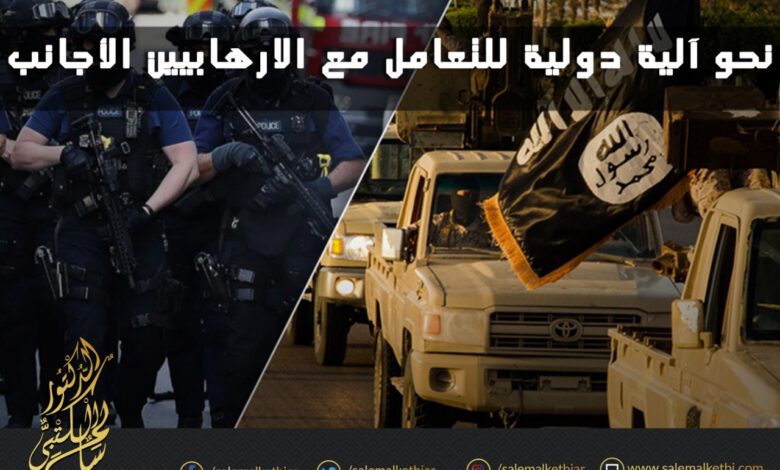
Despite the many events and developments on the world stage in recent months, the question of determining the fate of foreign terrorists who left Daesh, Al Qaeda and other terrorist organizations in Syria remains a complex problem. Many countries are concerned about the return of their nationals who were fighting in the Syrian civil war.
The United States, for example, has categorically refused to repatriate fighters. In European countries, the mechanisms vary from legal remedies, rehabilitation programs, “surgical” decisions to separate terrorists from their families and treat them on a case per case basis, to withdrawing their nationality.
The case is different for countries like Russia. The number of Russian women who went to Syria is about 4,000 according to official estimates, and about 5,000 women belonging to the republics of the former Soviet Union. Nearly seven thousand women travelled from Russia, Kazakhstan and Uzbekistan. Also, they have more than a thousand children.
Chechen President RamzanKadyrov has taken a distinguished position. He supports the campaign to find Russian women in Syria and Iraq. I personally think he does so because of his extensive personal experience of terrorism in Chechnya. He knows that closing doors to these people does not guarantee that the danger is completely eliminated. It may delay or freeze the danger.
The possibility that they may become a source of threat to Russia is perhaps even more serious. Theymay even settle in other regions where it would be hard to locate them. Over a thousand children could grow up in a terrorism hotbed and perhaps become a more dangerous and deadly generation than the current generation of terrorists.
Kadyrov learned from experience about the dynamics of terrorist organizations. He probably understands that women travelled to the strongholds of terrorist organizations in Syria with their husbands and often not on their own initiative.
The media reported that Russian President Vladimir Putin supported the idea of the return of children, while there was no support for the idea of the return of women. But Russia is more willing to discuss the idea of the return of its citizens back from Syria than Western countries. This is perhaps due to Russia’s long experience in studying the thought and nature of terrorist organizations and the mechanisms of their development and transformation over generations. Its security services have a long experience in the war on terrorism.
Two cases caught the attention of the world in recent years. The first is the case of Shamima Begum, a British student of Bengali origin. She became a member of Daesh four years ago, when she was a teenager. The second is the case of Hoda Muthana, a US citizen of Yemeni origin. She joined the organization five years ago.
The two women were denied return to their respective countries.
My own conviction, as a researcher, is that the idea of letting terrorists return back is still full of dangers and difficult to accept, even if it is more realistic in the long term than the idea of a total rejection of this return.
However, we should note that repatriation requires considerable and continuous security efforts to monitor, rehabilitate, and integrate women found to be involved in terrorist crimes. It’s not easy at all.
These are hundreds or even thousands of cases. Over one thousand came from Russia or Western countries to Syria. It is estimated that about five thousand nationals of European countries have been active members of Daesh in recent years. Only about 1800 of them made it back. The others were killed or moved to other conflict zones like Libya, or remained in Syria. Anyway, it is a security dilemma.
The children need substantial budgets to rehabilitate them psychologically, help them blank out the horrific scenes they might have seen, reintegrate them into society and ensure that they are fully immune to radical ideology.
I believe that this complex security dilemma requires a common international response. The search by each country for a separate solution for its nationals can aggravate the problem. Some terrorists may manage to escape the international network of prosecutions and exploit the gaps in individual prosecutions by States.
The problem does not end with allowing or denying repatriation. Return also requires considerable budgets for supervision, psychological and social rehabilitation of children and women.
As such, we may need to create a specialized international court under the auspices of the United Nations to try persons who have been arrested or surrendered in Syria and to determine their fate in accordance with international law.