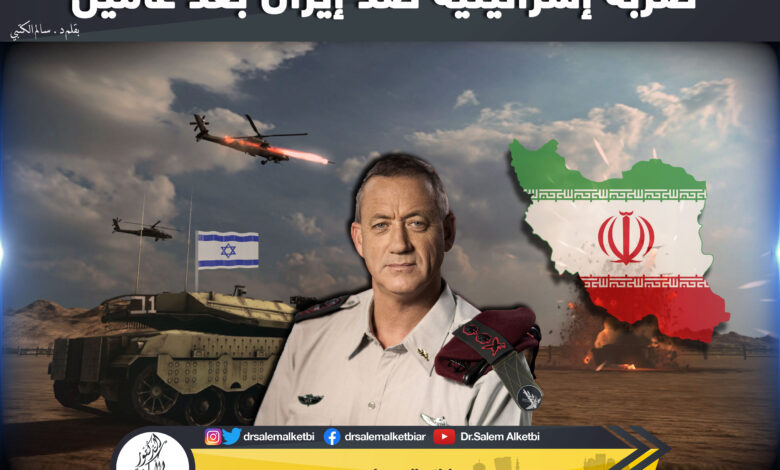
Outgoing Israeli Defense Minister Yeni Gantz has said in a remarkably timely and substantive statement that a military strike against Iranian nuclear facilities is possible within two or three years. The statement has attracted considerable attention from observers and experts because it is a direct statement by the Israeli defense minister, even though his term is coming to an end or, unusually, his last official statement concerned a timetable for an anticipated war. Graduating a group of Israeli Air Force pilots, he told them, “In two or three years, you may be crossing the skies to the east to participate in an attack on Iranian nuclear facilities.”
Several points stand out to me about this speech. First, it comes from the outgoing defense minister, who is also the most prominent political opponent of the new prime minister, Benjamin Netanyahu. The two sides have clashed verbally several times before, most notably over the Iranian nuclear dossier, and have two opposing views on the mechanics of engagement and the degree of urgency, but not on the nature of the Iranian threat. Gantz did not have the same vision this time, as he said, but is more conservative about the strike itself, preferring to consult with the US ally he considers crucial before making a decision on the matter. This raises some question marks about the significance of the announcement of the “timing” of the strike, even if it is an estimate. Gantz is aware that everything he writes on this issue is very carefully calculated; the dossier does not accept political imperatives as other dossiers do.
Second, even after the failure of the last elections, Gantz had claimed that Israel was capable of attacking Iran. However, he expected the next prime minister, Benjamin Netanyahu, to act in a balanced manner, as he had in previous terms. This statement indicates that Gantz does not support the scenario of an attack on Iran’s nuclear facilities and wants Netanyahu to act very cautiously on this issue and not follow the instructions of coalition partners; he is acting as he did on previous occasions during his tenure as Israeli prime minister. This raises the question of the motive behind Gantz’s statements about a specific timetable for the deployment of Israeli warplanes in Iran. Is this just conjecture or an attempt to persuade Netanyahu and his government to take action against Iran?
As for me personally, however, this style is not common in Israeli politics.
More generally, Gantz seems to have concluded in recent days that Iran “has recently been acting overly boldly” after strengthening its ties with Russia and exacerbating conflicts between major international powers; “this development of Iran’s increased self-confidence will affect the entire Middle East region,” according to text from earlier statements. Gantz himself is aware of the magnitude of the changes in Iranian behavior in the region; in light of this escalating behavior, which poses a growing challenge to Israel’s security and strategic interests, it is unacceptable to proceed with excessive caution.
Another important aspect of the matter is that Gantz wants to highlight and document his role in preparing for confrontation with Iran during his tenure as Israeli defense minister. In doing so, he wants to secure his position in Israel’s political confrontation in the event that the Israeli government is toppled, as has happened several times in the past two years. Talk of a timetable for an attack on Iran does not seem surprising, as Gantz himself said a few weeks ago that Israel has spent some NIS 7 billion (about $2 billion) preparing for a confrontation with Iran and continues to seek progress, development and full readiness for any scenario. It wants to consolidate its role and maintain its position in building Israel’s military capabilities to deter Iran. This is not necessarily to promote the idea of a military strike, but rather to define roles for a purely political purpose, so that it will not be said later that the Netanyahu government has deterred in the face of the Iranian threat.
Moreover, an analysis of the content of Gantz’s speech reveals other important points, some of which are negative rather than positive, including that he implied that Israel was “preparing for it,” i.e., moving toward Iran. This could mean, some suggest, that Israel is not fully prepared to carry out an attack scenario at this time.
Another aspect concerns Gantz’s statements that an Israeli attack on Iran would lead to a regional war. Such a statement amounts to an implicit warning against the decision to launch a military strike, even though he affirms that “Israel knows best how to deal with the consequences of such a (military strike).” Gantz has already called on Netanyahu to “put Smotrich and Ben-Gvir (Netanyahu’s partners in the new coalition government) in their place,” he said.
An attack on Iran would not necessarily result in the deaths of thousands of Israelis. “When taking action against Iran, one should weigh the direct and military success and the long-term strategic consequences.” The content of this speech contradicts the fact that talk of a possible attack in two years is an idea that Gantz supports or even promotes or advocates.
What interests me as a researcher is that Iran is picking up the contradictory signals from the Israeli side and analyzing them closely. These signals reflect the lack of consensus within Israel for a military strike against Iran’s nuclear facilities; some, like Gantz, implicitly support the idea of a nuclear agreement with Iran, provided that nuclear control standards are guaranteed; any action against Iran must be part of a joint international effort, not a single Israeli action. Gantz and others believe it is necessary to take into account the realities and changes that have occurred at the international level in the aftermath of the Ukraine war, where Iran has gained significant strategic advantages through cooperation with Russia and the use of drones, which provide Tehran with an important diplomatic umbrella, at least in the UN Security Council.