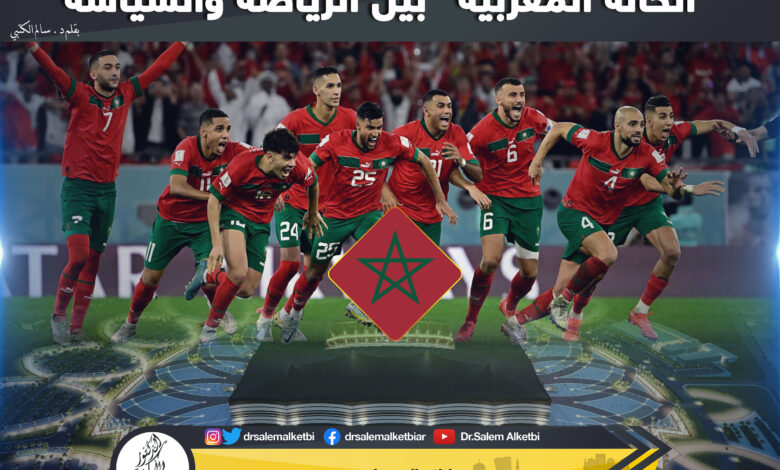
In recent months, during the 2022 World Cup, hosted by the state of Qatar, a new situation has arisen, not only in soccer, but also in the interaction between the Arabs and the performance of the Moroccan soccer team during the tournament. Social media in the Arab world was flooded with support for a team that achieved victories that even the most optimistic Arabs could not have imagined.
“Seer Seer Seer” (come on, come on, come on), which was chanted in the streets and cities of Arab countries for days, became a slogan of progress and winning in a context that reflected the collective Arab desire and urgent need for success, raising the morale of the people and the aspirations of young people in a region that had suffered years of frustration and negative news, encouraged only by some occasional successful Arab events, whether in the UAE, Saudi Arabia or Qatar.
For all the hope that radiates from these achievements, soccer retains its special charm and appeal, and the victories it witnesses leave a deep and significant mark in the hearts of young people. Despite all the claims of radicals that football comes under the “Western conspiracy” and other nonsense, such ludicrous rhetoric is refuted as presidents and high-ranking officials of Western countries attend matches of their national teams and urge their players to win.
The US president even interrupted a meeting he was attending to celebrate his country’s victory over Iran. The Morocco effect that we have all been following is a positive example that goes a long way toward changing the traditional stereotype about Arabs and Muslims. It reinforces the positive impression that Qatar’s excellent management of the tournament has made on the world.
Morocco has been described as a strong team from an Arab-Muslim country that is capable of competing with the strongest soccer teams in the world. Hopes of reaching the final of the tournament lasted until midway through the second half of the match against France, when they were defeated by a margin of one goal.
Even if fortune ran counter to the ambitions of a promising generation of players whose names are known around the world for their relentless determination and skill, surpassing that of many previous teams in the most famous game in the world, the case of Morocco is a case that will go down in sports history in our Arab world. It’s not just about soccer either.
Moroccan players have crossed the line of ambition. They reignited dreams where there are no more limits and constraints, where there is the will to win and triumph. This is the kind of spirit that is needed in our region, in sports and elsewhere, so that our nations can emerge from the darkness and our youth can find hope for the future.
It is the power against frustration and despair that extremists and terrorists rely on to recruit new elements into their ranks, and it is the serum that can breathe new life and bring a different perspective to our community. Soccer in particular and sports in general is an antidote and a vaccine against extremism. The Moroccan team has succeeded in putting Arab soccer in a global competition.
We expect this success to be shared not only at the level of the Kingdom of Morocco, but also at the level of the rest of the Arab world. Some people say that sport should not be political, but in fact it is very much politicized because it is connected to our lives, our happiness and our emotions. All of these things are at the core of politics.
Decisions about team formation, news about wins and goals sometimes outweigh the impact of political decisions that are closely tied to people’s lives. The instantaneous dose of collective joy that a scoring goal gives is such that it can even eclipse all other decisions or actions geared toward happiness.
It is one of soccer’s wonders and magical ways that have drawn it into people’s hearts and minds. The Morocco effect, which has become an Arab and, indeed, a global example, remains exceptional in its unique impact.
Some say that the Moroccan team united Arabs more than any other political event, achieving what Arab summits and conferences by the hundreds did not, even when they were decorated with slogans and spent billions on media: goals and soccer victories united Arabs from the East and the West. Interestingly, all the rumors about inter-Arab sensitivities fizzled out.
The political divisions with which societies wanted nothing to do melted away. The Moroccan players also managed to project beautiful images of humanity on everyone, especially the youth.
The photographs of Achraf Hakimi and Sofiane Boufal with their mothers will remain a precious human symbol of the loyalty of a son, the value of motherhood and the spread of the culture that young generations need amidst the flood of polluted media content that overwhelms everyone.
The Morocco episode really confirmed the new impressions and stereotypes that the whole world, East and West, now has about Arabs and Muslims, especially about women. Arab women are not Al Qaeda women or Daesh women, but instead they are an integral part of the social reality that the whole world saw in the stadiums and streets of Qatar and in all Arab cities, celebrating the victory of the Moroccan team as if it were their own, in a sentiment that perhaps has an analog only among Arabs, who really share the feelings and connections that have been much discussed in the political literature.
Yet only in rare historical events have we seen them.