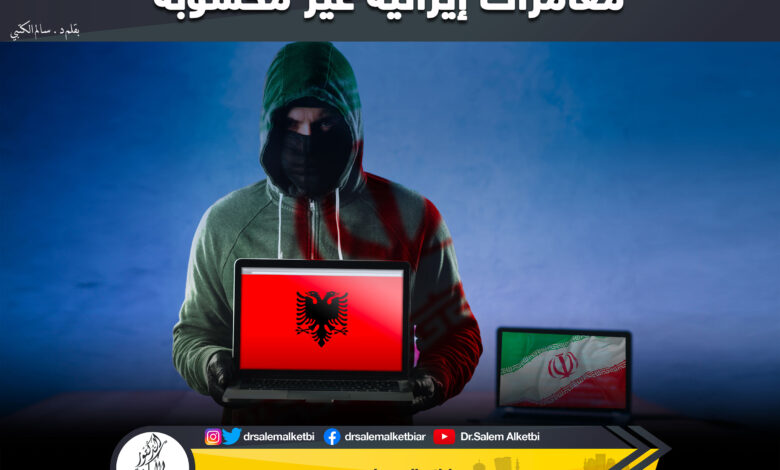
Iranian regime leaders’ delusion of grandeur seems to drive them to serious strategic mistakes and uncalculated adventures at a time their seriousness and sensitivity cannot be overlooked by any political or military decision maker.
The most recent example of such practices by Iran is the cyberattack on Albania, which described the attack as serious and confirmed that “compelling evidence” was found that Iran used four groups to carry out the attack in mid-July. The goal of the attack was to “cripple government services, delete and steal official data, and cause chaos.”
Iranian Foreign Ministry spokesman Nasser Kanaani dismissed the allegations against the attack as hollow. He warned against any political adventures against his country.
He stressed that “America and Britain, which have been silent about numerous cyberattacks on the Islamic Republic of Iran’s infrastructure as well as nuclear facilities in the past and have even directly or indirectly supported these attacks, lack credibility when they make such accusations against the Islamic Republic of Iran.”
Far from an Iranian denial, whether in the face of this attack or others – we as observers are used to Tehran denying all its acts, even those where there is no doubt about the authenticity of Iranian fingerprints – the timing of the announcement of the investigation confirms that negotiations to revive the nuclear agreement have reached a real standstill. Perhaps even an impasse.
The US reaction to these findings is unusual for the Biden administration, which has been too reluctant to take a hard line when Washington’s allies have come under serious attack from notoriously pro-Iranian militias.
In particular, the White House has been very clear about how to respond to cyberattacks on Albania, and has specifically referred to discussions about the possibility of activating Article V of the NATO treaty.
Although this mention was followed by talk of “multiple measures” before resorting to this clause, which requires NATO countries to respond to any attack directed against one of their allies, the mere mention of this clause reflects a different US posture than previous repeated incidents committed by Iran, including Iranian cyberattacks against Washington’s closest allies such as Israel.
As observers, we cannot seriously envision Article V being activated in the Atlantic response to the Iranian cyberattack against Albania. NATO has invoked Article V only once in its history, when it responded to the 9/11 terrorist attacks on the US.
But also because it is almost impossible to seek escalation against Iran when NATO’s European members themselves are making maximum diplomatic efforts to persuade Iran to return to the nuclear agreement. Moreover, the possibility that the White House will decide on a response to the Iranian attack is unlikely, at least for now.
The issue here is not whether or not the fifth clause will be activated, nor the nature of a possible Atlantic response. But it is about Iran’s growing brazenness and expansion into a new space, aware in advance that it can be used against it, knowing with certainty that Albania is a member of NATO and that the background of a cyber attack can be uncovered.
But Tehran also seems to have gone beyond these traditional calculations and decided to launch an attack without regard to the consequences. This in itself is a signal of what the future may hold for Iran against those it considers its adversaries.
Indeed, part of the reason for the strong US reaction is not just the scale of the attack on the sovereignty of an allied Atlantic state, as expressed in the official US statement. But it is essentially a threatening signal, or rather a reminder to Tehran that there are several files that could be opened if negotiations on the nuclear agreement fail.
It is not only about the cyber attack on Albania, but also about the target of the attack itself, the MEK organization, which was attacked in response to holding a conference in the Albanian city of Manez, home to a camp housing some three thousand members of this opposition group staying there at the request of Washington and the UN.
Despite the vociferous American tone in the comments on the Iranian cyberattack on Albania, in reality, things did not go as quietly as thought by the Iranians, who apparently decided to carry out the attack in the belief that things would turn out the same way as in previous ones. Coincidence seems to have played in, and negotiations on the nuclear agreement have grown rocky.
The timing of the announcement of the investigation suggests an important signal from the US to Iran, which has undertaken one of its ill-advised adventures. It will continue to deny as before, and the attack will remain only a tug of war between Iran and the US. Expectations are fluctuating, and it is hard to get an accurate picture of how things will unfold in this complex affair.